

Disclaimer: The opinions expressed by our writers are their own and do not represent the views of U.Today. The financial and market information provided on U.Today is intended for informational purposes only. U.Today is not liable for any financial losses incurred while trading cryptocurrencies. Conduct your own research by contacting financial experts before making any investment decisions. We believe that all content is accurate as of the date of publication, but certain offers mentioned may no longer be available.

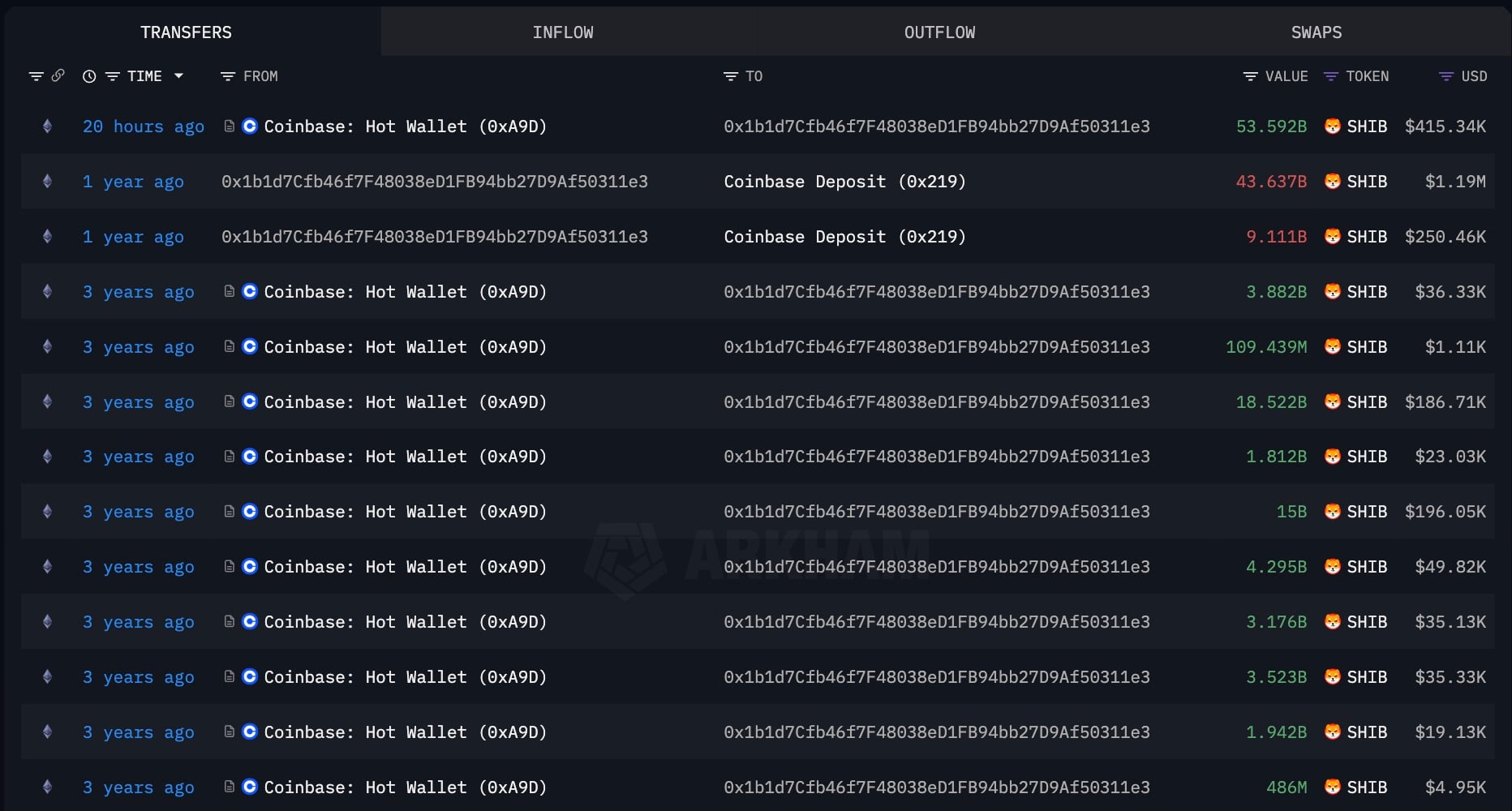
A Coinbase-linked Shiba Inu whale has reappeared on-chain after a full year of silence, and the numbers make it impossible to ignore. According to Arkham, wallet "0x1b1" received 53,591,805,991 SHIB from a Coinbase hot wallet about 20 hours ago, a transfer valued at around $415,000 right now.
What is most interesting is that this was not a new accumulation story starting from zero, and the history matters more than the headline number.
The same address interacted with Coinbase deposits multiple times three years ago, moving blocks ranging from 1.8 billion to 109.4 billion SHIB during earlier cycles. One year ago, the wallet sent out 43.6 billion SHIB and 9.1 billion SHIB to Coinbase deposit addresses, then went dark. No visible on-chain activity followed until now.
At the same time, the Shiba Inu coin has spent 2025 unwinding a long drawdown rather than building an upside structure to say the least. The year opened above $0.00002, then sold off aggressively through January and February, pushing the price into the $0.000012-$0.000015 range by spring.
Has worst already happened to Shiba Inu coin?
The decisive breakdown finally came in October, when SHIB lost $0.00001 in a single expansion move and never reclaimed it. Since then, the price has compressed lower, trading around $0.0000080, near the bottom of the yearly range.

Against this context, the Coinbase-linked whale is waking up to exhaustion rather than strength. After months of price decline and waning participation, this phase has historically preceded either aggressive redistribution or the kind of positioning that only occurs when larger players believe the worst damage has already been priced in.
 Dan Burgin
 U.Today Editorial Team
