

Disclaimer: The opinions expressed by our writers are their own and do not represent the views of U.Today. The financial and market information provided on U.Today is intended for informational purposes only. U.Today is not liable for any financial losses incurred while trading cryptocurrencies. Conduct your own research by contacting financial experts before making any investment decisions. We believe that all content is accurate as of the date of publication, but certain offers mentioned may no longer be available.

The market is certainly close to reaching the bottom on the short-to-medium term perspective, as suggested by assets like Ethereum, XRP or Shiba Inu. However, the overall structure of the market is far from being too bullish.
Did SHIB reach bottom?
Shiba Inu is trading at levels that resemble the bottom of its local cycle more and more. The price of SHIB is now significantly below its major moving averages, having compressed into a narrow range close to long-term support following months of continuous downward pressure. Even though price action still appears unsightly on the surface, historically, this type of structure is where downside momentum begins to wane.
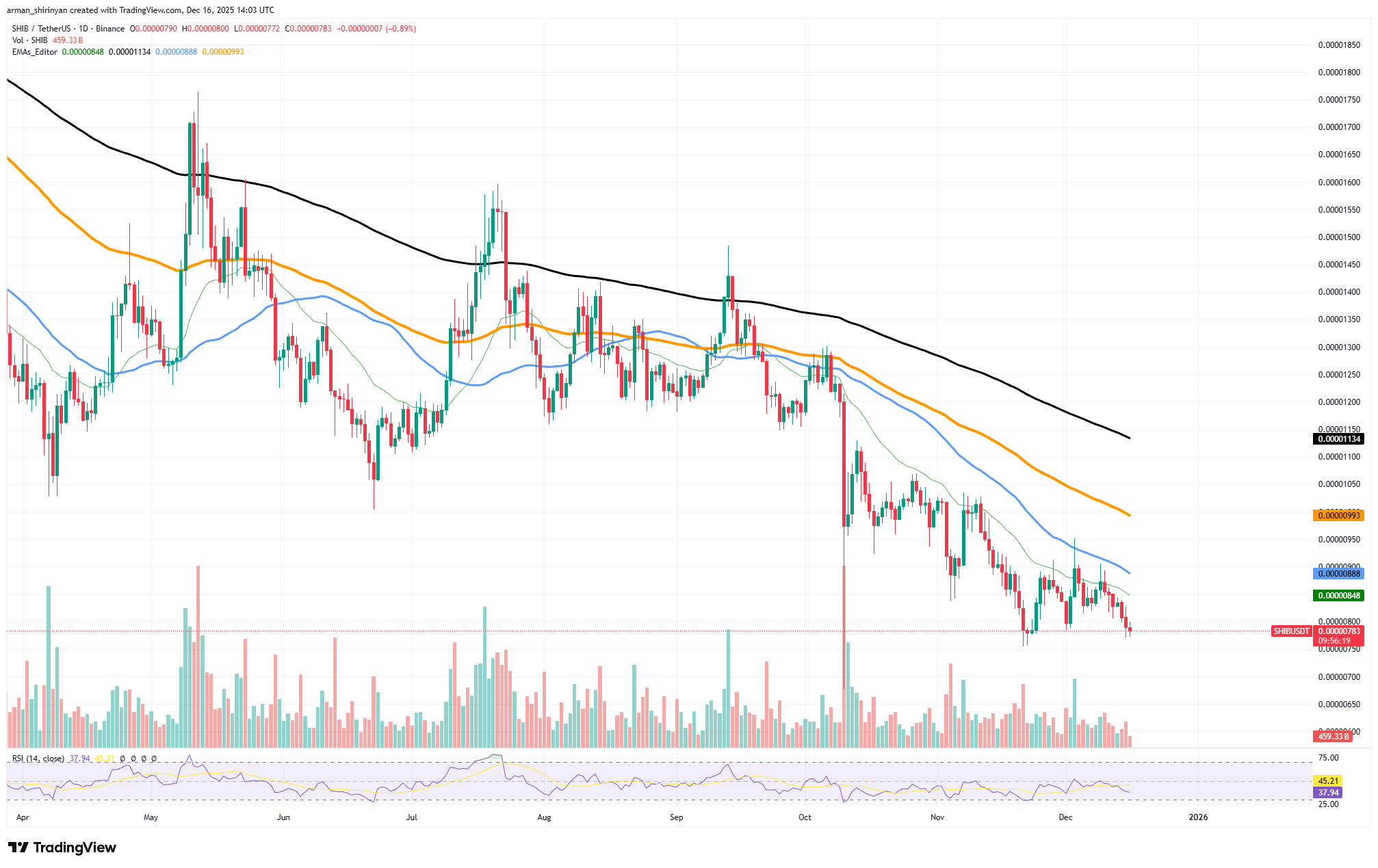
Technically speaking, SHIB is currently in the exhaustion zone of a late-stage downtrend. The larger bearish trend is confirmed by the 200-day moving average, which is still far above the price, but this is not the signal that counts. Distance is important. Following the most recent sell-off impulse, SHIB is significantly stretched to the downside, and volatility has completely collapsed.
Markets either reverse or go into a protracted accumulation phase rather than continuing to trend in straight lines. The former is becoming more likely, but SHIB is currently leaning toward the latter. RSI is in the low-to-mid-40s, and despite price pressure to decline, it is no longer setting new lows. This is a subtle but significant bullish divergence: sellers are becoming less efficient even though they are still active.

The story of volume is similar as well. Although aggressive spikes accompanied previous sell-offs, recent downside attempts have come on declining volume, indicating that distribution may be mostly finished for this leg. This does not imply that SHIB will rip vertically tomorrow. Usually, a recovery from a local cycle bottom begins silently.
Stabilization is the first stage, and it is characterized by erratic, annoying price movement that displaces impatient longs and late shorts. Given how aggressively the asset has been discounted, momentum may change more quickly than most anticipate if SHIB can maintain this base and recover short-term moving averages.
Ethereum changes structural mode
Ethereum's decline below $3,000 is a structural change that compels the market to reevaluate short-term expectations, rather than merely being a cosmetic decline. The failure of ETH to recover declining moving averages led to the breakdown, demonstrating that sellers continue to control momentum. However, this action does not necessarily indicate a reversal of the macro trend. Nonetheless, it outlines three crucial price points that investors should keep a close eye on going forward.

First level: $2,900-$2,850 (zone of immediate support). This is where Ethereum is currently hovering, and it is important because buyers are trying to stabilize the price in this area first after the breakdown. Losing this zone would indicate that the $3,000 loss was a continuation move rather than a fakeout, as it has served as a reaction level on several occasions in the past. Short-term bounces are still possible as long as ETH stays above this range, and the downward acceleration is contained.
$2,700-$2,600 (cycle support) is the second level. This is the next important area to keep an eye on if $2,850 fails. This zone corresponds with earlier-in-the-cycle high-volume trading activity and previous consolidation. This move would probably flush late longs and reset sentiment and funding.
Third level: Reclaim zone $3,200-$3,300. Ethereum needs to recover this region on the upside in order to refute the bearish structure. This range coincides with declining mid-and-short-term moving averages, as well as previously lost support. In addition to indicating that the $3,000 breakdown was a liquidity event rather than a shift in trend, a clean reclamation would put ETH back into a recovery phase.
XRP's institutional support
The idea that XRP is crashing to literal zero does not hold up to even a cursory examination, despite the fact that its current price action appears unsightly. Indeed, XRP is trading under pressure as it grinds inside a declining channel and sits below important moving averages. The market has been losing confidence for weeks, as evidenced by the chart, which shows poor momentum and worse sentiment. However, XRP is far from a terminal situation for specific structural reasons, and a recovery may occur sooner than many anticipate.
First, XRP is not holding a fictitious demand zone. Aggressive buyers have historically been drawn to the region surrounding the current range, even in times of general market weakness. So far, absorption rather than panic liquidation has responded to every decline below $2.00. It is significant. Total demand evaporation is necessary for a crash to zero, but that is not happening. The volume is still high, suggesting involvement rather than desertion.

Second, the long-term structure of XRP is weakened but not destroyed. The price is not accelerating away from the 200-day moving average, which indicates compression rather than collapse. Assets do not consolidate but rather fall when they actually die. In contrast, XRP is experiencing seller fatigue, tightening ranges and decreasing volatility. The fact that the RSI is in the low 40s confirms that the downward momentum is diminishing rather than growing.
Third, the basics continue to serve as a safeguard. XRP is prevented from becoming obsolete by its liquidity, exchange presence and institutional significance, which are especially linked to cross-border payment infrastructure. Instead of completely leaving XRP, capital continues to move through it even during significant drawdowns.
 U.Today Editorial Team
 Dan Burgin
