
Disclaimer: The opinions expressed by our writers are their own and do not represent the views of U.Today. The financial and market information provided on U.Today is intended for informational purposes only. U.Today is not liable for any financial losses incurred while trading cryptocurrencies. Conduct your own research by contacting financial experts before making any investment decisions. We believe that all content is accurate as of the date of publication, but certain offers mentioned may no longer be available.

Bears are finding it more difficult to ignore the uncommon divergence that XRP is displaying between price weakness and network activity. On-chain metrics indicate a sharp increase in actual network usage, which has historically preceded volatility expansions, even though XRP’s price is still compressed below important moving averages.
XRP moves down
The 50- and 100-day moving averages serve as the price chart’s ceiling, and XRP is still trading inside a wider declining channel. Attempts to recover these levels have consistently failed, indicating that momentum will still be brittle in the near future.
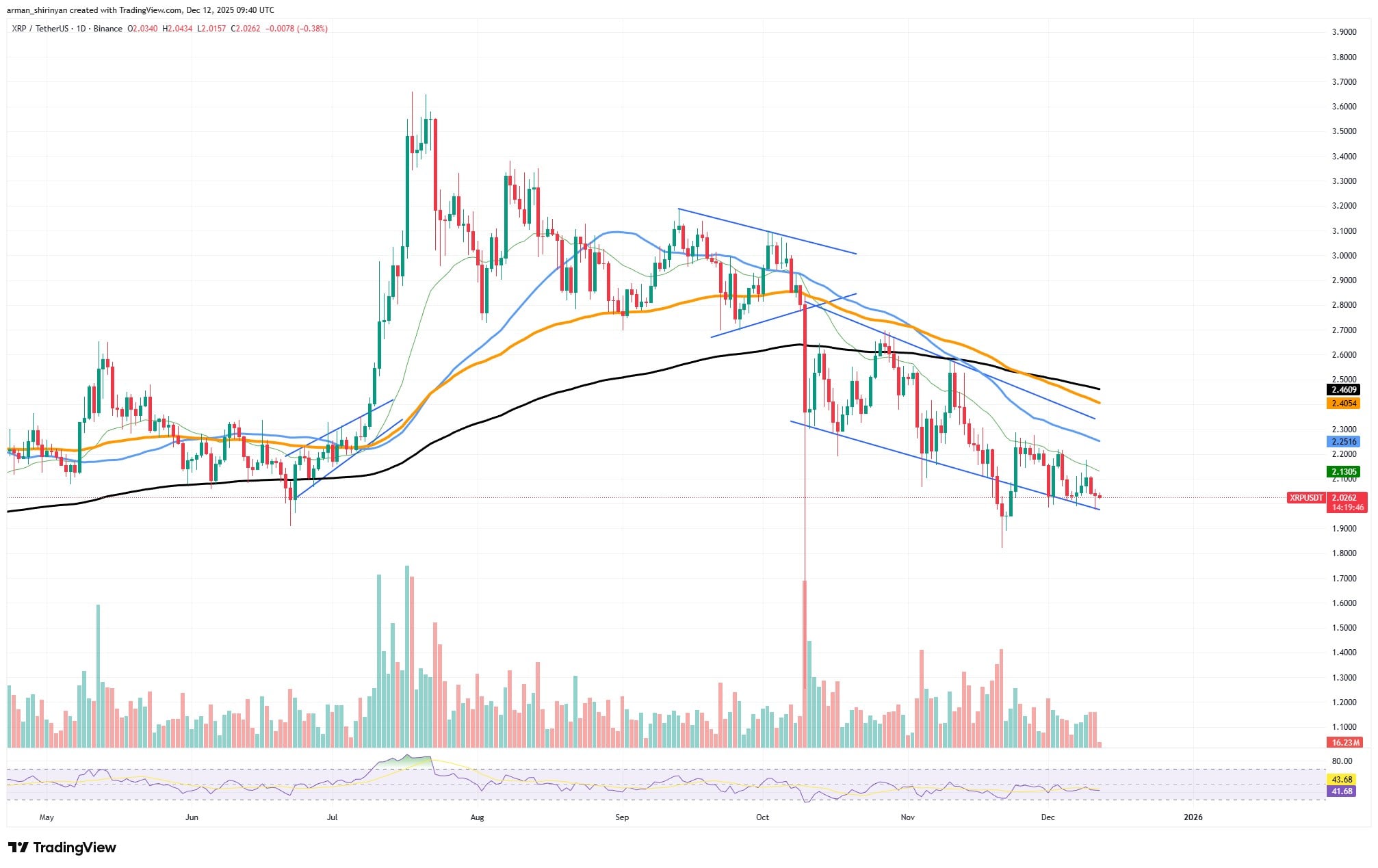
The most recent rejection forced the price back toward the channel’s lower boundary, which is now serving as a crucial demand zone in the $2.00-$2.05 range. A deeper retracement toward $1.85-$1.90, where historical liquidity is located, would probably be possible with a clear breakdown below this level.
XRP's enormous surge
But price is not the whole story in this case. According to on-chain data, the volume of XRP payments has increased by about 280%, with daily transaction flows momentarily approaching the $1.7-$2 billion range. At the same time, the daily total of payments between accounts has continuously been close to one million.
It matters. Sustained activity above this threshold indicates actual network usage, as opposed to speculative churn, which XRP has frequently lacked during rallies that are solely motivated by hype.

The most important lesson is that, despite price suppression, capital is still flowing through the network. Bearish positioning is put under pressure as a result. Downside follow-through usually weakens when price stagnates but utility picks up speed. Rising transactional demand over time makes it more difficult for sellers to maintain the price because they require continuous inflows of new supply.
That does not imply that a breakout will occur right away. The price must recover the 50-day EMA and exit the declining channel with volume in order for XRP to turn the structure bullish. Rallies remain corrective rather than impulsive without it. However, the likelihood of a significant upside squeeze rises if on-chain payment volume remains high and the price remains above the $2.00 range.
 U.Today Editorial Team
 Dan Burgin
