

Disclaimer: The opinions expressed by our writers are their own and do not represent the views of U.Today. The financial and market information provided on U.Today is intended for informational purposes only. U.Today is not liable for any financial losses incurred while trading cryptocurrencies. Conduct your own research by contacting financial experts before making any investment decisions. We believe that all content is accurate as of the date of publication, but certain offers mentioned may no longer be available.
The market is at a pivotal point where retraces are possible at any given moment; volume is the only thing that is needed for them. XRP will use the double bottom formation to bounce, Shiba Inu might enter an uptrend and Bitcoin will break $90,000 if everything aligns perfectly.
XRP is plummeting down
A distinct double bottom is forming close to the $1.90-$2.00 zone, which is one of the more positive technical developments XRP has printed in months. This pattern indicates a possible turning point rather than just another dead-cat bounce following a protracted downtrend and several failures to recover important moving averages.
The structure is important. After a vigorous sell-off into October and December, XRP returned to the same demand zone in January and was unable to reach a lower low. Rather than continuing, sellers lost momentum, volume decreased and price stabilized. The double bottom is significant because of that second rejection of lower prices.
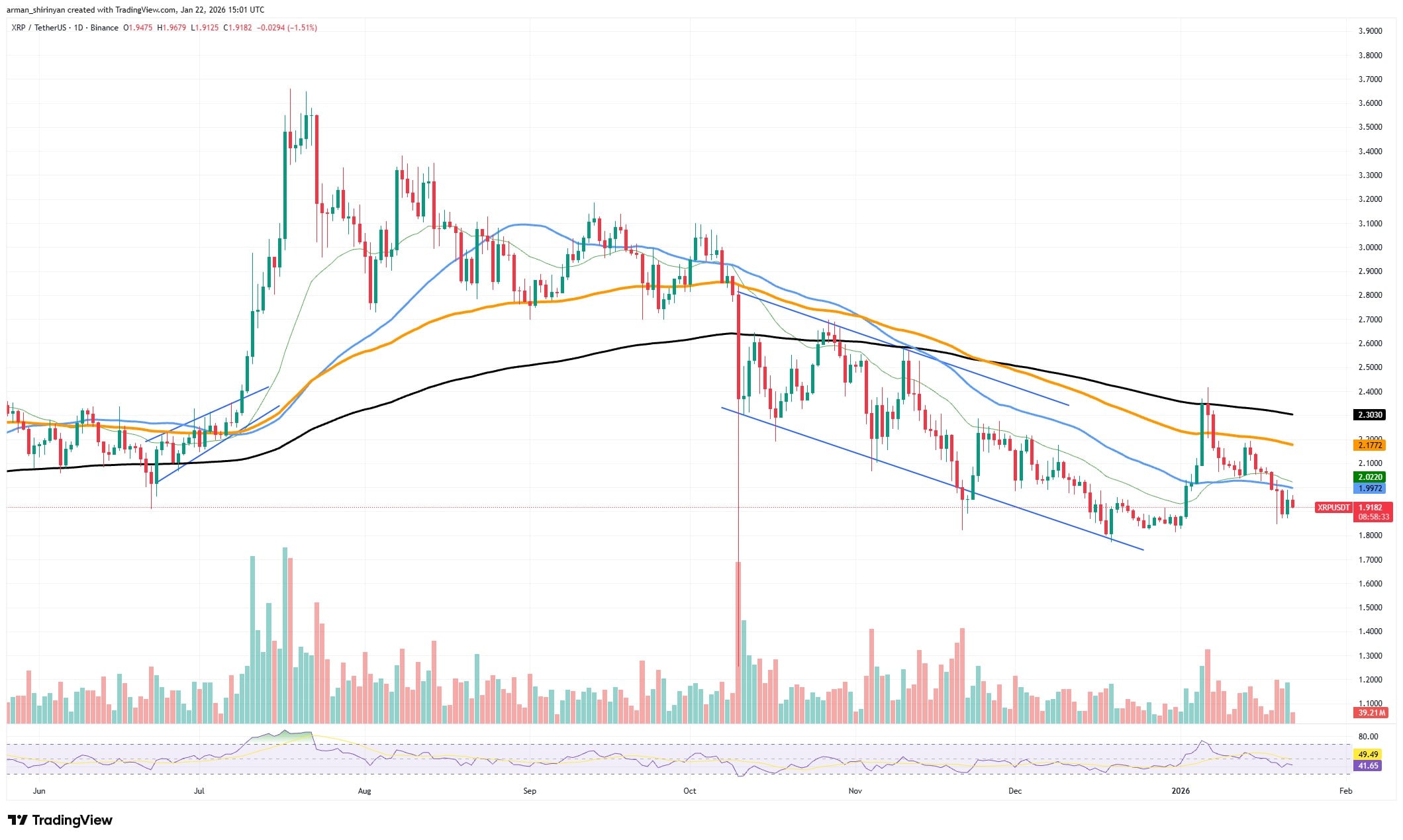
It is crucial to distinguish between sudden buyer strength and sell-side exhaustion. Major resistance levels, such as the 50 and 200 EMAs, are still below XRP at the moment. This indicates that the market has not yet turned bullish. Double bottoms, however, seldom end immediately.
Typically, they start by shifting the market from trend to range. Consolidation above the base is what investors should be looking for at this point, not sudden upside fireworks. The neckline zone around the $2.15-$2.20 range is the crucial area to keep an eye on. The pattern would be confirmed and a wider trend shift would be possible with a sustained break above that level ideally accompanied by increasing volume.
Although repeated defenses of the same level would further strengthen the structure, XRP runs the risk of chopping sideways and retesting support once more in the absence of that breakout. This pattern has the potential to significantly alter how XRP trades from the standpoint of market shape.
The price may begin to compress upward rather than cascade lower highs and lower lows, compelling short sellers to cover and directing liquidity toward accumulation. This refutes the clean bearish continuation thesis, but it does not ensure a rally.
Shiba Inu's pivotal moment
Shiba Inu is getting close to a crucial technical juncture, where the next few sessions could determine whether the market eventually moves past its protracted bearish phase. It is reasonable to argue that an uptrend rather than another short-term relief move is emerging if SHIB is able to bounce and hold this area.
The price is currently hovering near a well-established support zone that has already absorbed several sell-offs. Structurally speaking, SHIB no longer prints aggressive lower lows. The chart's months-long downward momentum has clearly subsided, and price compression is occurring close to the local base. Trend reversals frequently start with sellers gradually losing control rather than with an explosive upside.

The market will have successfully confirmed a higher low, which is necessary for any long-term uptrend if buyers defend this level and drive prices higher. The behavior of volume supports this theory. Significantly decreasing volume has coincided with the current bearish trend, indicating a lack of conviction on the part of sellers.
In order to maintain pressure, strong trends –especially bearish ones — need to increase volume. Rather than becoming louder, SHIB's sell-offs are becoming quieter. A retracement or change in trend is frequently preceded by this divergence between price and volume, especially when it occurs close to established support.
Technically speaking, a recovery here would direct attention toward recovering short-term moving averages, which might then serve as dynamic support, as opposed to resistance. An uptrend does not necessitate immediate dominance of the entire structure, even though higher-time-frame averages are still above.
All that is needed is consistency: controlled pullbacks, gradual higher highs and defended lows. Conditional optimism is the most important lesson for market participants. Although it has not been confirmed yet, an uptrend is obviously possible. The setup collapses if SHIB is unable to bounce and breaks clearly below this zone.
Bitcoin's key moment
In the current state of Bitcoin, indecision is no longer neutral. Around the $90,000 mark, the market has contracted into a narrow area that is now a structural decision point rather than merely another support or resistance level. What transpires here will probably determine the medium-term course of Bitcoin.
Technically speaking, BTC's previous uptrend has already lost steam. The 200 EMA looms above as far-off resistance rather than support, while the price is trading below important short- and midterm moving averages. There have been numerous unsuccessful attempts to push higher, and every rejection close to $90,000 weakens the level even more. Repeated failures at psychologically significant prices are rarely forgiven by markets.

For this reason, the current situation is now or never. Bitcoin has the potential to rebuild a foundation for recovery if it can successfully recover and hold above $90,000. Short covering would probably result in sentiment stabilizing, and the price would be able to push past higher resistance levels. In the absence of that reclamation, the risk would drastically shift to the downside and the structure remain bearish. The risk is what happens if $90,000 does not work out.
Liquidity rapidly diminishes below this threshold, and there is little historical structure to impede a decline. A breakdown would indicate that buyers are unwilling to actively defend the market, which would allow selling pressure to build.
In that case, Bitcoin increases rather than decreases. The issue is made worse by volume behavior. Strong participation in recent bounces indicates that buyers are hesitant rather than confident. When combined with repeated resistance failures, this type of low-conviction recovery frequently precedes another leg down.
 Gamza Khanzadaev
 Alex Dovbnya
 Arman Shirinyan
 Caroline Amosun