
Disclaimer: The opinions expressed by our writers are their own and do not represent the views of U.Today. The financial and market information provided on U.Today is intended for informational purposes only. U.Today is not liable for any financial losses incurred while trading cryptocurrencies. Conduct your own research by contacting financial experts before making any investment decisions. We believe that all content is accurate as of the date of publication, but certain offers mentioned may no longer be available.

Leading derivatives marketplace CME Group has announced the launch of Nasdaq CME Crypto Index futures, scheduled for June 8, officially including XRP in this regulated benchmark. At the same time, CME is preparing a major technical reform, with its entire cryptocurrency product lineup moving to a 24/7 trading model starting May 29.
Why XRP was selected for CME's new crypto index
Unlike single-asset contracts, the new instrument is weighted by market capitalization. At launch, alongside XRP, the index includes Bitcoin, Ether, Solana, Cardano, Chainlink and Stellar. Contracts will be available in both standard and micro formats with fully cash-settled execution.
Interest in such structures is supported by the numbers, with CME recording a 43% increase in average daily trading volume across its crypto segment since the start of the year.
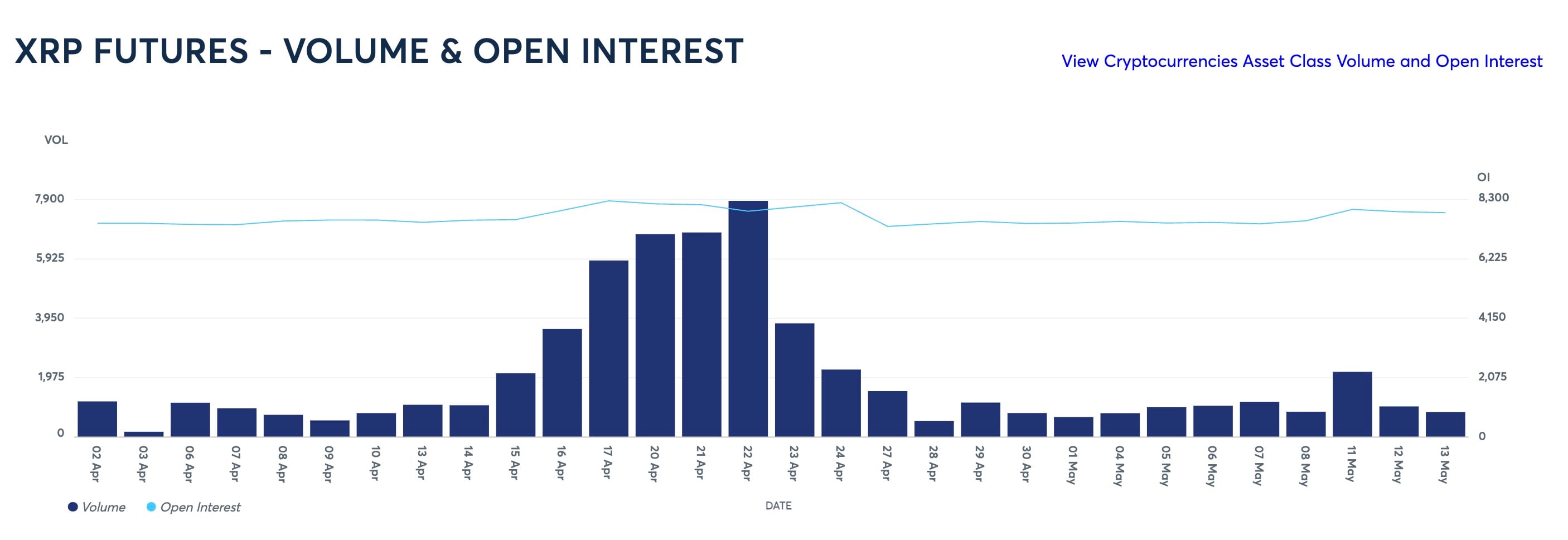
At the same time, open interest in XRP futures has firmly remained in the upper tier around 7,900-8,300 contracts according to CME data, following a major surge in volumes at the end of April.

The inclusion of XRP in the index is not happening in isolation, but as part of CME's aggressive expansion into the altcoin market with the exchange systematically removing the barriers separating traditional finance from the specifics of the crypto market through the transition to 24/7 trading starting May 29.
Why does this matter for XRP?
For the asset itself, this is not just another listing, but a transition into the top tier of systemic crypto assets. Until now, funds have been buying XRP selectively, and now the token becomes a mandatory component for any investor purchasing exposure to the entire crypto market through a regulated U.S. exchange index product.
With round-the-clock liquidity arriving in just two weeks, this move effectively erases the difference between trading XRP and traditional equity indices such as the S&P 500.
 Dan Burgin
 U.Today Editorial Team
