

Disclaimer: The opinions expressed by our writers are their own and do not represent the views of U.Today. The financial and market information provided on U.Today is intended for informational purposes only. U.Today is not liable for any financial losses incurred while trading cryptocurrencies. Conduct your own research by contacting financial experts before making any investment decisions. We believe that all content is accurate as of the date of publication, but certain offers mentioned may no longer be available.

With the launch of Stocks 2.0, Bitget is expanding beyond digital assets into U.S. equities, offering users both tokenized stocks and direct access to real U.S. shares from within a single account.
Bitget has integrated them into its broader Universal Exchange (UEX) vision, where crypto, tokenized real-world assets (RWAs), commodities and traditional financial products coexist under one platform.
The result is an ecosystem that aims to eliminate the friction of moving funds between crypto exchanges, banks and brokerage accounts.
What Is Bitget’s Stocks 2.0?
Stocks 2.0 includes two products: rToken for tokenized stocks and Stock+ for real stocks and stock options.
The latest version of Stocks 2.0 is built around three core enhancements designed to improve both accessibility and functionality.
The first is deeper access to global equity market liquidity. By connecting tokenized stock trading with liquidity from traditional markets, Bitget aims to provide fuller order books, faster execution and lower trading friction while allowing users to trade directly within the Bitget app.
The second enhancement introduces 1:1 economic mapping between eligible stock tokens and their underlying equities. Users can trade these assets directly against USDT, while cash dividends are automatically converted into USDT and credited to their accounts.
Stock dividends are reflected in token balances, and corporate actions, including stock splits and reverse splits are mirrored to maintain economic exposure consistent with the underlying shares.
The third improvement expands the role of tokenized equities throughout the Bitget ecosystem.
Stock tokens can now be used within the platform's Unified Trading Account that maximizes capital efficiency. For example, if a user is bullish on Bitcoin and bearish on Nvidia, one can use their Bitcoin as cross-margin collateral to short Nvidia stock derivatives without selling their digital assets.
They are also supported by products such as Spot Grid, Futures Grid, Copy Trading and selected yield offerings. This enables users to put their tokenized equity holdings to work without giving up market exposure.
Stocks 2.0 also offers one of the most competitive fee structures in the tokenized equity market.
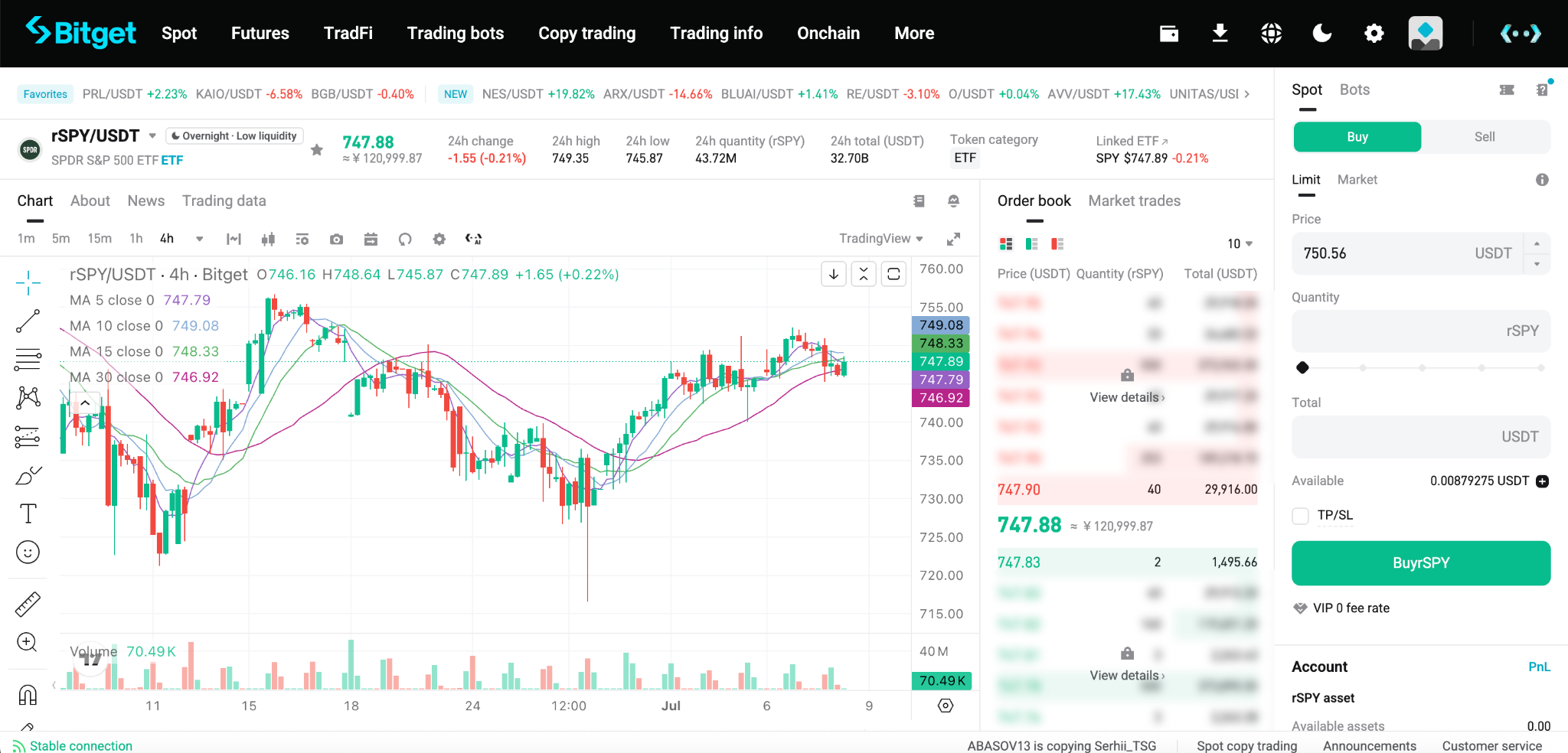
Trading interface of rTokens (rSPY/USDT)
The latest release builds on Bitget's existing presence in tokenized equity markets, which already includes tokenized stocks, exchange-traded funds, stock futures and pre-IPO investment products.
Bitget was among the first major cryptocurrency exchanges to support tokenized equities at scale. By January 2026, cumulative spot trading volume for tokenized stocks had exceeded $1 billion. The platform also accounted for approximately 89% of trading volume for Ondo-issued tokenized stocks during December 2025.
Meanwhile, cumulative trading volume for Bitget's stock futures products has surpassed $10 billion, reinforcing the company's broader Universal Exchange strategy.
On July 2, 2026, Bitget launched U.S. stock options, giving eligible users direct access to trade options on leading U.S.-listed companies for directional trading, earnings-cycle strategies, and downside exposure management.
The initial release supports long call and long put positions. Long calls allow traders to speculate on rising share prices, while long puts can be used to benefit from declining prices or hedge existing positions.
The lineup includes tokenized exposure to leading companies and exchange-traded funds such as Apple, Amazon, Meta, Tesla, Alphabet, NVIDIA, Microsoft and the QQQ ETF. Availability depends on users' jurisdictions and applicable regulatory eligibility requirements.
Stock+ and rToken: Which one should you choose?
Although both are part of Bitget's Stocks 2.0 ecosystem, Stock+ and rTokens are designed for different types of investors rather than competing with one another.
Stock+ is aimed at users who want direct ownership of U.S. stocks. Eligible users purchase actual shares through regulated brokerage partners, receiving the same core benefits associated with traditional investing, including cash dividends, stock splits and voting rights where applicable under custody agreements.
It is therefore more akin to a brokerage-style product experience, built for users who prioritize holding real U.S. equities through regulated brokerage infrastructure over tokenized composability. Its familiar interface, including market data, order entry, and portfolio views, helps reduce the learning curve for traditional brokerage users.
Under Stock+, Bitget also launched US stock options, adding a more advanced trading strategy layer.
rTokens, issued by Reality, take a different approach. In addition to reflecting the economic performance of the underlying stocks, rTokens map cash dividends and corporate actions such as stock splits. Changes are shown directly on the user's balance.
rTokens are also built for capital efficiency within Bitget’s trading ecosystem. Beyond buy-and-hold exposure, they can support margin use, trading-tool integration, and flexible capital deployment, enabling professional clients to use tokenized stock exposure as collateral, borrow against it, and manage hedging, arbitrage, or delta-neutral strategies more efficiently.
There are also practical differences. rTokens support 24/7 trading for selected assets and are not subject to CRS tax reporting, while Stock+ follows traditional U.S. market hours, including pre-market and after-hours sessions, and complies with international CRS reporting requirements.
Stock+ currently offers access to more than 10,000 U.S. stocks and ETFs, whereas rTokens cover over 500 major U.S. equities.
Ultimately, the choice depends on investment goals. Investors seeking real share ownership and full shareholder rights will likely prefer Stock+. Those looking to combine equity exposure with the flexibility of crypto-native portfolio management may find rTokens the better fit.
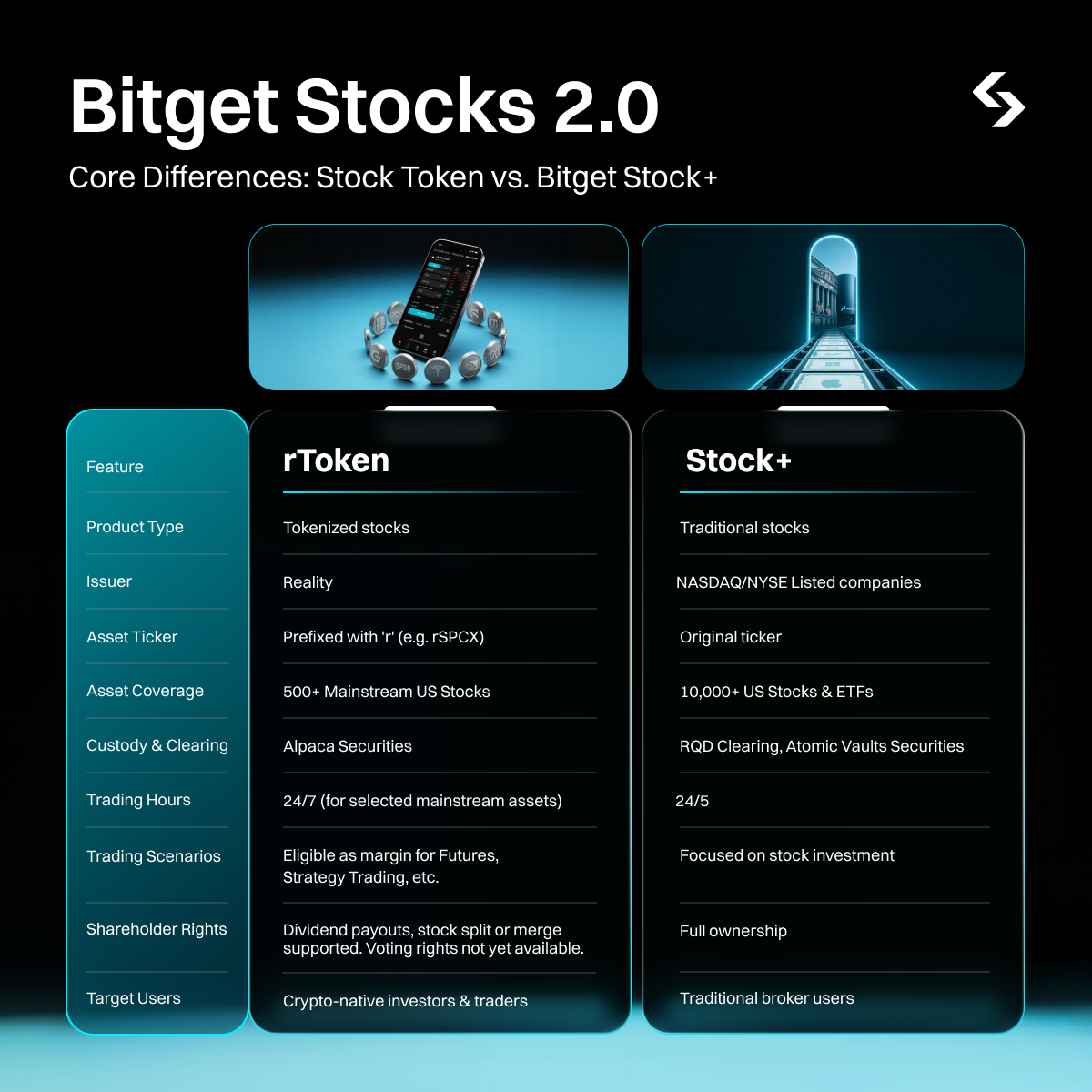
Together, the two products complement each other by serving distinct roles within the Bitget Stocks 2.0 ecosystem: Stock+ provides traditional equity ownership, while rTokens extend those assets into the broader world of digital finance.
Unified investment portfolio
Stocks 2.0 fits naturally into Bitget's broader Universal Exchange strategy. Historically, crypto investors and stock investors have lived in separate ecosystems. Each required different accounts, funding methods and interfaces.
Bitget attempts to consolidate those experiences. Within one account, users can potentially manage:
- Cryptocurrencies
- Spot trading
- Futures
- Tokenized real-world assets
- Tokenized stocks
- Stock options
- ETFs
- Direct U.S. equities
- Copy trading
- Earn products
For investors actively participating in multiple markets, reducing operational complexity may prove just as valuable as introducing new investment products.
Fees and accessibility
Stock+ trading begins with fees starting at 0.1%, and Bitget is offering a 50% promotional discount through August 31, 2026.
Maker and Taker fees follow the VIP pricing model at a fixed rate of 0.05% when using BGB discounts.
According to Bitget, the pricing structure reduces trading costs and minimizes friction for users seeking exposure to global equities through digital assets.
The platform also supports stock transfers from participating brokers, including Futu, Tiger, Moomoo, Longbridge, Webull and Interactive Brokers (IBKR).
During the launch campaign, eligible users may receive transfer fee reimbursements of up to 10,000 USDT, making portfolio migration more attractive for existing stock investors.
For new users, Bitget has paired the launch with promotional campaigns featuring tokenized SpaceX and Micron stock reward pools tied to account opening, qualifying deposits, transfers and Stock+ trading activity.
While these incentives are temporary, they lower the cost of exploring the platform and encourage users to experience Stock+ firsthand.
The main advantages of Stocks 2.0
The strongest aspect of Stocks 2.0 is not any single feature, but the combination of several capabilities that traditionally required multiple financial institutions. This position-by-position flexibility is the central idea behind Stocks 2.0.
Users can decide whether each exposure should prioritize direct ownership, trading flexibility, portfolio consolidation, or capital efficiency.
Instead of maintaining separate relationships with a crypto exchange, brokerage, bank and investment app, users can increasingly manage everything within Bitget.
Other notable strengths include:
- Direct ownership of real U.S. stocks and stock options through Stock+
- A large catalog of tokenized equities and ETFs
- Fractional investing from 0.0001 shares
- Stablecoin-funded investing
- Integrated portfolio management
- Support for dividends and corporate actions
- Unified account functionality across crypto and traditional assets
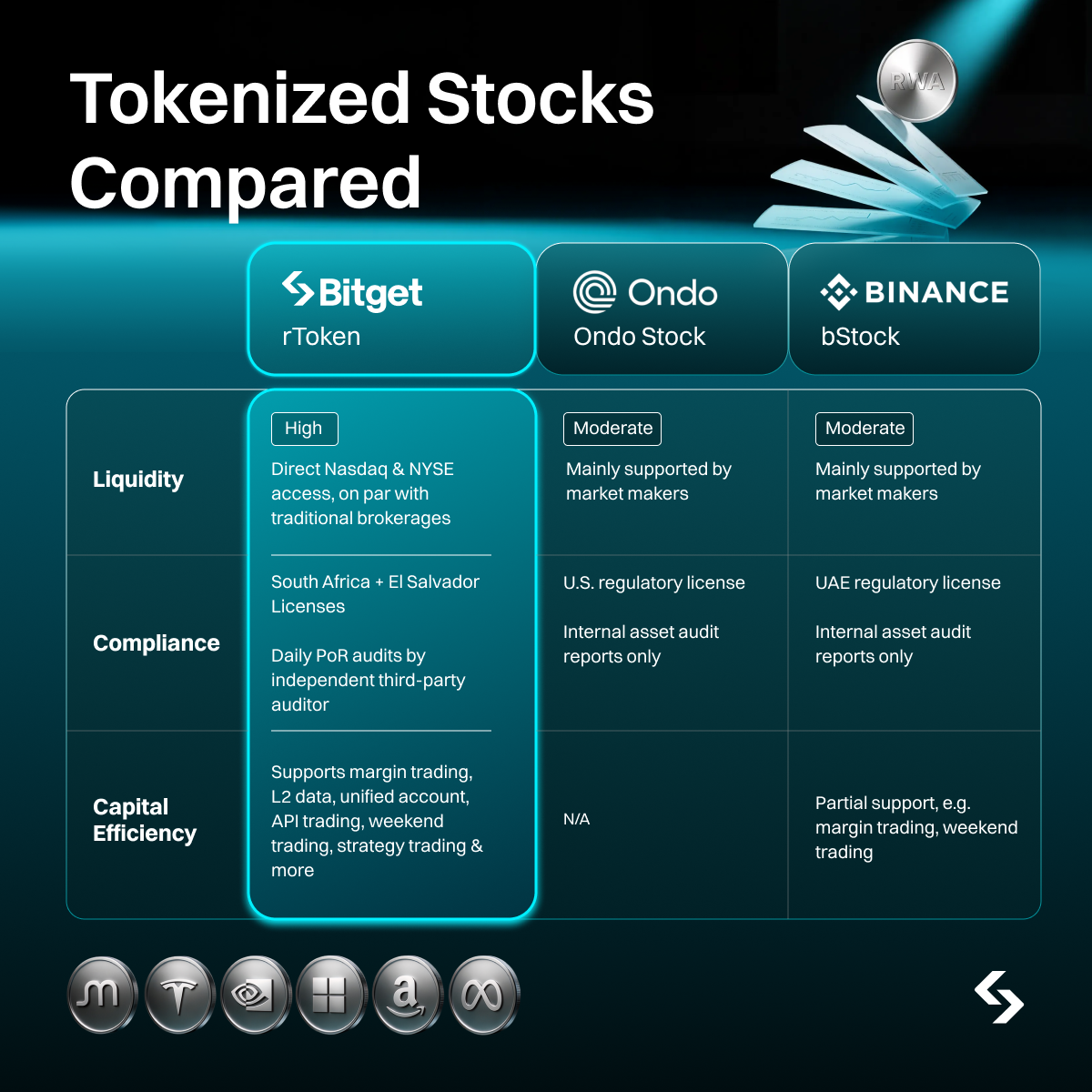
Comparison of rTokens, Ondo Stock, and Binance bStock
Although Stocks 2.0 significantly expands Bitget's offering, there are a few practical considerations.
First, Stock+ availability depends on user eligibility and jurisdiction, meaning not every Bitget customer will have immediate access to direct U.S. stock trading.
Second, users should understand the distinction between Stock+ and tokenized stocks. While both provide equity exposure, they differ in structure, ownership model and potential ecosystem utility.
Investors should choose the product that aligns with their objectives rather than assuming the two are interchangeable.
Why Stocks 2.0 matters
The launch reflects a broader shift occurring across financial markets. For years, crypto and traditional finance operated as parallel systems with limited interoperability. Stocks 2.0 represents another step toward merging those ecosystems.
Reality's rToken platform surpassed $50 million in assets under management less than one month after launch, suggesting growing demand for regulated, blockchain-based financial products.
This aligns with Bitget CEO Gracy Chen's forecast that tokenized assets could represent roughly 10% of major global asset classes by 2030, compared with an estimated **0.5% to 1% today.

Whether that prediction proves accurate remains to be seen, but the direction of travel is increasingly clear: digital assets and traditional financial markets are becoming more interconnected.
Bitget is also positioning itself as the first crypto exchange to launch U.S. stock options, following earlier moves in tokenized stocks and pre-IPO access.
Bottom line
Bitget has built a broader ecosystem that combines regulated brokerage access through Stock+, blockchain-based rTokens, stablecoin-funded investing and unified portfolio management within a single account.
Stock+ and rTokens are built for different investment styles rather than competing with each other.
Stock+ is designed for investors who want direct ownership of U.S. equities. The overall experience closely mirrors that of established brokerage platforms.
rTokens, issued by Reality, serve a different purpose. Instead of providing direct ownership, they offer tokenized exposure to U.S. equities within a crypto-native environment.
Verdict
The ability to purchase real U.S. stocks and stock options using digital assets, alongside access to more than 500 tokenized equities and over 10,000 U.S.-listed stocks and ETFs, gives the platform broad appeal for both crypto-native users and investors looking to consolidate their portfolios.
Despite its broad feature set, Stocks 2.0 is not without trade-offs. The platform combines several different product types, which may increase the learning curve for users unfamiliar with both crypto markets and conventional investing. Understanding the differences between these products is essential before building a portfolio.
Regulatory considerations also remain an important factor. Access to Stock+ depends on local regulations and user eligibility, meaning the complete Stocks 2.0 experience is not available in every jurisdiction.
As Stocks 2.0 is a relatively new product, long-term performance, liquidity and user experience will become clearer as adoption grows.
Overall, Bitget Stocks 2.0 moves the platform closer to its Universal Exchange vision by bringing crypto, tokenized assets and U.S. equities into a single ecosystem.
For users who want to manage both digital assets and traditional investments without switching between multiple platforms, it offers one of the most comprehensive solutions currently available.
 Dan Burgin
 U.Today Editorial Team
