

Bali — Indonesia's Financial Services Authority (OJK) is advancing rules for stablecoins and real-world asset (RWA) tokenization as several blockchain-based financial models move beyond the regulator's sandbox toward the next stage of development.
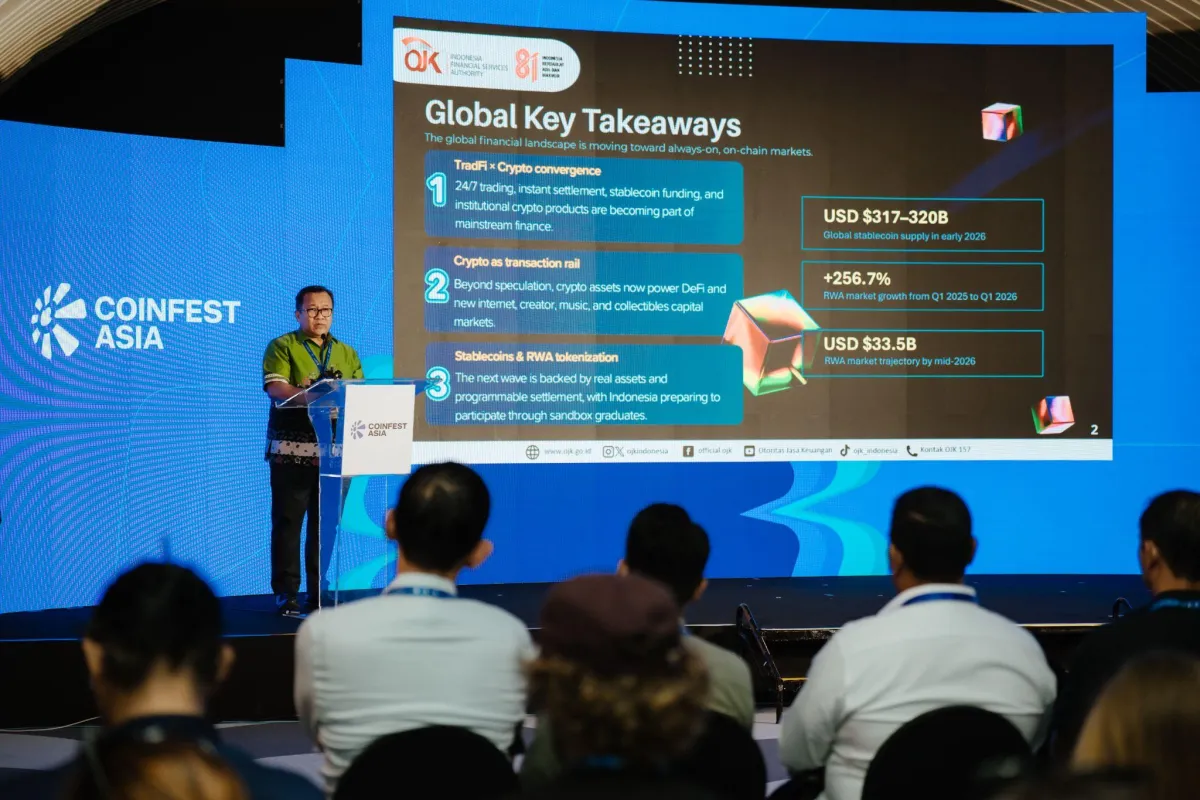
Adi Budiarso, OJK's Chief Executive for Financial Sector Technology Innovation, Digital Financial Assets and Crypto Assets Supervision, outlined the regulatory direction during a keynote at Coinfest Asia 2026, The World's Crypto Festival, held in Bali on Aug. 20–21. The event brought together policymakers, investors, technology companies and industry leaders from across Asia and beyond, creating a platform for discussions around the next phase of digital-asset adoption and regulation.
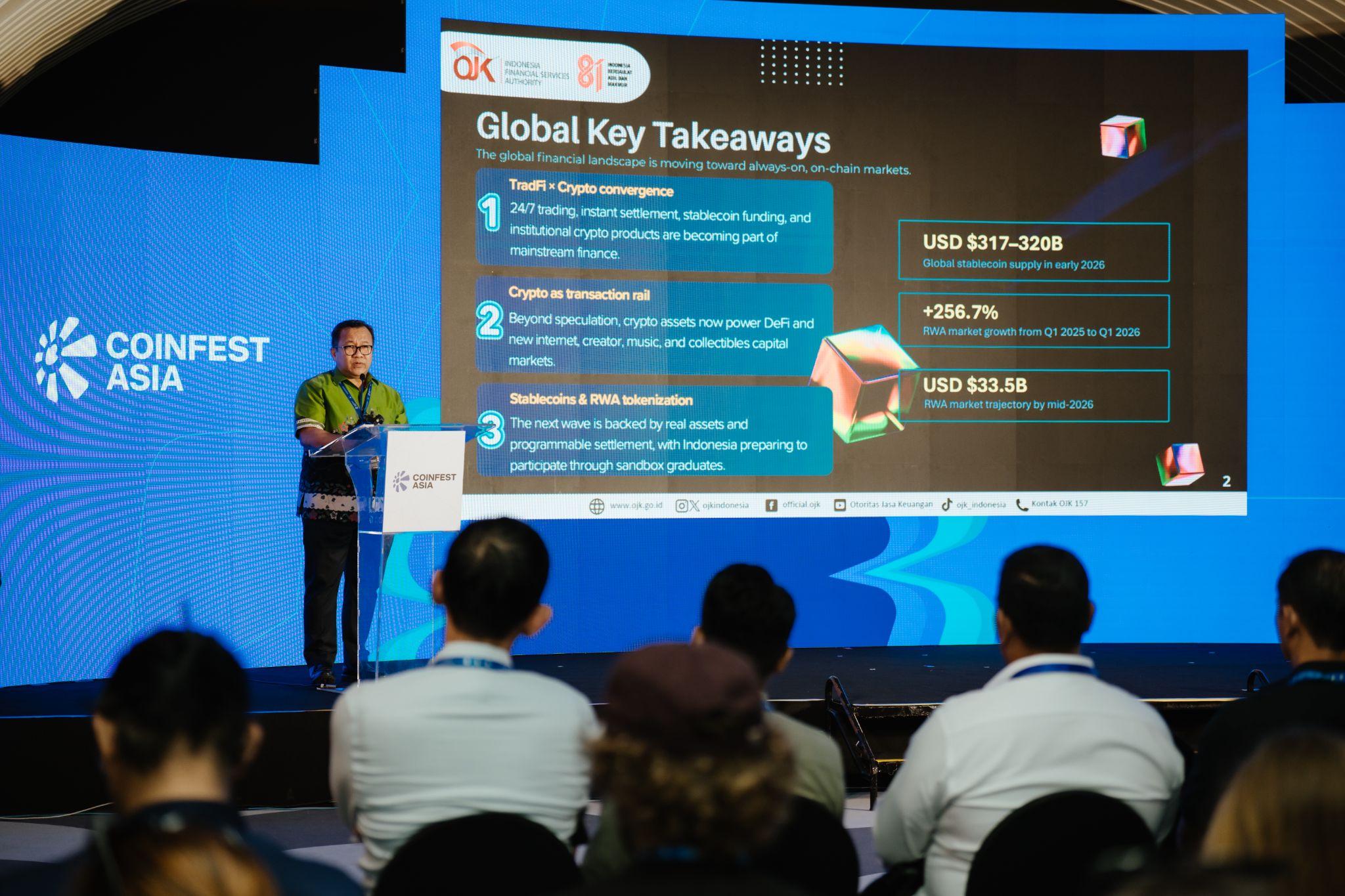
Adi Budiarso delivers his keynote at Coinfest Asia 2026 in Bali. Photo: Coinfest Asia
The push comes as OJK sees crypto assets taking on a broader role in financial markets, extending beyond investment and trading into transactions, decentralized finance, stablecoins and tokenized assets.
"Crypto assets are no longer merely speculative investment instruments; they have become the engine and rail for DeFi transactions," Adi said.
Some of those use cases have already moved through OJK's regulatory sandbox. OJK's official sandbox records show that multiple digital-asset business models have undergone testing, with results published by the regulator through July 2026.
Adi said stablecoin and tokenization projects involving gold, government bonds and property economic rights had passed OJK's sandbox.
"We are ready to enter the next phase of commercialization," he said.
Stablecoin Rules Move Forward
Stablecoins are among the areas OJK is seeking to bring under a clearer regulatory framework.
The authority plans to treat stablecoins as transactional instruments, but not as payment tools, while coordinating closely with Bank Indonesia, which oversees the country's payment system.
Indonesia already has a rupiah-linked stablecoin model that has completed the sandbox process. OJK's sandbox records provide the regulatory status of participants and models that have completed the process.
The IDRP stablecoin, developed as a rupiah-pegged digital asset, is designed to maintain a 1:1 value against the Indonesian rupiah and is backed by rupiah reserves.
The regulatory work comes as stablecoins continue to expand globally. CoinGecko's 2026 RWA research puts the broader stablecoin market at more than US$320 billion in Q1 2026, with fiat-backed stablecoins accounting for the majority of the market.
OJK Finalizes RWA Tokenization Framework
OJK is also finalizing regulations for real-world asset tokenization as models involving traditional assets move beyond testing.
RWA tokenization allows assets or economic rights linked to real-world assets to be represented digitally using blockchain infrastructure.
In Indonesia, models developed through OJK's sandbox include gold tokenization, securities tokenization and property-related economic rights. Adi also referenced government bonds as part of the tokenization models being developed.
"We are drafting a comprehensive OJK regulation to ensure scalability and security," Adi said.
OJK also sees tokenization as a potential channel for expanding access to capital, including for small and medium-sized enterprises.
The push comes amid rapid growth in tokenized assets globally. CoinGecko data showed the tokenized RWA market, excluding stablecoins, rising 256.7% from US$5.42 billion at the start of 2025 to US$19.32 billion by the end of the first quarter of 2026. Tokenized Treasuries remained the largest asset class.
CoinGecko's research also shows that tokenized Treasuries reached US$12.99 billion by March 2026, while tokenized commodities rose to US$5.55 billion, highlighting the expansion of tokenized financial and real-world assets beyond stablecoins.
Part of a Broader Crypto Policy Push
The stablecoin and tokenization rules form part of a broader regulatory shift following revisions to Indonesia's Financial Sector Development and Strengthening Law, known as the P2SK Law.
OJK has outlined four priorities for digital assets: recognizing crypto asset providers as financial services institutions, restructuring market infrastructure and introducing a Single Investor Identification system, regulating stablecoins, and finalizing RWA tokenization rules.
Adi said bringing crypto providers into the financial services framework would also raise governance standards across the industry.
"This is not merely a label; it does represent an elevation for the industry class," he said.
Indonesia already has a sizable domestic crypto market. OJK recorded 22.69 million crypto-asset investors as of June 2026, while monthly transaction value reached IDR 28.58 trillion, according to an official OJK update.
The regulatory transition comes as Indonesia seeks to build a digital-asset market capable of supporting innovation, attracting investment and strengthening its position in the regional financial ecosystem.
"We are fully committed to establishing Indonesia as Asia's crypto hub, a center for innovation, investment, and crypto transactions in this region," Adi said.
Disclaimer: This is sponsored content. The information on this page is not endorsed or supported by U.Today, and U.Today is not responsible or liable for any inaccuracies, poor quality, advertising, products or other materials found within the publication. Readers should do their own research before taking any actions related to the company. U.Today is not responsible, directly or indirectly, for any damage or loss caused or alleged to be caused by or in connection with the use of or reliance on any content, goods or services mentioned in the article.
 U.Today Editorial Team
 Dan Burgin
