

Disclaimer: The opinions expressed by our writers are their own and do not represent the views of U.Today. The financial and market information provided on U.Today is intended for informational purposes only. U.Today is not liable for any financial losses incurred while trading cryptocurrencies. Conduct your own research by contacting financial experts before making any investment decisions. We believe that all content is accurate as of the date of publication, but certain offers mentioned may no longer be available.

The latest Max Pain readout from CoinGlass finally provides a clear picture of where leveraged traders stand on XRP. The situation is more balanced than the social media drama usually suggests. The short side carries a larger dollar amount, with $12 million at the max-pain line of $2.28587.
However, that level is far from the current price. XRP is trading at around $2.07, so bears have a cushion of about 10% before they start to feel the heat. There is nothing urgent for them, just a clearly defined point they do not want the market to reach.
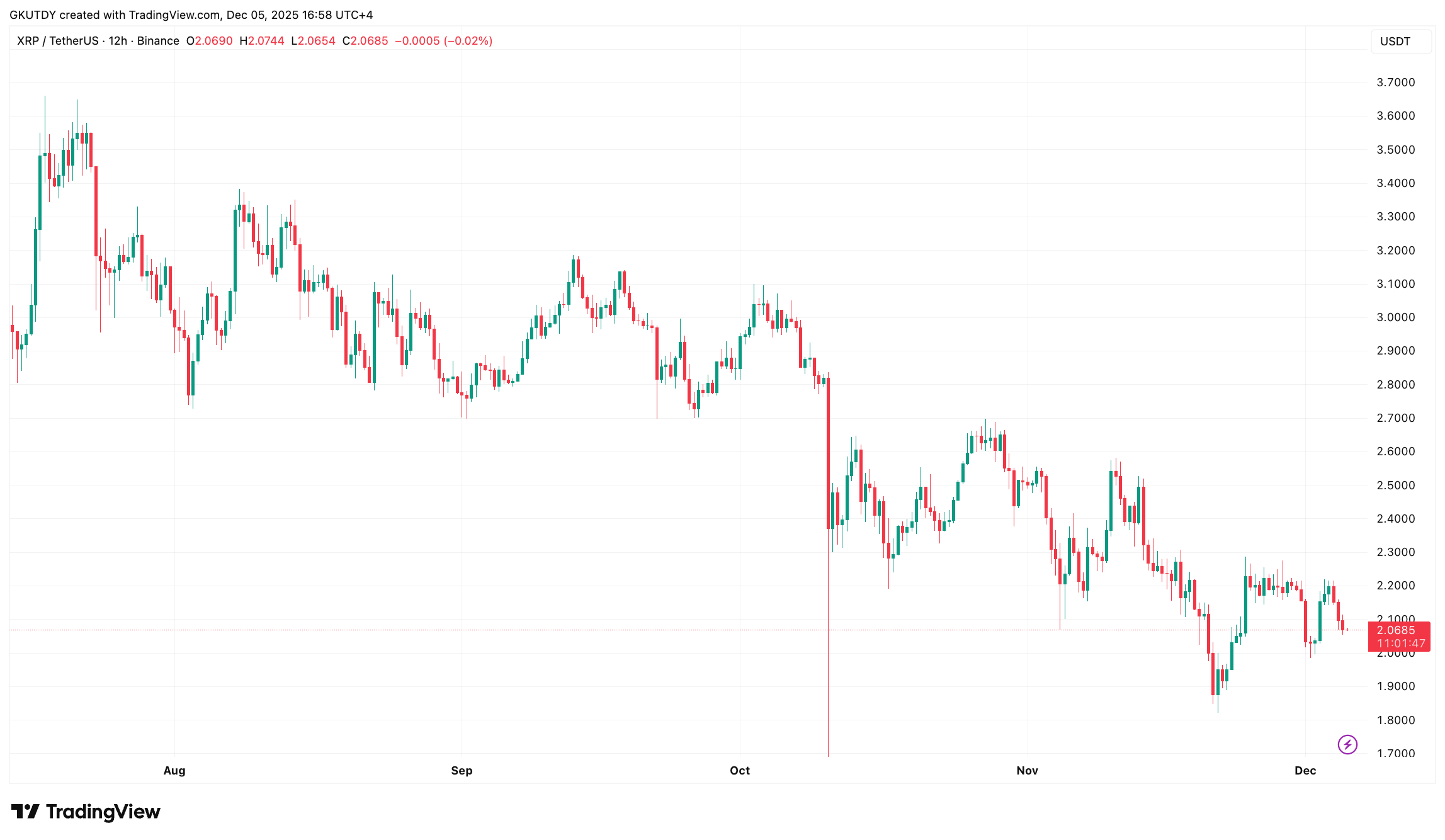
The long side has the opposite problem. Their max-pain marker sits nearly at the spot price, showing a distance of 0.91%. This means that any minor pullback, even within this slow range, will affect long exposure first.
It does not matter that bulls' money stack is not as large as the short side's — $7.59 million vs. $12 million — because the pressure is closer, and the market does not need a big move to test it.
$2.28 becomes real pressure line for XRP price
The chart tells the same story as the numbers on the board. XRP has been slipping aimlessly on the 12-hour time frame, forming a pattern that appears neutral but keeps both sides on edge.
If the XRP price increases and heads toward $2.20-$2.30, the short cluster will come into focus. Reaching $2.28 would be the first point at which bears would actually feel maximum risk, and not just theoretically.

Until then, the setup remains split. Longs face immediate proximity risk, while shorts carry a larger payout zone higher up. The indicator does not pick a winner; it only shows which levels attract the most attention. For now, the real tension sits between the spot price and the $2.28 threshold.
 U.Today Editorial Team
 Dan Burgin
