
Disclaimer: The opinions expressed by our writers are their own and do not represent the views of U.Today. The financial and market information provided on U.Today is intended for informational purposes only. U.Today is not liable for any financial losses incurred while trading cryptocurrencies. Conduct your own research by contacting financial experts before making any investment decisions. We believe that all content is accurate as of the date of publication, but certain offers mentioned may no longer be available.

TL;DR
- GRAM/Telegram App Store incident: Apple pulled Telegram worldwide over a content-policy violation on Aug. 4, causing the GRAM price to drop by over 6% to $1.297 before rebounding to $1.3818 after Telegram removed the content and Apple restored the app hours later.
- XRP-backed RLUSD loans: Flare's wrapped FXRP token is now approved collateral in Sentora's $280 million lending vault on Morpho Blue, letting large XRP holders borrow Ripple's RLUSD stablecoin without selling their XRP.
- Bitcoin undervaluation signal: CryptoQuant's UTXO Age Bands data shows "young" BTC supply at a multi-year low — a pattern last seen at the 2015, 2019, and 2022 cycle bottoms — pointing to an accumulation phase, with a bull cycle expected closer to 2027.
- ETF flows vs. wallet hack: U.S. spot Bitcoin ETFs added $170.1 million on Aug. 3, while spot Ethereum ETFs saw $11.42 million in outflows. In the meantime, a Coldcard hardware-wallet exploit stole roughly 1,596 BTC worth around $130 million from about 7,300 addresses.
How Apple's temporary ban sent the GRAM token on a price rollercoaster
On the night of Aug. 4, the GRAM token took investors on a real rollercoaster ride, instantly falling by more than 6% to $1.297 before sharply recovering to $1.3818. The price turbulence was caused by Telegram's sudden removal from Apple's App Store.
The application temporarily disappeared from Apple's marketplaces worldwide, including in the United States, India, Australia, and Singapore. According to Reuters, the trigger was user-generated content that violated the platform's rules. Telegram's developers quickly removed the violating content and blocked its author, after which Apple fully restored the messenger to the marketplace.
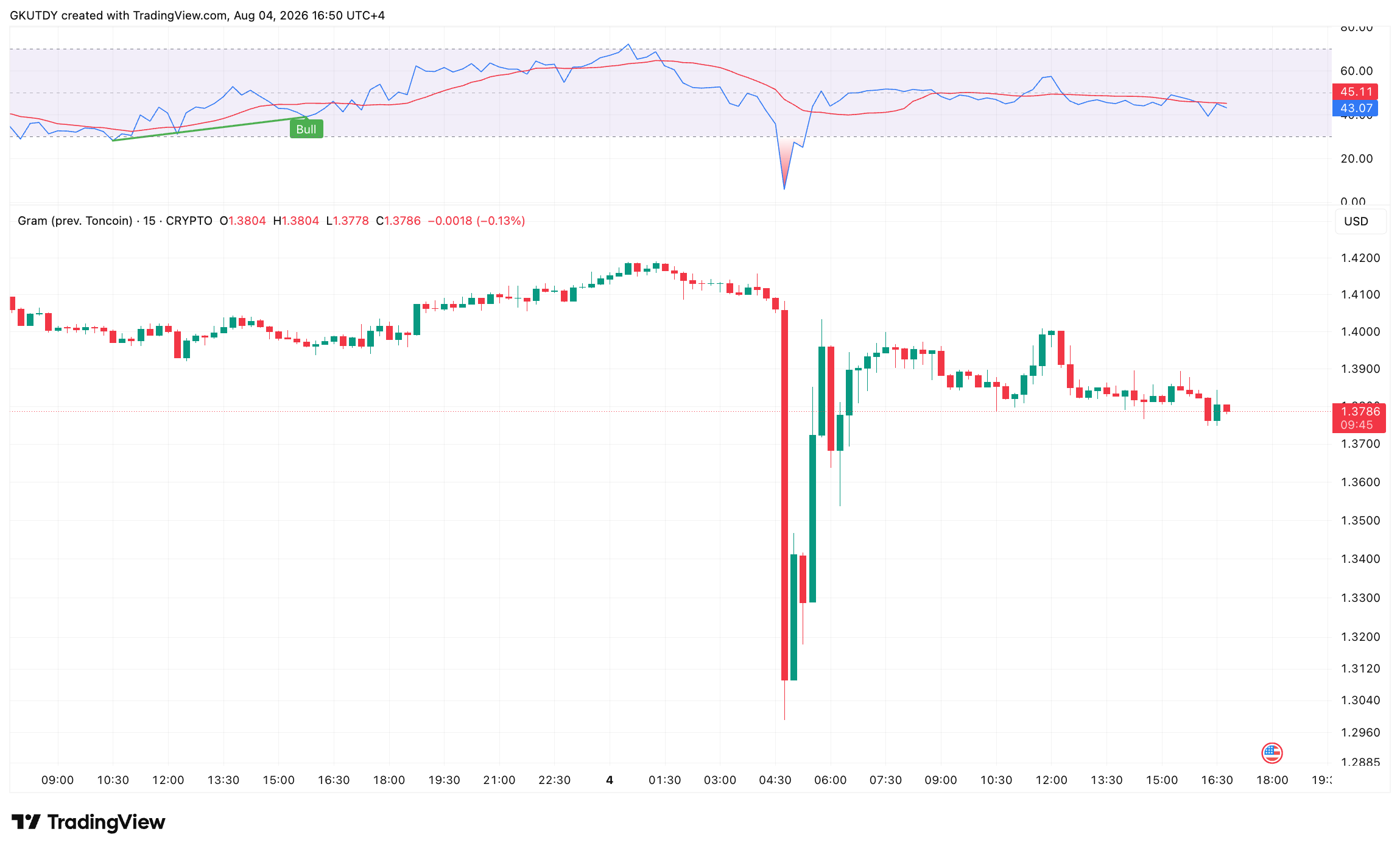
Traders' reaction to the ban news formed a deep red candle on the intraday GRAM/USDT chart by TradingView. However, the sell-off did not continue. As soon as the application returned to the marketplace, buyers aggressively bought the dip, forming a powerful green candle and returning the asset to its previous trading range.
Perhaps the main takeaway for cryptocurrency investors is that, despite strong fundamental support in the form of Pavel Durov's direct backing and announcements of integrated wallets, GRAM remains hostage to the regulatory risks surrounding Telegram, which is already attracting close attention from authorities in France and Australia.

XRP-backed loans: RLUSD stablecoin gains new source of liquidity
Large XRP holders can now obtain dollar liquidity against their tokens without having to sell them. This became possible after Flare Networks' wrapped FXRP token was officially approved as collateral in Sentora's lending vault on the Morpho Blue platform on Ethereum.
The pool allocated for these operations totals $280 million.
Sentora, the institutional curator, added the asset to the listing after a detailed analysis of the token's market behavior, decentralized oracle performance, and automatic liquidation mechanisms.
The lending chain works in three stages: users mint FXRP on Flare at a 1:1 ratio to XRP through the FAssets protocol, transfer it to Ethereum through the Stargate bridge, and lock it in the pool as collateral to borrow Ripple's regulated RLUSD stablecoin.
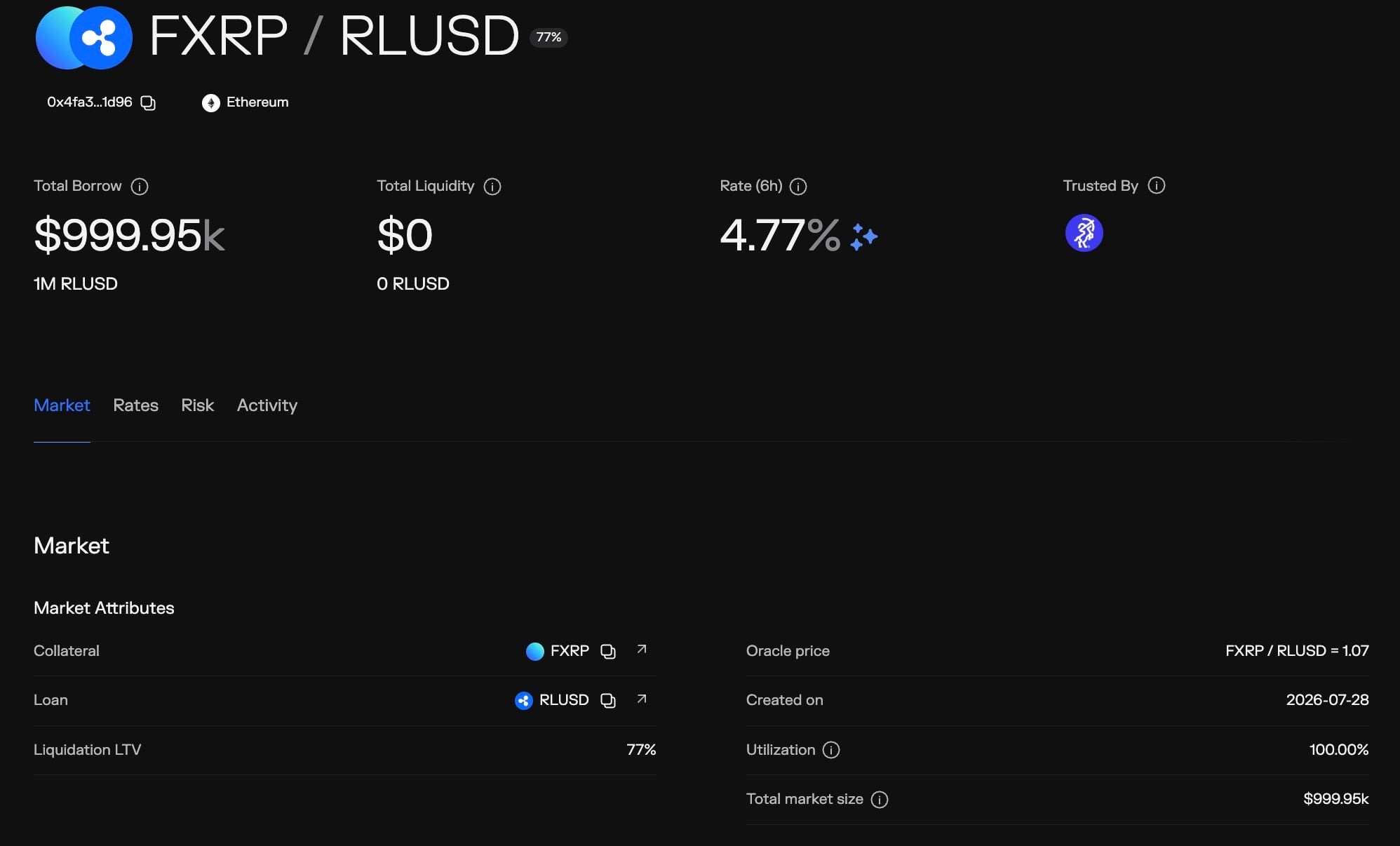
"This is something we have been working toward for a while," Flare Networks co-founder Hugo Philion commented on the launch. He emphasized that the lending market curated by Sentora "opens the door for much larger FXRP lending markets and for institutions that hold billions of XRP to participate." In effect, the project has deployed full-scale lending rails for large capital directly on the Ethereum mainnet.
According to the developers, the integration addresses the issue of XRP's utility in the DeFi sector while simultaneously stimulating the issuance of the stablecoin itself.
As the next step, the Flare team is already designing a smart account system that will automate the process and transfer liquidity directly from XRPL into RLUSD.
Only diamond hands left: CryptoQuant signals Bitcoin is deeply undervalued
Bitcoin is stuck in a zone of deep undervaluation, while total apathy has taken over the market — and for long-term investors, this is the best possible signal. Fresh on-chain analysis from CryptoQuant shows that the current calm closely mirrors market behavior at the bottom of previous cycles.
The main indicator here is the age of coins on the network, measured by the UTXO Age Bands metric. The share of "young" capital — Bitcoin that has been actively traded during the past month — has fallen to a critical low. This means that casual speculators and retail investors have completely lost interest in crypto and left the market.
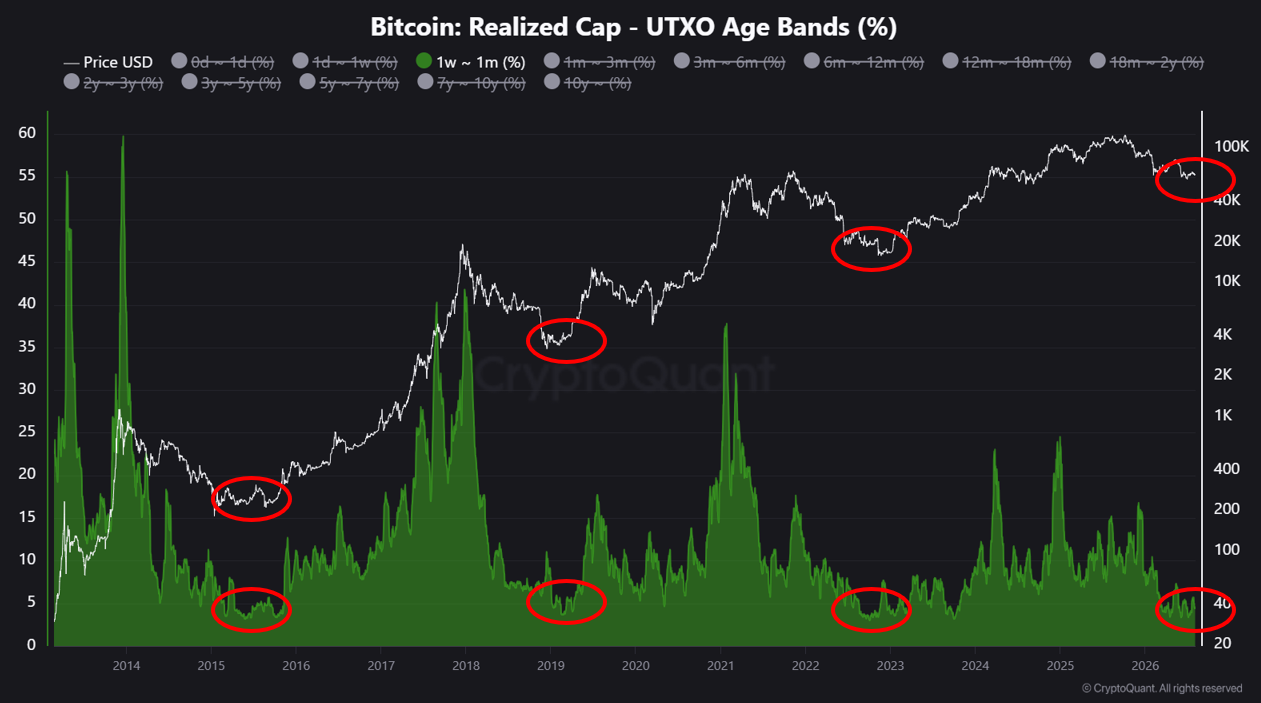
Bitcoin's supply is now almost entirely controlled by long-term holders who are simply maintaining their positions and refusing to sell the asset at current prices.
The same picture of total boredom and a shortage of actively traded coins has been recorded on the chart only three times in history: in 2015, 2019, and 2022. Each time, this phase preceded the beginning of a major reversal.
According to the on-chain analysis, Bitcoin has already entered a bottoming structure from the perspective of its four-year cycles. It is impossible to identify the exact price bottom down to the dollar, but the current price range represents a classic accumulation zone ahead of the next major bull market, which analysts expect closer to 2027.
Crypto market outlook: Institutions hold Bitcoin despite ETH outflows and hardware wallet uncertainty
Institutional capital is stabilizing the market, with a one-day inflow into U.S. spot Bitcoin ETFs offsetting recent selling pressure and fears surrounding isolated hacking incidents.
While Bitcoin remains in a range just below key technical barriers, the long-term trend is shifting toward the deep integration of tokenized deposits by major global banking institutions such as Wells Fargo.
Key checkpoints:
- ETF momentum accelerates: After a period of uncertainty, U.S. spot Bitcoin funds recorded net inflows of $170.1 million on Aug. 3, 2026. BlackRock's IBIT led the market with $111.43 million in inflows, while spot Ethereum ETFs recorded a modest outflow of $11.42 million.
- Bitcoin consolidation range: The leading cryptocurrency is trading within a consolidation range between $56,300 and $66,000. Despite a bullish divergence on the daily RSI after it reached oversold territory, a clean breakout above the nearest local resistance is required to initiate a sustainable growth scenario.
- Major hardware wallet vulnerability: Galaxy Research confirmed that an exploit targeting a Coldcard vulnerability resulted in the theft of 1,596 BTC from approximately 7,300 addresses. Total estimated losses involving at least 15 coordinated hackers could reach 2,000 BTC, worth approximately $130 million.
- Commercial tokenization takes root: Wells Fargo, with $2.2 trillion in total assets, officially announced the upcoming launch of tokenized deposits for corporate clients this fall. The initiative, built on a proprietary blockchain, is targeting 24/7 settlements by mid-2027 in cooperation with JPMorgan and Citigroup.
 U.Today Editorial Team
 Dan Burgin
