

Disclaimer: The opinions expressed by our writers are their own and do not represent the views of U.Today. The financial and market information provided on U.Today is intended for informational purposes only. U.Today is not liable for any financial losses incurred while trading cryptocurrencies. Conduct your own research by contacting financial experts before making any investment decisions. We believe that all content is accurate as of the date of publication, but certain offers mentioned may no longer be available.

Shiba Inu is showing one of the more interesting divergences it has printed in months. While the price continues to grind lower and sit uncomfortably near local lows, on-chain behavior tells a different story. Nearly 100 billion SHIB are leaving exchanges in a 24-hour window. That kind of outflow matters, especially at depressed price levels.
Exchanges losing fat
Exchange reserve data shows a clear contraction. Coins are moving off trading platforms, not piling onto them. That typically signals reduced immediate sell pressure, not aggressive distribution. At this stage of the cycle, sustained outflows suggest holders are choosing custody over liquidity, which is often how bottoms form rather than how crashes accelerate.
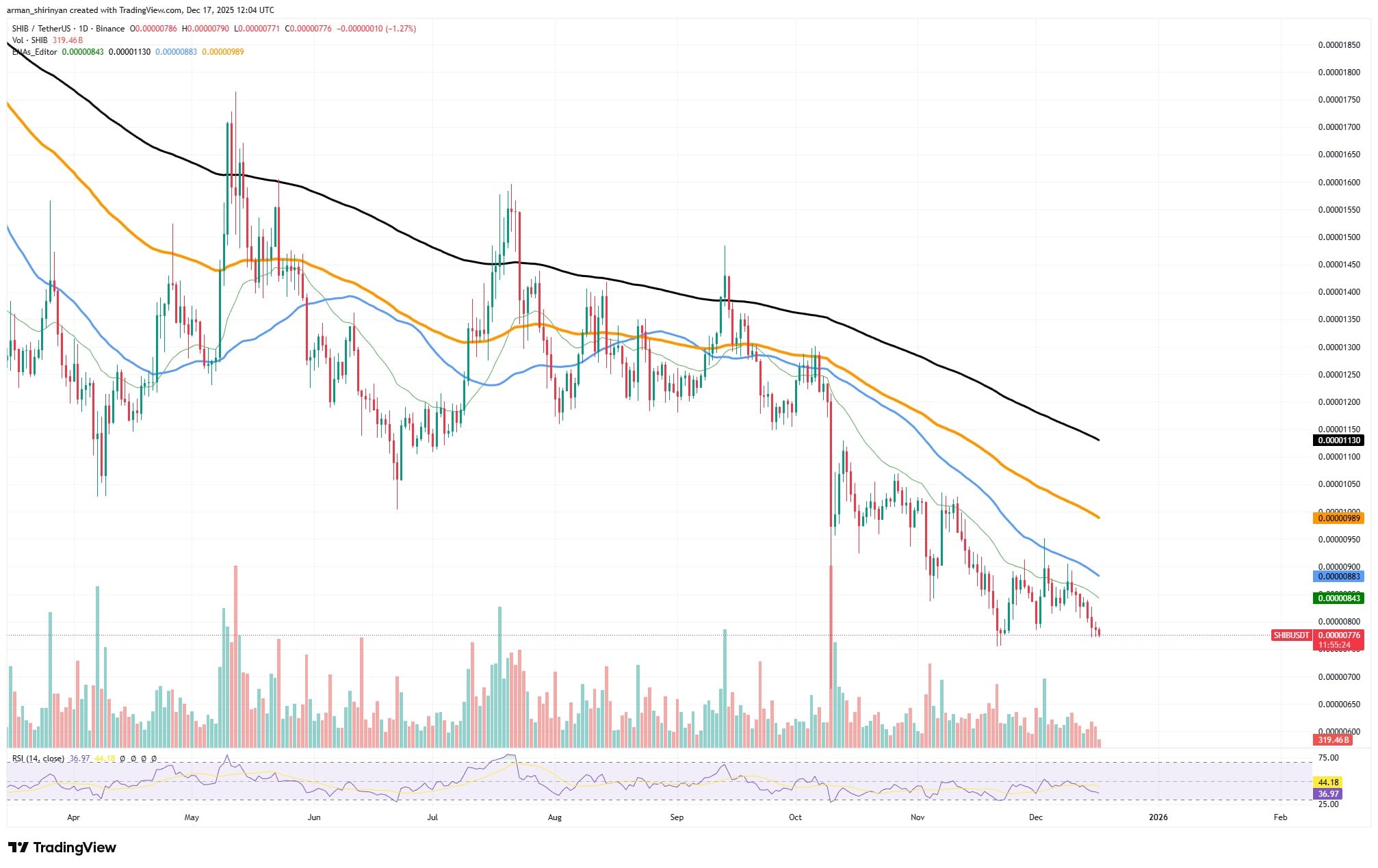
Price action, however, still looks ugly. SHIB remains pinned below all major moving averages, and the broader structure is firmly bearish. That matters. This is not a confirmed reversal yet, and anyone pretending otherwise is lying to themselves.
Are risks shifting?
But what’s changing is the risk profile. Selling pressure has cooled relative to earlier breakdown phases, and RSI is hovering in a compressed zone, where further downside requires renewed volume expansion. Without that, continuation lower becomes harder to sustain.

The key point is this: SHIB does not go to zero from here without fresh, aggressive distribution. Meme token or not, the current supply dynamics do not support a death-spiral narrative. For another meaningful breakdown, exchange inflows need to spike again and invalidate the recent outflow trend. So far, that has not happened.
What’s more likely in the near term is a stabilization range. Choppy price, fake-outs, slow absorption and attempts to reclaim short-term moving averages. If SHIB can build acceptance rather than immediately rejecting every bounce, a relief rally becomes increasingly plausible, even if it starts out weak and messy.
 U.Today Editorial Team
 Dan Burgin
