
Disclaimer: The opinions expressed by our writers are their own and do not represent the views of U.Today. The financial and market information provided on U.Today is intended for informational purposes only. U.Today is not liable for any financial losses incurred while trading cryptocurrencies. Conduct your own research by contacting financial experts before making any investment decisions. We believe that all content is accurate as of the date of publication, but certain offers mentioned may no longer be available.

TL;DR
- XRP led a $369 million crypto liquidation wave on Wednesday, dropping alongside Ether and Solana amid a scheduled escrow unlock and broader market pressure.
- Bitcoin fell to $77,200–$77,600, Ether to $2,410–$2,430, and Solana below $100 to $98.47, pulling total crypto market capitalization down to $2.59 trillion–$2.70 trillion.
- Rising oil prices and Treasury yields pushed Fed rate-hike odds for September 16 to 66%, the main trigger behind the sell-off.
- The SEC proposed overhauling blockchain transfer agent rules ahead of Congress's Clarity Act, with a September 17 roundtable set to bring in BlackRock, Nasdaq, NYSE and Robinhood on 24/7 stock trading.
Wednesday morning, September 2, 2026, began with the cryptocurrency market under heavy pressure as worsening external macroeconomic factors triggered $369.67 million in derivatives liquidations, hitting the largest altcoins.
At the same time, a divergence in capital flows emerged: institutional inflows into spot Ethereum, Solana and XRP ETFs remained positive despite the broader decline in spot prices.

Meanwhile, the U.S. Securities and Exchange Commission (SEC) initiated a sweeping reform of blockchain infrastructure that directly affects the interests of long-term investors.
At the start of trading, the industry's total market capitalization fell to $2.59–$2.70 trillion, losing around 1.4–2.2% from yesterday's highs and slowing the August uptrend, during which Bitcoin gained 25%.
The internal redistribution of capital exposed a split among market participants. According to SoSoValue, despite $236.46 million in outflows from Bitcoin ETFs, regulated Ethereum, Solana and XRP funds demonstrated resilience, closing with net inflows of $10.95 million, $10.19 million and $14.38 million, respectively.
September begins with a long squeeze: How expensive oil triggered liquidations for 90,000 crypto traders
The market's steep decline over the past 24 hours turned into a large-scale long squeeze, hitting buyers using high leverage. Real-time data from CoinGlass shows that of the $369.67 million in total liquidations, $301.84 million came from long positions.
Short positions, meanwhile, lost $67.83 million.
Most of the forced closures occurred within a narrow time frame: $141.44 million was liquidated over a 12-hour period, while another $82.10 million was wiped out during the final four hours before dawn. In total, exchanges closed the positions of more than 90,000 leveraged traders.
Price movements among the largest assets were distributed as follows:
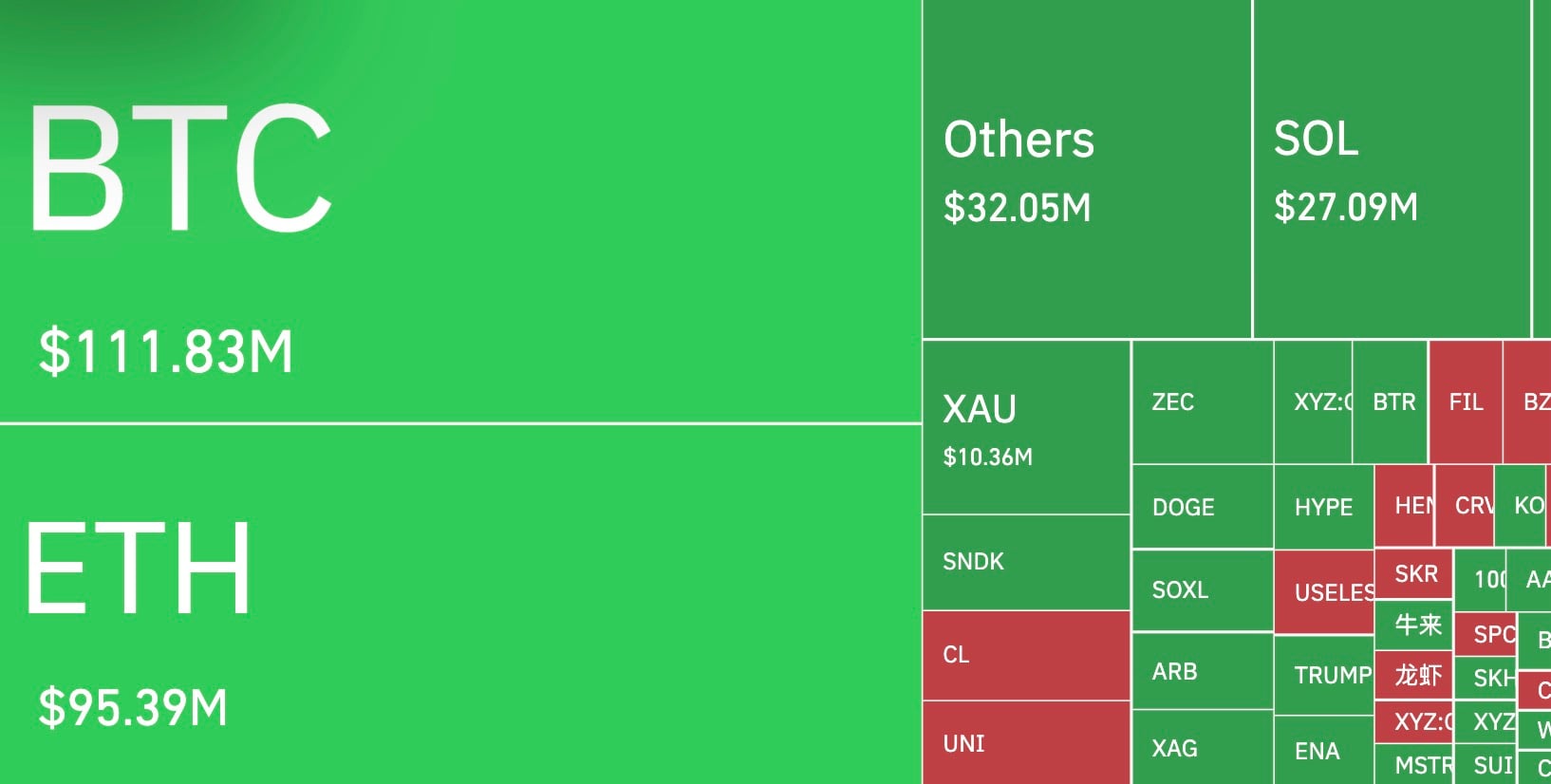
- Bitcoin (BTC) recorded the largest losses in absolute terms, with $111.83 million in liquidations pushing the price down 1.3–1.8% toward the $77,200–$77,600 support zone.
- Ethereum (ETH) fell by around 2% into the $2,410–$2,430 range, with liquidations reaching $95.39 million. The asset also saw the largest single liquidation of the day: an $11.99 million order on Binance.
- Solana (SOL) declined by 2–3.5%, falling below the psychologically important $100 mark to $98.47. The total value of forcibly closed positions reached $27.09 million.
- XRP retreated amid a scheduled escrow unlock, despite a strong backdrop that included $170 million in ETF inflows over the past 11 days and Goldman Sachs joining the ranks of major holders.

The main trigger for the sell-off was the external macroeconomic backdrop and the shift by global markets into a defensive position amid commodity-related risks. The price of WTI crude oil jumped above $90–$92 per barrel, while the yield on 10-year U.S. Treasury bonds climbed to the current cycle's highs of around 4.78–4.79%.
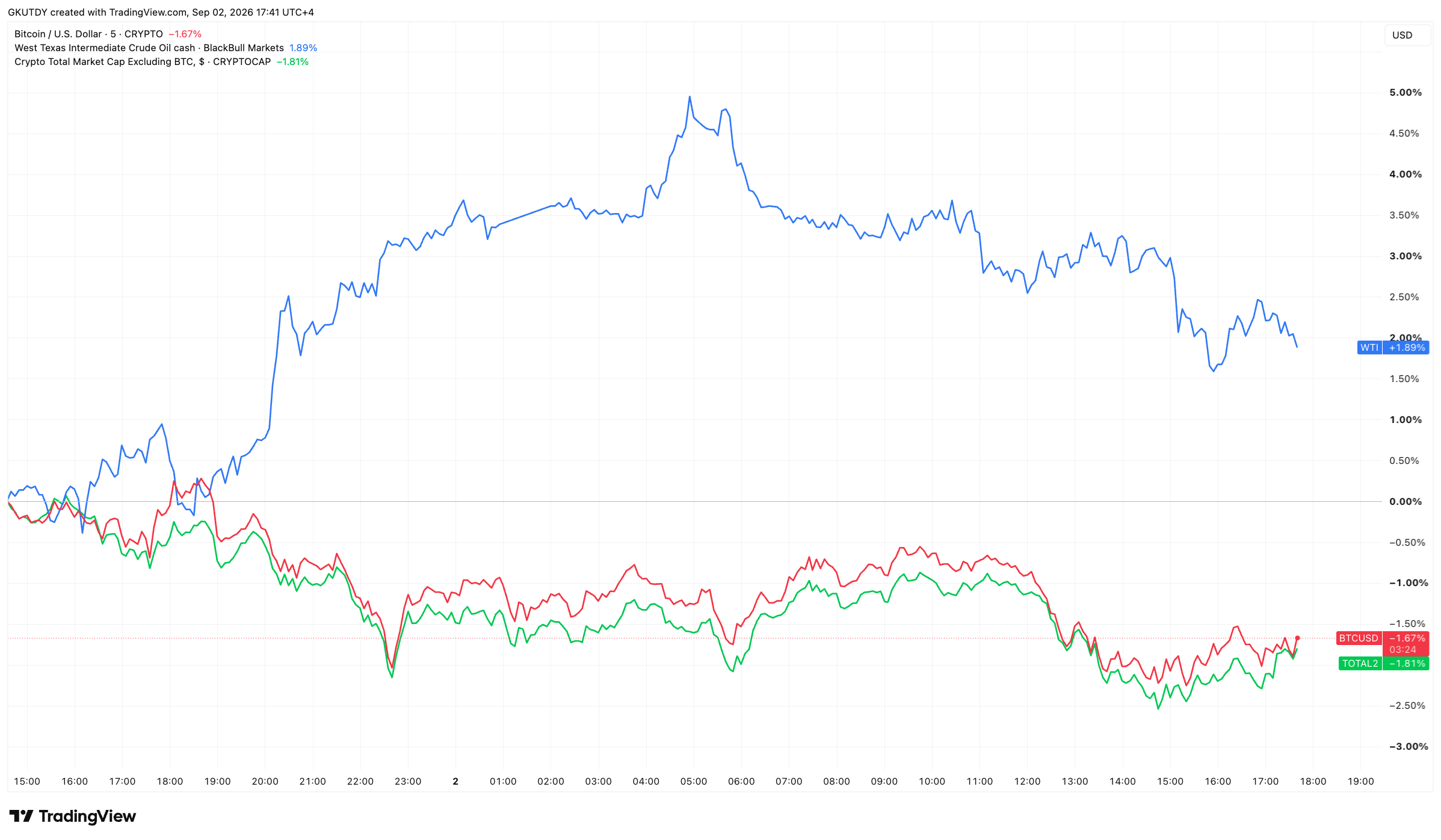
Because of inflationary pressure and rising Treasury yields, market participants raised the probability of a Federal Reserve rate hike on September 16 to 66%, which traditionally reduces demand for risk assets.
The only significant counterweight to the decline was that long-term Bitcoin holders became net buyers for the first time in a month. Several assets also ignored the broader sell-off: Filecoin gained 14–15% amid demand for decentralized AI data storage, while Uniswap rose 11% alongside improving metrics for Aave and Curve.
Congress's feint and 24/7 trading: Why the SEC is moving quickly to take control of tokenization
Amid the current market liquidations, the U.S. SEC moved to seize the legislative initiative from Congress, deciding not to wait for lawmakers to agree on the Clarity Act.
The Commission officially proposed a complete overhaul of the rules governing transfer agents, adapting them to public blockchains, tokenized stocks and artificial intelligence.
By advancing its own strict regulations, the SEC is effectively presenting lawmakers with a fait accompli and preemptively securing control over the emerging digital securities market under its exclusive jurisdiction.
The next key step in implementing this strategy will be a major SEC roundtable scheduled for September 17. The agency is bringing together Wall Street leaders and technology giants, including BlackRock, Citadel Securities, Nasdaq, NYSE, DTCC and Robinhood, to discuss the official launch of round-the-clock trading in traditional stocks.
Participants will be expected to establish working rules for moving the stock market to continuous settlement, including the introduction of overnight supervision, instant clearing systems and protections for retail investors outside regular market hours.
In the long term, this reform will completely erase the infrastructure boundaries between traditional finance and the digital asset industry. Round-the-clock access to trading on a 365 basis will no longer be a unique advantage of cryptocurrencies, as the stock market adopts the same standard, leading to a redistribution of speculative liquidity.

The largest players are already adapting to the new rules. A banking consortium led by Citi and Goldman Sachs is developing its own dollar-backed stablecoin for 2027, while the London Stock Exchange (LSE), together with Kraken's owners, is testing the transfer of major British stocks onto blockchain rails.
The industry interpreted the regulator's actions as the final recognition of the technology at the government level. Real-world asset tokenization platform Securitize, a BlackRock partner, said the new rules should "raise standards, not lower them" and that updating the regulatory framework to reflect the current evolution of financial markets is "exactly the right move."
ETF Store President Nate Geraci similarly emphasized that major Wall Street players are no longer debating whether crypto will survive. Today, "pretty much nobody is debating" its integration, with the entire discussion focused exclusively on "how it exists or replaces" outdated financial mechanisms.
For investors, these developments form a clear picture. September has historically had a reputation as a weak month for digital assets: since 2013, Bitcoin has closed the month in the red eight times out of 13, with an average return of -3%. The S&P 500 has also declined by an average of 0.6% in September since 1945.
The current pressure on cryptocurrency prices is being intensified by the commodity shock and expectations surrounding fresh U.S. unemployment data due on September 3.
The localized commodity shock is temporarily weighing on prices, but long-term funds continue to increase their positions. The next key benchmark for the market will be the release of the latest U.S. unemployment data, which will determine asset performance through mid-September.
 U.Today Editorial Team
 Dan Burgin
