
Disclaimer: The opinions expressed by our writers are their own and do not represent the views of U.Today. The financial and market information provided on U.Today is intended for informational purposes only. U.Today is not liable for any financial losses incurred while trading cryptocurrencies. Conduct your own research by contacting financial experts before making any investment decisions. We believe that all content is accurate as of the date of publication, but certain offers mentioned may no longer be available.

Over the last three months, XRP’s on-chain activity has increased dramatically, with a number of network metrics approaching levels that resemble a 400% surge in comparison to their late-summer baselines.
What moves XRP forward
The total volume of payments, the number of payments made between accounts and the overall transaction throughput have all significantly increased. However, the price chart presents a far less optimistic picture, and this discrepancy is the main risk moving forward.
There is an improvement in network throughput. Daily payments usually fall into the upper end of the multi-month range, and spikes in payment volume show increasing value movement throughout the network.
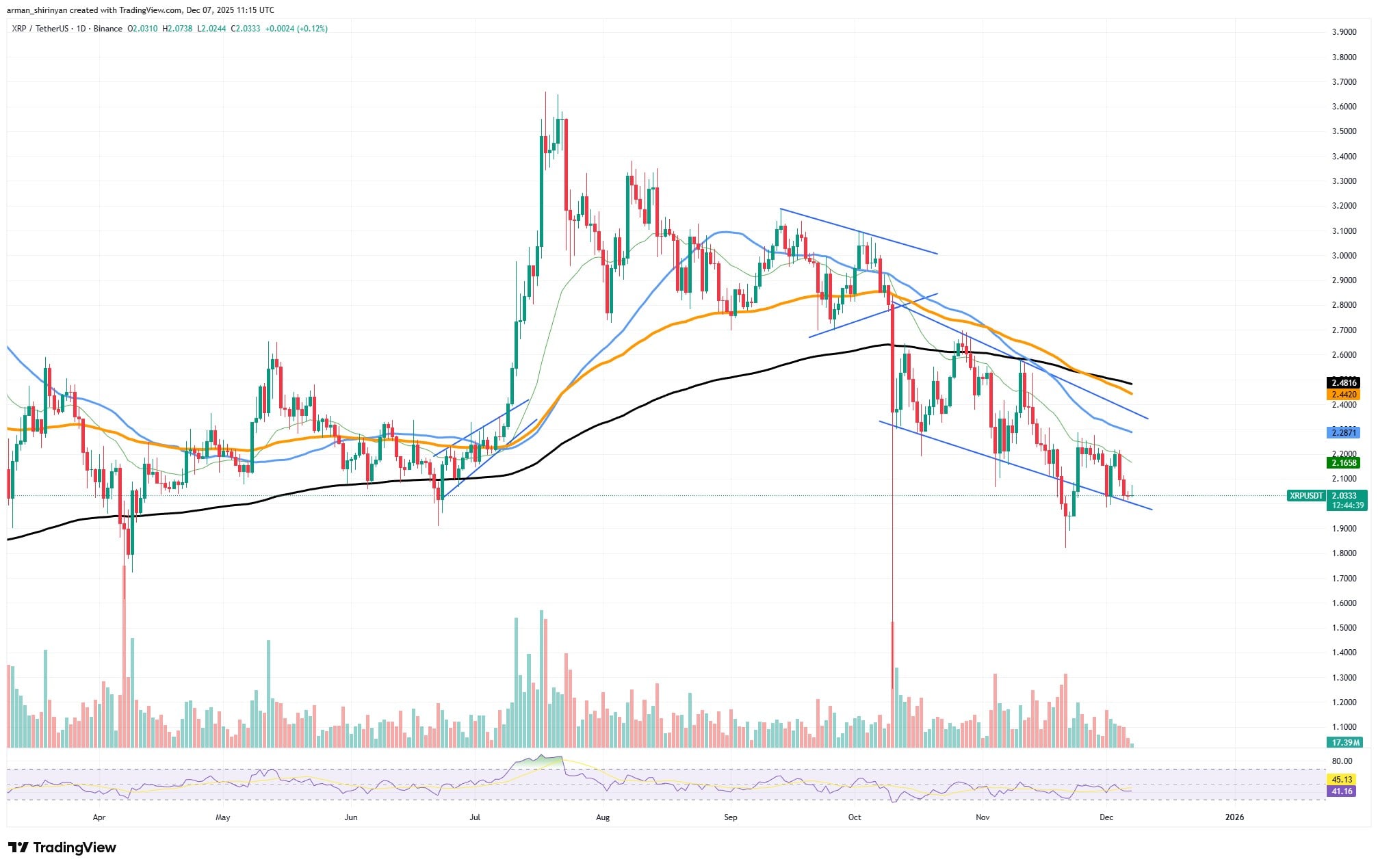
However, this momentum is not reflected in the market structure. The price of XRP is still stuck in a distinct downward channel and keeps missing declining resistance. More worrisomely, all attempts to break above the 20- and 50-day moving averages are swiftly rejected.
Moving averages sloping down
The 50-day, 100-day and 200-day major moving averages all slope downward, indicating a persistent bearish environment. The chart was momentarily distorted by a single vertical liquidation wick in October, but price action quickly re-anchored inside the broader downtrend, confirming rather than refuting structural weakness.

This is where reality and the surge narrative clash. Growing network usage frequently indicates early strength for emerging ecosystems, but XRP has shown time and time again that transaction growth by itself does not translate into market demand.
Because a large portion of the activity is driven by automated flows, arbitrage paths and institutional routing rather than speculative accumulation, the ledger processes high volumes even during times of poor price performance.
 Dan Burgin
 U.Today Editorial Team
