

Disclaimer: The opinions expressed by our writers are their own and do not represent the views of U.Today. The financial and market information provided on U.Today is intended for informational purposes only. U.Today is not liable for any financial losses incurred while trading cryptocurrencies. Conduct your own research by contacting financial experts before making any investment decisions. We believe that all content is accurate as of the date of publication, but certain offers mentioned may no longer be available.

Shiba Inu (SHIB) holders have triggered a sharp increase in on-chain activity, simultaneously increasing transfer volumes in both directions. According to the latest CryptoQuant data, the average exchange inflow (Exchange Inflow Mean, MA7) surged 206.98%, comfortably surpassing the billion-token mark, while the average outflow (Exchange Outflow Mean, MA7) posted a simultaneous increase of 255.78%.

The spike in activity points to a large-scale redistribution of liquidity by major players. In absolute terms, the balance remains tilted toward potential sellers: the average inflow transaction amounts to 2.2786 billion tokens, roughly twice the average withdrawal of 1.0996 billion SHIB.
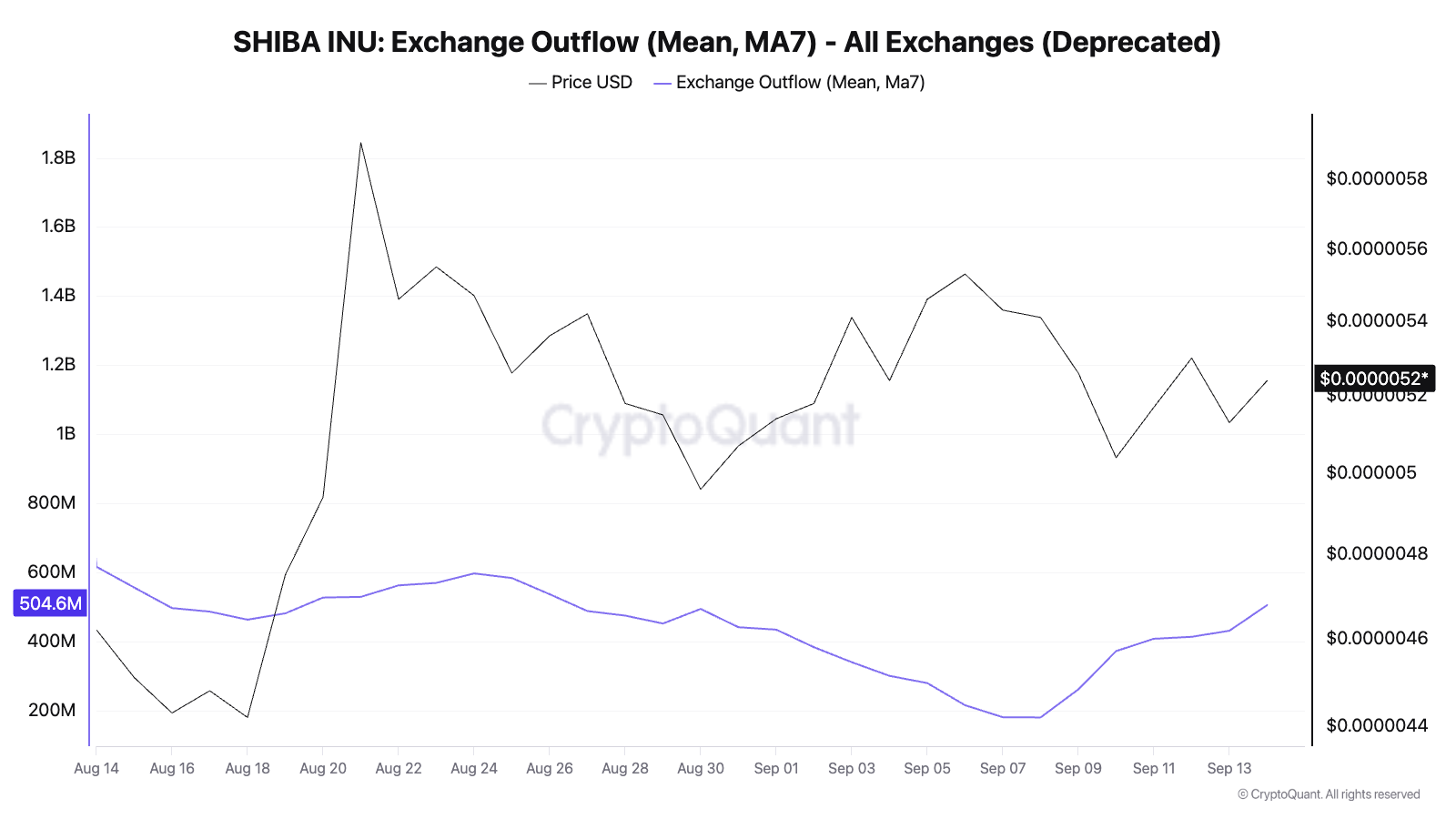
Despite this substantial supply overhang, incoming volumes are not driving prices lower and are being quickly absorbed by buying demand throughout the day. Total exchange reserves stand at 87.16 trillion tokens, while the net daily balance (Exchange Netflow Total) shows a marginal negative reading of -0.24%, according to CryptoQuant.
This fragile equilibrium mirrors capital rotation from Ethereum's $3,000 push, cementing SHIB's status as a high-beta proxy asset where whale spot accumulation battles surging sell-side liquidity across platforms with the most SHIB liquidity.
Why SHIB's price stability is misleading right now
The price chart is responding with consolidation. SHIB is confined to a narrow range around $0.0000052, steadily testing support following a recent correction from a local peak of $0.00000555, CryptoQuant data shows. Meanwhile, the network itself remains highly active: the number of active addresses shows organic growth of 0.92%, while receiving addresses are up 0.93%.

The current on-chain situation maintains a fragile balance: holders are accumulating substantial volumes on exchanges for potential sale, but the spot market is absorbing them without pushing prices lower.
However, if buying demand weakens by even a few percent, the accumulated tokens could quickly push prices below current support levels.
 Dan Burgin
 U.Today Editorial Team
