

Disclaimer: The opinions expressed by our writers are their own and do not represent the views of U.Today. The financial and market information provided on U.Today is intended for informational purposes only. U.Today is not liable for any financial losses incurred while trading cryptocurrencies. Conduct your own research by contacting financial experts before making any investment decisions. We believe that all content is accurate as of the date of publication, but certain offers mentioned may no longer be available.

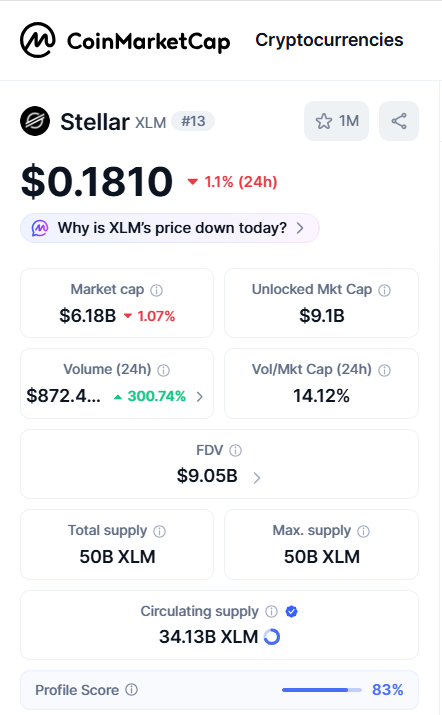
Stellar (XLM) is experiencing a surge in trading activity in the last 24 hours, with volume up by more than 303%. Trading volume for XLM is up 303% in the last 24 hours to $873 million, according to data from CoinMarketCap.
This is noteworthy as most major cryptocurrencies, including Bitcoin and Ethereum, saw a drop in volume over the last 24 hours, falling 20% and 15% respectively. Dogecoin's trading volume fell by nearly 26% in the same timeframe. Stellar's 303% volume surge while its price fell, however, remains an outlier.
The main trigger behind the volume increase is not evident, but some factors might have contributed. Stellar's third major protocol upgrade has taken place so far in 2026, with a corresponding rise in trader activity.

The 303% increase in volume for Stellar indicates a sudden surge in trader activity. Increased liquidity helps market participants carry out larger trades with less price slippage and promotes a healthier trading environment.
Zipper upgrade goes live
The Zipper (Protocol 27) has been deployed on Stellar's mainnet. The protocol upgrade introduces authentication delegation for custom accounts and address-bound smart contract address credentials.

The upgrade introduces authentication delegation for custom accounts (CAP-0071-01), which adds a first-class protocol mechanism for custom (smart contract) accounts to delegate their authentication logic to other addresses. It also introduces two new host functions and a new credential type. These are, however, additive changes, with existing contracts and credential types remaining valid.
A new credential type introduced by the upgrade allows all delegated signers and their (potentially nested) signatures to be bundled into a single authorization entry. This eliminates the need for a separate authorization entry per delegated signer, reducing transaction size and simplifying simulation.
Address-bound Soroban address credentials (CAP-0071-02) included in the upgrade introduce a new credential type that uses the same signature payload introduced in CAP-0071-01.
 Dan Burgin
 U.Today Editorial Team
