

A few years ago, stablecoins were associated almost exclusively with the crypto market: traders used them to settle positions, held them as a haven during volatility, and traded them on exchanges. Today the picture looks different. According to the Visa, adjusted stablecoin transaction volume over the past 12 months exceeded $10 trillion. The word "adjusted" matters here: Visa deliberately excludes bots, duplicate transactions, and other inorganic activity, leaving only volume that resembles real movement of funds between people and businesses.
This means stablecoins increasingly serve a practical rather than speculative function: people are paid for their work in them, send money to family with them, and settle accounts between companies in different countries with them. This is where an increasingly common scenario appears: a person receives payment in USDT or USDC, and that is only the beginning of their interaction with digital assets.
If you regularly receive payment in stablecoins, you are probably already familiar with what happens next: checking an address in one service, storing funds in another, sending a transfer through a third, and swapping through yet another platform, often at an unpredictable fee. Each of these switches costs time and adds risk. What follows explains why this happens and how to avoid it.
Why International Contractors Are Looking for New Ways to Get Paid
For a contractor or remote specialist working with clients abroad, the question is not only how to receive money but how long it takes. A study commissioned by Zero Hash in partnership with Lightspark among 2,500 freelance contractors and independent workers in the United States, Brazil, Argentina, Mexico, and the UAE found that 48% of respondents consider international payment delivery too slow, and 93% are interested in receiving at least part of their income in cryptocurrency or stablecoins. These are results from a specific survey of a specific sample of contractors, not universal global statistics.
The problem is not only speed. According to the World Bank's Remittance Prices Worldwide, the average global cost of an international money transfer is 6.36% of the transfer amount. This figure applies to the remittance market broadly and cannot be treated directly as a fee for paying a contractor. Still, it illustrates the scale of costs that can arise in cross-border settlements: bank fees, currency conversion, and intermediary charges.
This pattern extends well beyond any single country. According to Chainalysis, after adjusting for population size, Ukraine, Moldova, and Georgia rank among the countries with the highest levels of mass digital asset adoption. In markets like these, stablecoins are not an abstract technology topic but part of everyday financial practice: a way to get paid, preserve the value of savings, and make international transfers without unnecessary intermediaries.
Getting Paid Is Only the Beginning
Consider a typical situation: a remote developer completes projects for clients in several countries and gets paid in USDT. Crediting the funds to a wallet solves only the first part of the task: speed and access to payment. From that point, a different, less visible job begins: the ongoing management of what has already landed in the balance.
This is not a one-time action but a recurring process that accompanies every incoming payment. The same steps repeat each time new funds arrive in the wallet.
What Happens to Funds After They Arrive
Practical work with received stablecoins typically consists of several sequential tasks.
First, address verification. Before confirming any transaction, it is worth making sure the recipient's address is correct and not linked to suspicious activity. An AML check helps assess the risk level of a given address, though it does not by itself guarantee full transaction safety. It is a risk assessment tool, not insurance against risk. In products like 001k.bot, this task is handled by tools such as Address Book and Whitelist, which allow verified addresses to be stored securely and reused without re-entering them each time. At the same time, these tools do not replace an AML check, since an address's risk profile can change over time.
Second, storage. Received funds need to be held somewhere between the moment they arrive and the next action.
Third, transfers. Part of the funds is regularly sent onward, to a supplier, partner, team member, or another account of the user's own.
Fourth, swapping. Swapping between digital assets here is a practical operation, not a speculative trading tool: converting USDT to USDC to meet a specific client's requirements, or into another asset for a specific purpose.
Fifth, transaction history. Without a clear transaction log, it is difficult to track how much has moved through a wallet over a given month and reconcile it against actual client payments.
Why Several Separate Services Complicate the Process
In practice, these five tasks are often split across different tools: one service is used to store funds, another for AML address checks, a third for swapping, and reviewing transaction history requires yet another interface, or even a blockchain explorer.
This fragmentation is not necessarily dangerous in itself. The real problem lies elsewhere: every switch between services is an extra action, an extra login, an extra address to verify. And transaction history scattered across several interfaces has to be pieced together manually whenever a full picture of fund movement over a given period is needed.
For someone who receives payment in stablecoins regularly rather than occasionally, this fragmentation turns into a constant drain on time, which is why more users are looking for a single interface instead of a set of disconnected tools. One example of this approach is 001k.bot.
One Interface for Ongoing Asset Management
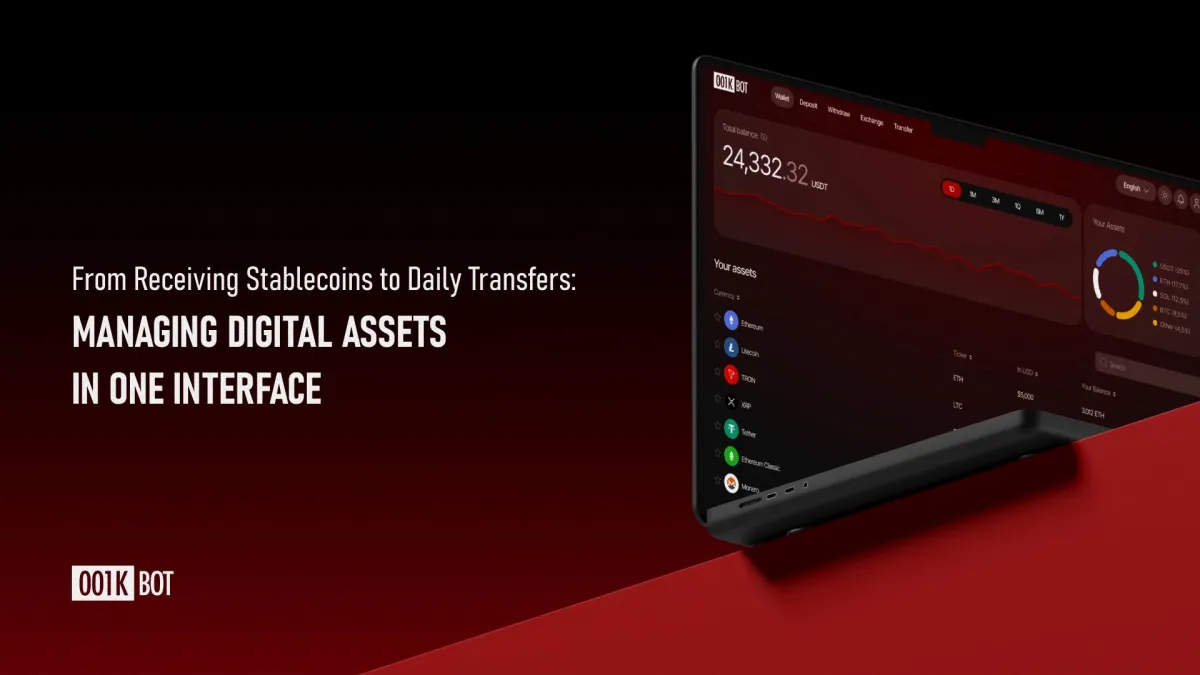
One example of a platform that brings these operations together is 001k.bot. Within 001k.bot, a user can store digital assets, verify addresses before a transfer, execute transfers and swaps, and see the history of all these operations in one place.
001k.bot is a standalone platform for ongoing digital asset management, accessible through a web app and Telegram. The messenger is one way to access the product, not its only entry point. For users who regularly receive payment in stablecoins, including contractors, remote specialists, and small distributed teams, a single interface simplifies control over where funds go next. There is no need to keep track of which service handles which task or reconcile data from multiple sources to see the full picture.
For many users, stablecoins have become a modern tool for international settlements, one that can complement traditional financial solutions depending on the specific situation. At the same time, using digital assets does not exempt users from complying with applicable legal requirements, including tax and AML/CFT obligations.
Conclusion
Getting paid in stablecoins is only the first step. Working with digital income on an ongoing basis requires tools that allow you to verify addresses, store funds, execute transfers, adjust asset structure through swaps, and track the full transaction history without piecing that data together from several different services. As stablecoins move further beyond the crypto market and become part of everyday international settlements, the way this second, less visible stage, managing funds after they arrive, is organized matters more and more.
Disclaimer: This is sponsored content. The information on this page is not endorsed or supported by U.Today, and U.Today is not responsible or liable for any inaccuracies, poor quality, advertising, products or other materials found within the publication. Readers should do their own research before taking any actions related to the company. U.Today is not responsible, directly or indirectly, for any damage or loss caused or alleged to be caused by or in connection with the use of or reliance on any content, goods or services mentioned in the article.
 U.Today Editorial Team
 Dan Burgin
