

Disclaimer: The opinions expressed by our writers are their own and do not represent the views of U.Today. The financial and market information provided on U.Today is intended for informational purposes only. U.Today is not liable for any financial losses incurred while trading cryptocurrencies. Conduct your own research by contacting financial experts before making any investment decisions. We believe that all content is accurate as of the date of publication, but certain offers mentioned may no longer be available.

Shiba Inu has just crossed a level that few long-term holders want to see: more than 82 trillion SHIB now sit on centralized exchanges. While the number itself is eye-catching, its implications are far more concerning than impressive.
Shiba Inu reserves
Exchange reserves at this scale typically reflect sustained distribution rather than accumulation, and for SHIB, this development significantly undermines the chances of a meaningful trend reversal in the near future.
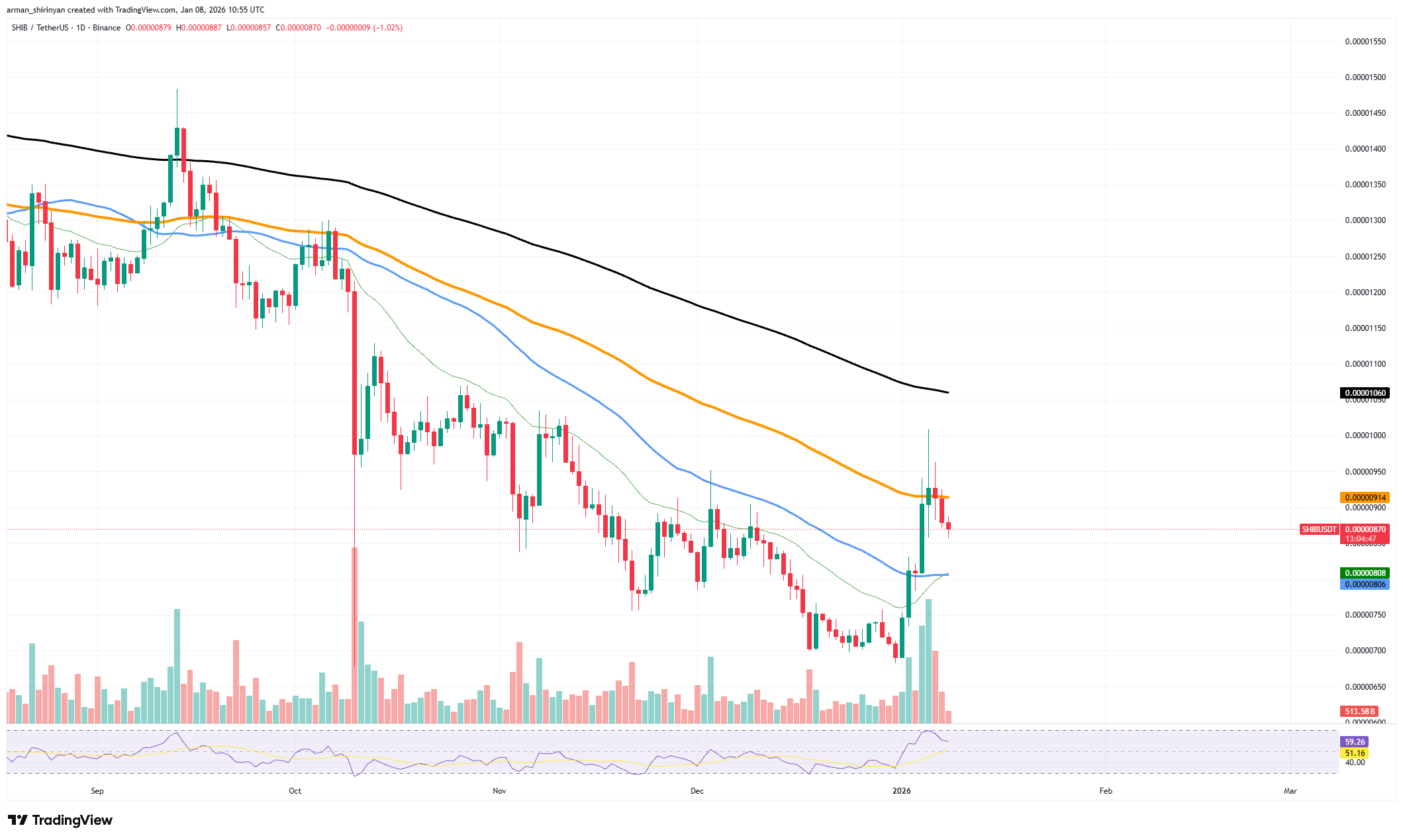
Exchange reserves represent tokens that are readily available for sale. When this metric grows instead of shrinking, it signals that holders are preparing to exit rather than commit to long-term exposure.
In Shiba Inu’s case, the steady climb above the 82 trillion threshold suggests that selling pressure is not only present but structurally embedded in the market. Even short-term rallies struggle to gain traction when such a large supply remains parked on exchanges, waiting for liquidity.

Price action reinforces this concern. SHIB has failed to hold above key moving averages, particularly the 100 EMA, which has acted as a firm ceiling. Each bounce has been met with aggressive selling, indicating that rallies are being used as exit opportunities rather than entries. This behavior is typical of assets stuck in prolonged distribution phases, where upside moves are shallow and short-lived.
On-chain metrics offer little relief. Although active addresses have seen mild increases, they do not offset the broader context of rising exchange reserves. Increased activity without corresponding outflows usually points to speculative churn rather than genuine accumulation. In other words, traders are active, but conviction is missing.
Structurally, exceeding 82 trillion SHIB on exchanges is close to a death sentence for any clean trend change. For normalization to even become plausible, the market would need to see a sustained reduction in exchange balances, paired with price stabilization above key technical levels. Neither condition is currently in place.
 U.Today Editorial Team
 Dan Burgin
