

Disclaimer: The opinions expressed by our writers are their own and do not represent the views of U.Today. The financial and market information provided on U.Today is intended for informational purposes only. U.Today is not liable for any financial losses incurred while trading cryptocurrencies. Conduct your own research by contacting financial experts before making any investment decisions. We believe that all content is accurate as of the date of publication, but certain offers mentioned may no longer be available.

After an aggressive breakout that took Solana from about $76 to a local high of about $110 in less than two weeks, Solana is currently going through its first significant correction. With the asset currently trading close to $99.43, the psychologically significant $100 level is under immediate pressure.
Solana's strength is underestimated
Solana's overall technical structure is still much stronger than it was prior to the breakout, notwithstanding the correction. SOL successfully recovered the 200-day EMA, which is currently at $90.47. It is still significantly higher than the 50-day and 100-day averages, which are at roughly $83.47 and $82.17, respectively.
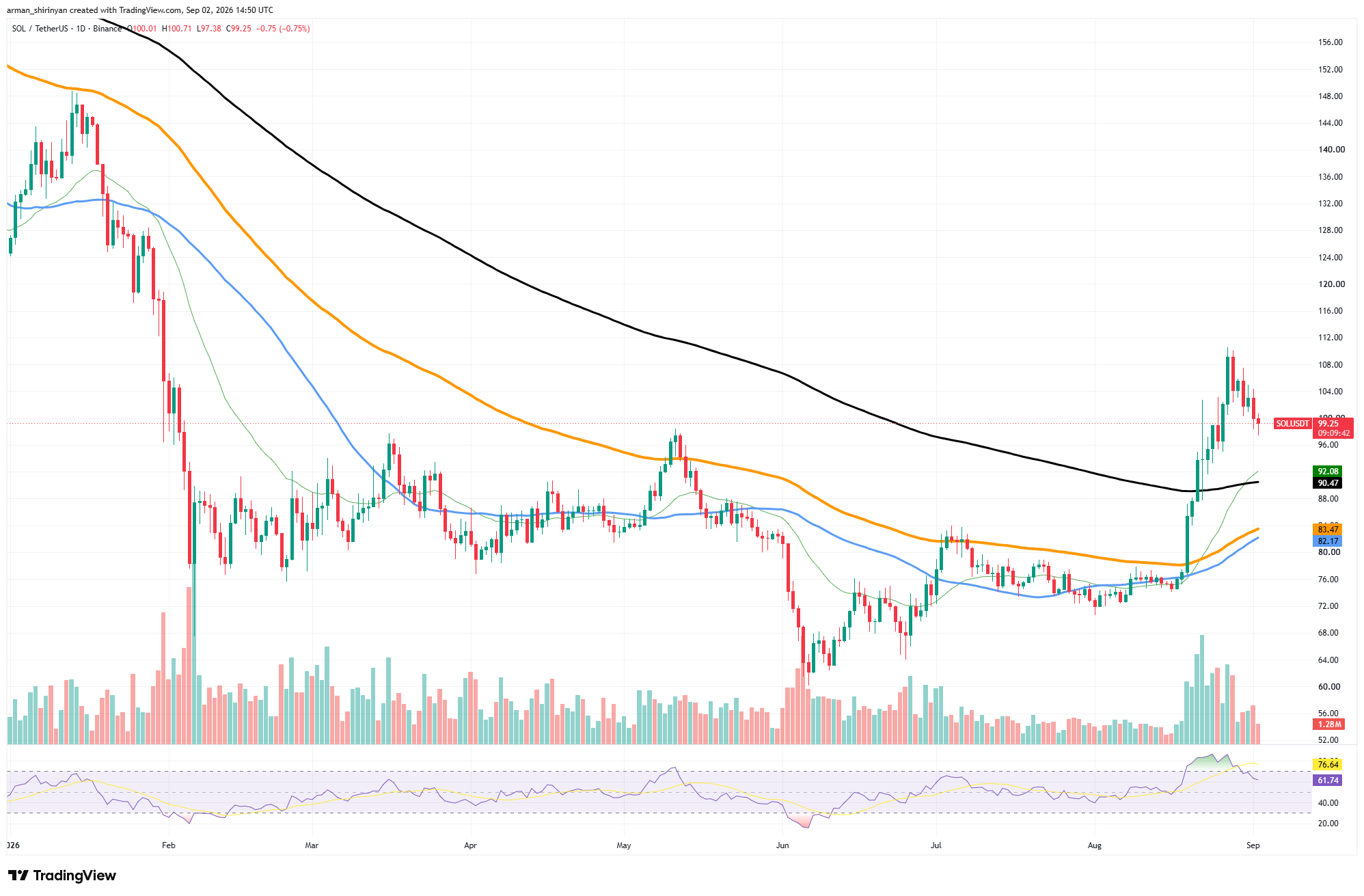
Additionally, the 20-day EMA has accelerated to $92.09. Because of this, the most crucial structural support in the event that $100 fails is the $90–$92 region. Instead of total invalidation, a correction in this area would still be considered a retest of the breakout. But momentum has drastically decreased.

After hitting extremely overbought territory during the rally, the RSI has dropped to roughly 62. If buyers stabilize the price, that normalization is beneficial, but further selling below $98 may pave the way for $95 and ultimately $92. On the plus side, before another attempt at the $110 local high becomes feasible, SOL needs to recover $102–$104.
A breakout above $110 might reopen the route toward $115–$120 and leave comparatively little immediate resistance. SOL is still technically bullish for the time being, but whether the market sees a shallow consolidation or a much deeper retest depends on the struggle for $100.
Hyperliquid is consolidating
Following one of its biggest rallies of the year, Hyperliquid is still consolidating near its recent highs. HYPE is currently trading at $81.57, which is between five and six percent below its most recent peak of $86 to $87. HYPE has not given up much ground, which is a significant distinction from many post-rally corrections.
Rather, the price has settled into a narrow range between $80 and $85, indicating that sellers have not yet been able to generate a significant reversal. Additionally, all of the chart's major moving averages are still significantly below HYPE.
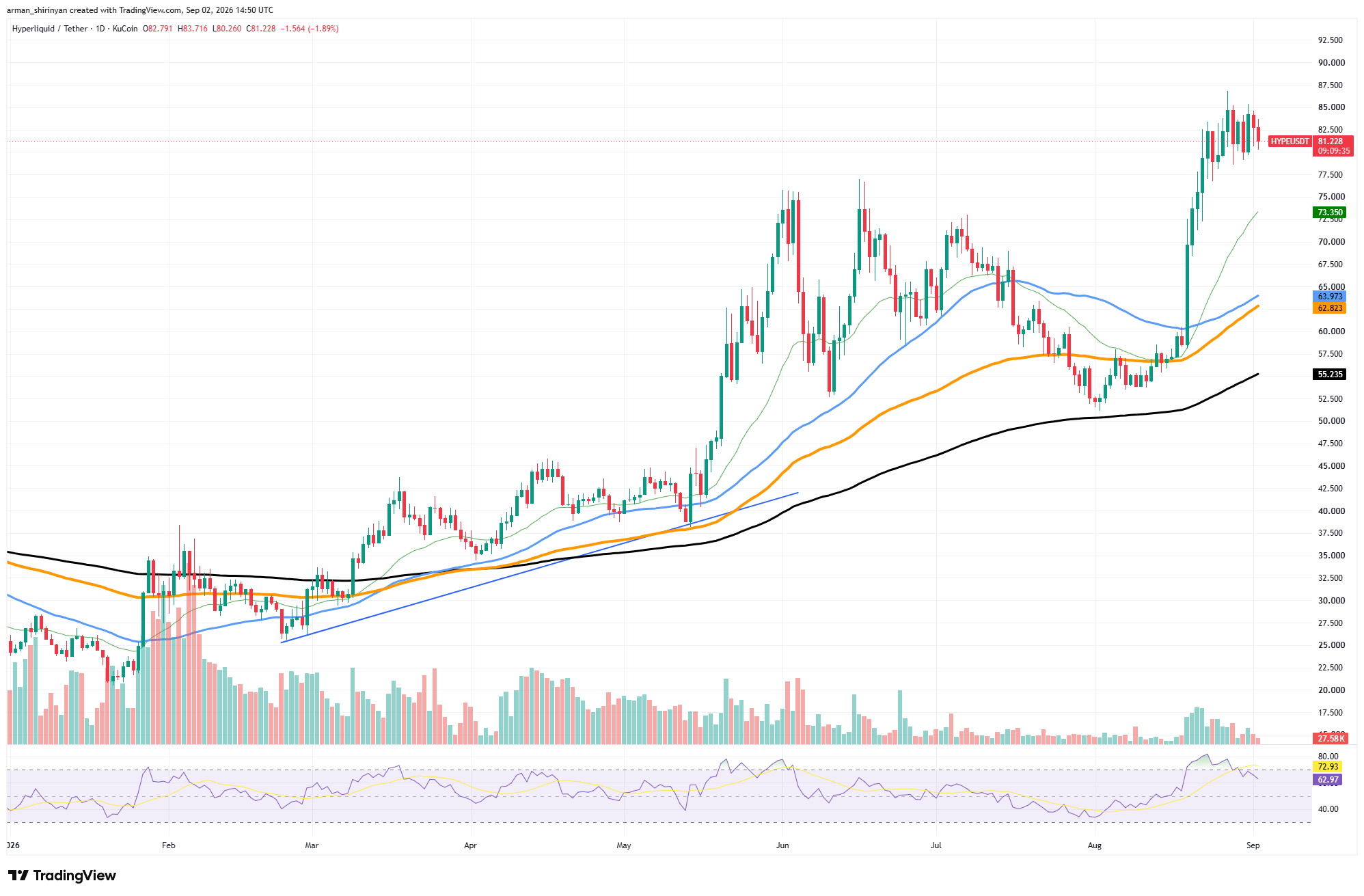
The 50-day and 100-day averages are at roughly $63.98 and $62.83, respectively, while the 20-day EMA has risen to about $73.38. The 200-day EMA is still at $55.24, which is significantly lower. Strong momentum is confirmed by that separation, but if the current consolidation breaks, there is room for declines.

The immediate support is $80. If that level is lost, HYPE may move toward $77–$78, then the quickly increasing 20-day EMA at $73. On the other hand, holding onto $80 preserves the current bullish structure.
Without generating a bearish momentum reading, the RSI has cooled to about 64 from overbought territory, reducing some of the excess created by the breakout. The $86–$87 peak would come back into focus with a recovery above $84–$85. After overcoming that obstacle, $90 would be the next psychological target; if momentum increases once more, $100 could still be reached.
Zcash is stronger than others
Despite starting to cool off following its most recent vertical expansion, Zcash is still in a very strong technical position. After a rally that raised the asset as high as roughly $880–$890, ZEC is currently trading at $811.
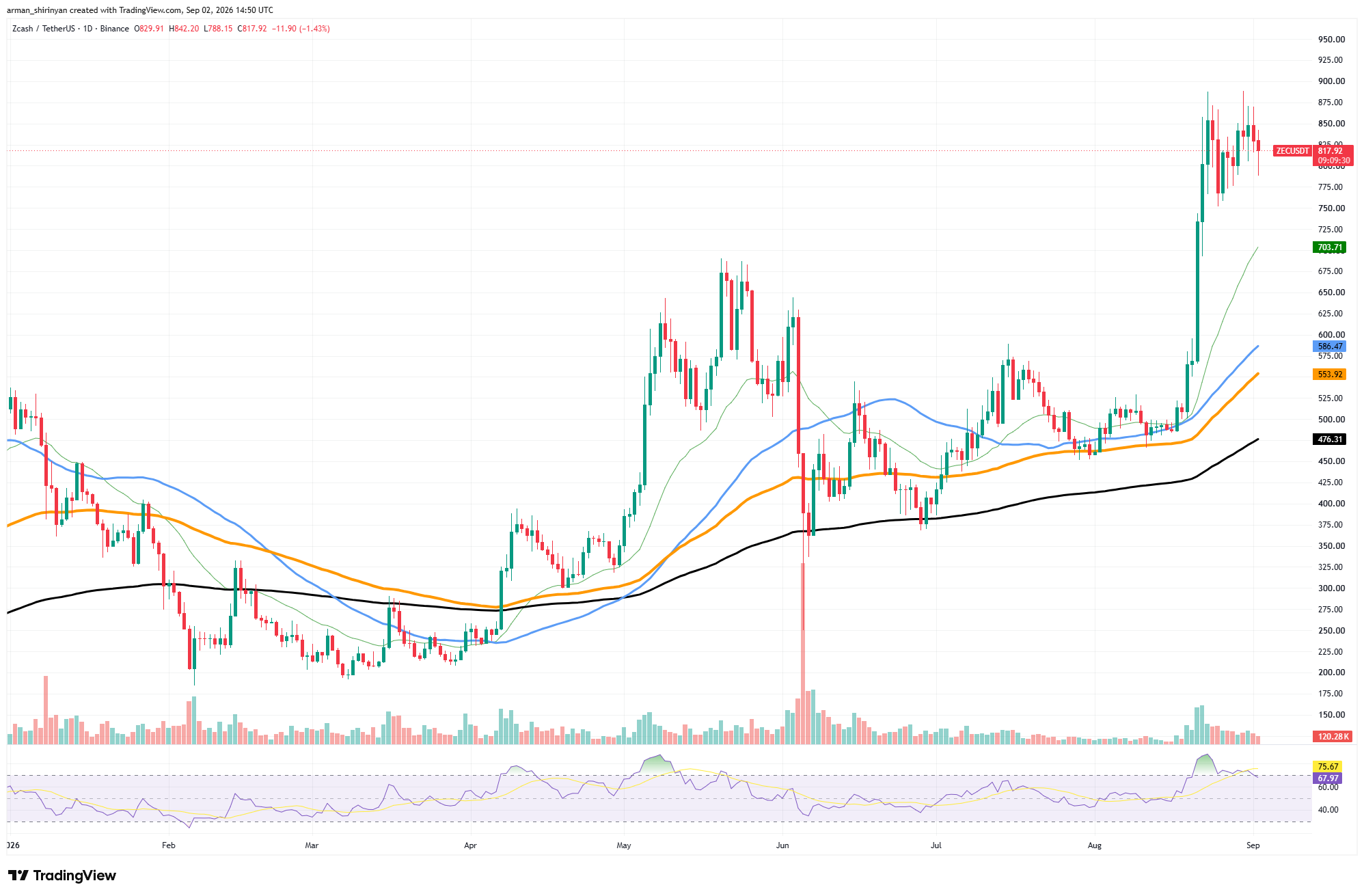
The breakout's magnitude is noteworthy. ZEC consolidated between $450 and $520 for the majority of August before quickly clearing $600 and then accelerating through $700 and $800. The breakout involved significantly more participation than the previous consolidation, as evidenced by the move's significant increase in volume.
On the other hand, the short-term outlook now indicates consolidation. ZEC has produced multiple large upper wicks as it has repeatedly failed to establish itself above the $850–$880 resistance zone. There are still buyers in the $780–$800 range, but neither side has taken firm control.

Additionally, momentum is normalizing. In contrast to the highly overbought readings during the initial breakout, the RSI has dropped toward 66.7. Without harming the larger bullish structure, this cooling can assist ZEC in building a stronger base. The first significant support is located between $775 and $780.
Below it, $750 becomes significant, and the quickly rising 20-day EMA around $703 comes next. Even if there was a significant correction toward $700, ZEC would still be well above its longer-term moving averages.
Bulls must eventually break the recent $880–$890 peak and recover $850 to continue. By doing this, the psychological $900 level would be activated right away, followed by $1,000. ZEC is still bullish for the time being, but consolidation around $800 is becoming more crucial following such a sharp rise.
Filecoin shines unexpectedly
After months of being in a persistent downtrend, Filecoin is attempting to establish its first convincing short-term reversal. After a strong recovery from roughly $0.65, FIL is currently trading close to $0.77.
More significantly, the most recent move has pushed the price back above the 50-day and 20-day moving averages, with a current position between $0.716 and $0.717. The 100-day EMA in the vicinity of $0.774 is the immediate challenge.
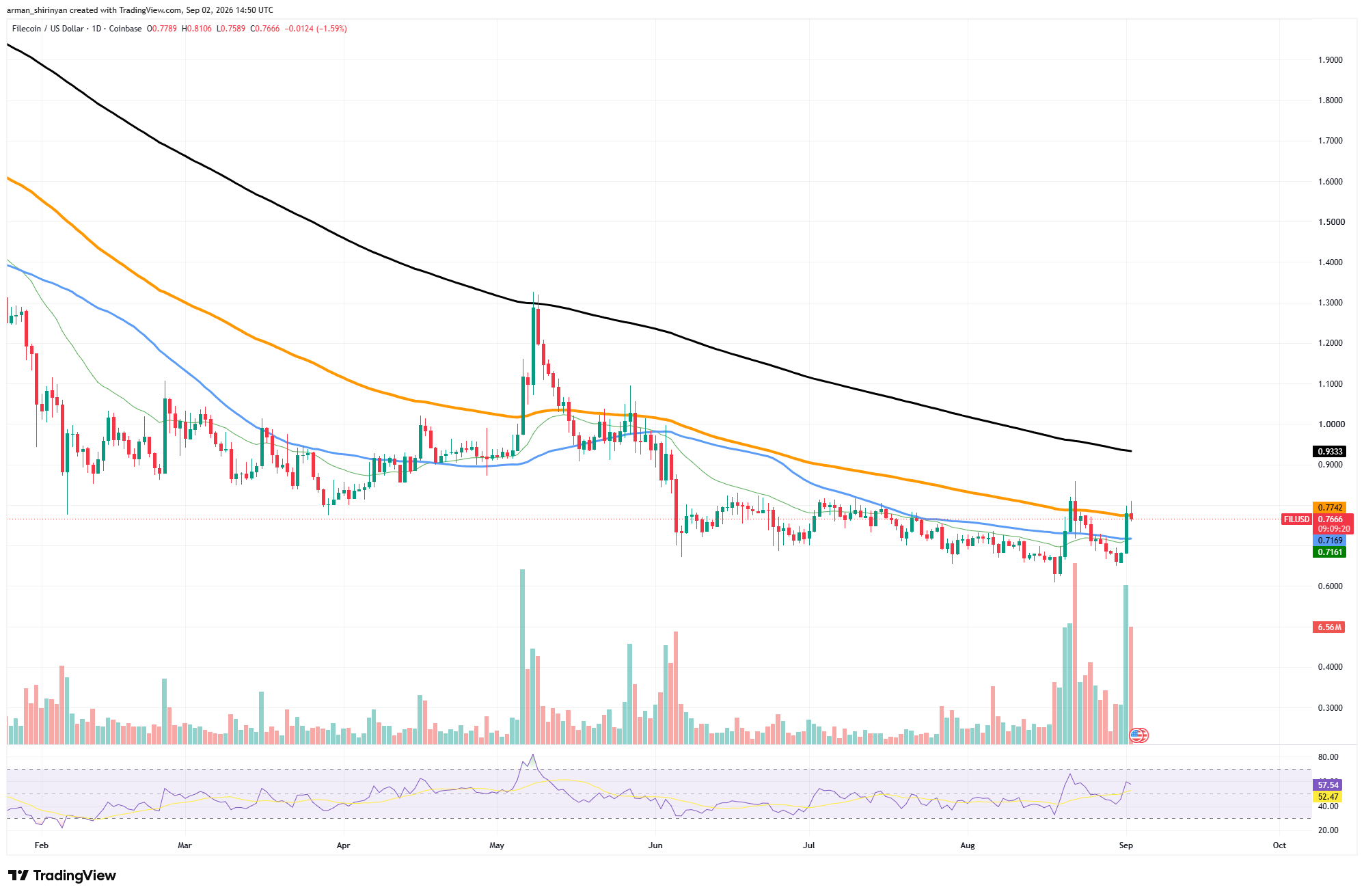
The $0.77–$0.80 region is the crucial technical barrier since FIL is currently actively testing this level. Buyers need an actual daily close above this area rather than another brief spike, because previous attempts to move above $0.80 during August were swiftly rejected. The recovery thesis has some backing from volume.

Recent upside sessions have seen a sharp increase in trading activity, indicating that the move is drawing participation rather than growing only from thin liquidity. Concurrently, the RSI has increased to about 58, providing FIL with positive momentum without putting it in overbought territory.
The path toward $0.85 could be opened by a confirmed breakout above $0.80, with the next significant structural obstacle being the much larger 200-day EMA around $0.93. If FIL fails at $0.77–$0.80, it would be open to another move toward $0.72.
The recovery would be significantly weakened if the moving-average cluster there were to give way, and $0.65–$0.67 would once again come into focus. Unlike ZEC, FIL has not yet confirmed a wider trend reversal, but it is exhibiting a respectable improvement.
 Dan Burgin
 U.Today Editorial Team
