
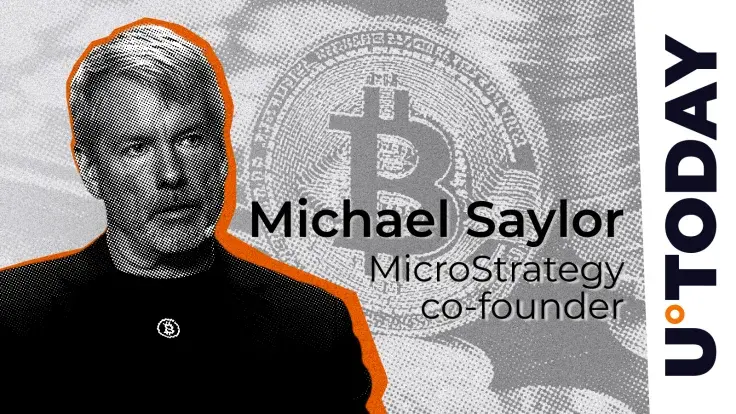

Michael Saylor countered venture capitalist Chamath Palihapitiya, warning that the threat of quantum computing is not just a "Bitcoin problem." In fact, according to Saylor, it poses an existential risk to the entire modern world.
Saylor argued that if quantum computers ever become powerful enough to crack the encryption securing Bitcoin, they will simultaneously dismantle every major pillar of the global economy, including banks, cloud providers, and the internet itself.
The conversation began when Palihapitiya shared a provocative thesis titled "The Collapse of Terminal Value." He argued that AI is lowering the cost of disruption so rapidly that no company can credibly project cash flows beyond a five-year window.
In this scenario, corporate "moats" disappear, and equity markets could face a catastrophic 75% drawdown.
Saylor, never one to miss a Bitcoin bull case, responded that this "disruption risk" is precisely why capital will rotate into Bitcoin. He described BTC as "Digital Capital" that is scarce, neutral, and uniquely impervious to the AI-driven obsolescence threatening traditional companies.

Palihapitiya pushed back, noting that for Bitcoin to be the ultimate safe haven, it would first need to survive the "Quantum Threat." "Your AI thesis assumes the digital world is quantum-resistant. If quantum breaks cryptography, it breaks AI, cloud infrastructure, banks, and the internet—not just Bitcoin. The entire stack upgrades together," Saylor.
"The entire stack upgrades together"
Saylor has the idea of a "Bitcoin-only" quantum collapse as a misunderstanding of how digital security works.
The world will see a coordinated shift to Post-Quantum Cryptography (PQC). National defense systems, banking protocols, and Google’s servers would all have to upgrade alongside the Bitcoin network.
He previously described the crypto sector as the "most sophisticated cybersecurity community."
Saylor treats the quantum transition as a "market-clearing event." Holders with private keys will re-encrypt their assets to new standards, while "lost" or "dead" coins on old encryption standards will simply be frozen, potentially leading to an even tighter Bitcoin supply.
 Dan Burgin
 Vladislav Sopov
