
Disclaimer: The opinions expressed by our writers are their own and do not represent the views of U.Today. The financial and market information provided on U.Today is intended for informational purposes only. U.Today is not liable for any financial losses incurred while trading cryptocurrencies. Conduct your own research by contacting financial experts before making any investment decisions. We believe that all content is accurate as of the date of publication, but certain offers mentioned may no longer be available.

Early in 2026, Shiba Inu is in a position that appears to be quiet on the outside but is actually quite busy. SHIB is currently trading just below a thin resistance zone that has repeatedly capped price action since late Q4, 2025, following months of consistent decline and compression.
Shiba Inu gets pressured
Compared to earlier unsuccessful rebounds, the current setup is far more beneficial. Selling pressure has significantly declined in the $0.0000075-$0.0000080 range, where the price is currently hovering. Despite the overall downward trend, volatility has declined, volume has stabilized, and downward follow-through has been constrained. Instead of being in complete control, this type of behavior usually manifests when sellers are worn out.
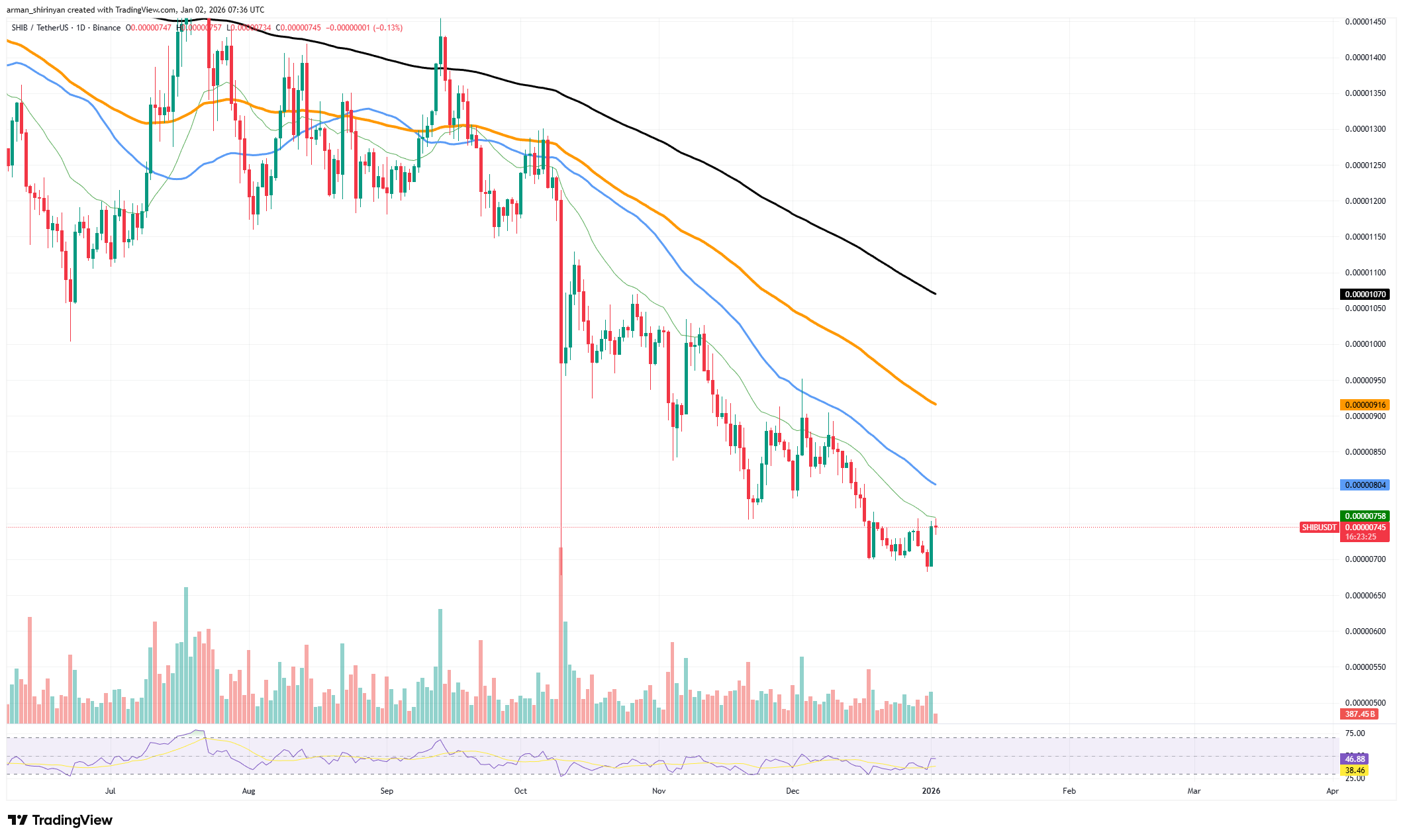
The distribution on the chart no longer appears to be aggressive but rather balanced. Technically speaking, the 26 EMA and 50 EMA continue to function as overhead resistance, and SHIB is still below its major moving averages. That is the reality of the bear market. Crucially, though, there is now much less of a gap between the price and those averages.
Volume is not there yet
There is not much historical volume to absorb buying pressure should momentum emerge, because the resistance immediately above current levels is thin. Because of this, a breakout in this situation only needs consistency rather than a powerful catalyst. Additionally, since September 2025, this is the cleanest compression structure SHIB has created. Back then, a sharp directional move was preceded by a similar tightening range.

Context now makes a difference: expectations are low, sentiment is subdued, and prices are lower. Because no one is positioned for them, that is typically when breakouts hurt the most. A clear push above short-term resistance and a recovery of the 26 EMA would constitute a breakout scenario. In that case, SHIB could test higher resistance zones fast and with minimal friction.
However, failure in this case does not necessarily mean collapse. Near present lows, strong demand has already developed, and buyers have consistently defended this area. A decision point is emerging in early 2026.
SHIB has not confirmed a reversal, but it is no longer trending sharply downward. How the price responds to this small resistance band is what matters right now. The next move can happen quickly when there is little liquidity and sellers are less active.
Once it begins, it probably will not wait for late buyers. It is not quite hype time yet. This is positioning territory. Furthermore, SHIB has not appeared to be on the verge of a significant breakout structurally in months.
 Dan Burgin
 U.Today Editorial Team
