

Disclaimer: The opinions expressed by our writers are their own and do not represent the views of U.Today. The financial and market information provided on U.Today is intended for informational purposes only. U.Today is not liable for any financial losses incurred while trading cryptocurrencies. Conduct your own research by contacting financial experts before making any investment decisions. We believe that all content is accurate as of the date of publication, but certain offers mentioned may no longer be available.

Technically speaking, XRP is about to enter an intriguing phase that could pave the way to a much stronger move than many market players currently anticipate. The asset now looks structurally reset on the chart following months of persistent downside pressure, a state that frequently precedes prolonged retracement phases rather than fleeting relief bounces. Technically speaking, XRP has finished a comprehensive corrective structure.
XRP locked in
The price flushed excess leverage, moved through a protracted declining channel and stabilized close to historically reactive zones. Resets of this kind are crucial. Overheated conditions rarely directly lead to parabolic advances in markets. Rather, they need to be compressed, have less volatility and gradually restore demand.
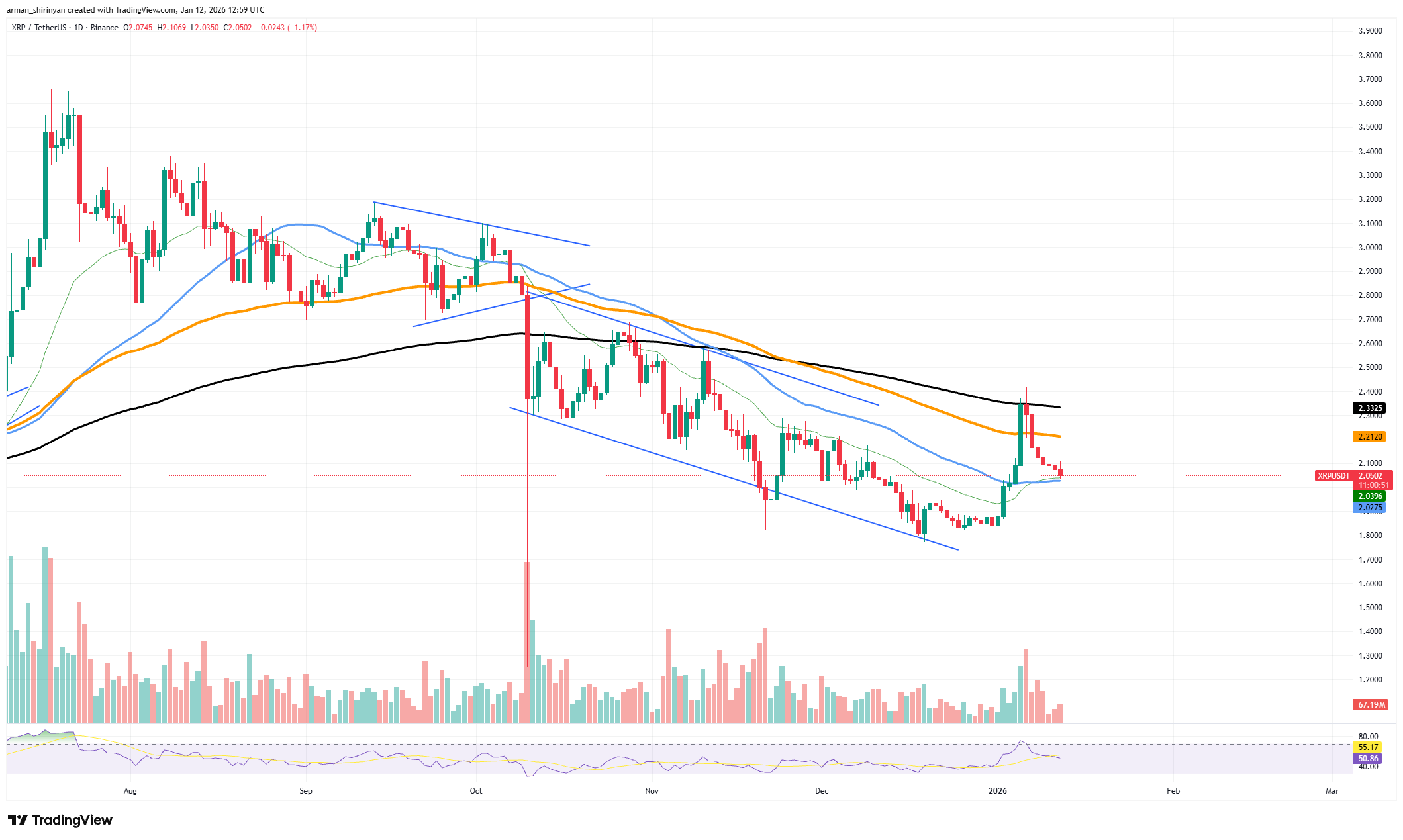
Early indicators of that process are being seen in XRP. Momentum indicators lend credence to this perspective. RSI is currently maintaining neutral-to-bullish levels without displaying fatigue after recovering from oversold territory. This implies that buyers are intervening with greater restraint than in earlier rallies, which were frequently fueled by speculative spikes rather than steady accumulation.
Concurrently there seems to be less selling pressure, with fewer aggressive breakdown attempts and less volatility on pullbacks. Positioning is another important factor. When sentiment changes, XRP frequently experiences asymmetric upside because it has underperformed in comparison to more general market leaders for a considerable amount of time.
Capital rotation can be abrupt when assets lag for long stretches of time before stabilizing. In those situations, sidelined players rush to reposition, which causes upside moves to accelerate more quickly than anticipated. A parabolic rally is not assured by this. Long-term moving averages and previous distribution zones continue to provide XRP with overhead resistance.
Clean acceptance above those thresholds would be necessary for any significant growth, ideally backed by an increase in volume and follow-through over several sessions. The price might keep consolidating in the absence of that confirmation before making a bigger move.
But for the first time in months, the overall setup is in favor of the bulls. Leverage appears to have decreased, the market appears to be calmer and XRP's structure no longer shows signs of panic or forced selling. The move that results could go well beyond a straightforward recovery bounce if momentum keeps increasing and resistance levels start to break.
Bitcoin's chance
The current structure of Bitcoin indicates that the conditions for a significant bounce are solidly in place, and the cryptocurrency is getting close to a technically critical moment. Price action has changed from aggressive downside momentum to controlled consolidation following a protracted corrective phase; this shift typically precedes recovery moves rather than additional breakdowns.
Structure is one of the key components that supports a bounce scenario. Despite numerous tests of demand, Bitcoin has respected a rising local support line after its steep sell-off, forming higher lows. This suggests that buyers are becoming more inclined to intervene sooner, while sellers are losing control.

This kind of behavior is common when the downside pressure has mostly subsided. Momentum metrics support this perspective. After recovering from oversold levels, the RSI has stabilized in neutral territory, indicating that bearish momentum has subsided without inciting undue optimism. This balance is beneficial because it implies that the market is resetting rather than overheating, which leaves space for further price growth if it starts. Another important component of the current setup is moving averages.
Short-term averages are flattening and beginning to converge with the price, even though Bitcoin is still below longer-term resistance zones. This compression frequently serves as a launching pad for outsized price reactions caused by comparatively slight increases in demand. Crucially, rather than being rejected, recent declines toward these averages have generated buying interest.
The bounce thesis is further supported by volume behavior. Selling volume has decreased in comparison to previous breakdowns, suggesting that widespread distribution might already be finished. Declining volume during consolidation frequently indicates sellers' lack of conviction rather than buyers' weakness.
However, a bounce does not guarantee an instant return to peak levels. For a wider trend reversal to be confirmed, Bitcoin still needs to recover important resistance levels. The market's current situation, however, favors a rebound scenario over fresh acceleration to the downside.
Dogecoin hit
After losing the 50-day exponential moving average, one of Dogecoin's most crucial support structures, the cryptocurrency is entering a notably weaker technical phase. For months, this level has served as a midterm trend guide. In the short-to-medium term, at least its loss significantly tips the scales in favor of sellers.
Price action reveals a blatant rejection close to diminishing resistance followed by a consistent decline that drove DOGE below the 50 EMA without significant buyer resistance. This is not a small error in technique. During corrective phases, the 50 EMA frequently acts as a line in the sand, and if it fails, downside extensions are far more likely.

In the past, DOGE has tended to accelerate rather than grind sideways after losing this level. Additionally, momentum indicators show a bearish trend. The RSI is moving lower without exhibiting a significant bullish divergence after rolling over from neutral territory. This implies that selling pressure is part of a larger trend continuation rather than the outcome of a single impulsive move.
The absence of aggressive dip-buying supports the notion that market players are more cautious than eager to buy at the current price. Another level of concern is added by volume behavior. Although there have been sporadic spikes, overall trading activity has remained muted, allowing sellers to drive down prices without encountering much resistance.
Because there is not much structural demand to absorb sell orders, this type of low-volume decline frequently results in deeper moves. From a structural standpoint, DOGE is now susceptible to going back to lower support zones that were created during earlier consolidation ranges. The likelihood of a continuation toward those lower levels rises dramatically if the price is unable to swiftly recover the 50 EMA.
 U.Today Editorial Team
 Dan Burgin
