

Disclaimer: The opinions expressed by our writers are their own and do not represent the views of U.Today. The financial and market information provided on U.Today is intended for informational purposes only. U.Today is not liable for any financial losses incurred while trading cryptocurrencies. Conduct your own research by contacting financial experts before making any investment decisions. We believe that all content is accurate as of the date of publication, but certain offers mentioned may no longer be available.

Despite the stabilization at the beginning of January, most of the crypto market dived into the void with exploding selling pressure that essentially ended the possibility of a proper bullish recovery for assets like XRP, SHIB and Bitcoin.
XRP blows up
After experiencing a swift and prolonged sell-off that erased months worth of gains, XRP is currently trading perilously close to the $1 zone as selling pressure continues to dominate market behavior. The asset's price structure has drastically declined, giving bulls very little opportunity to regain control.
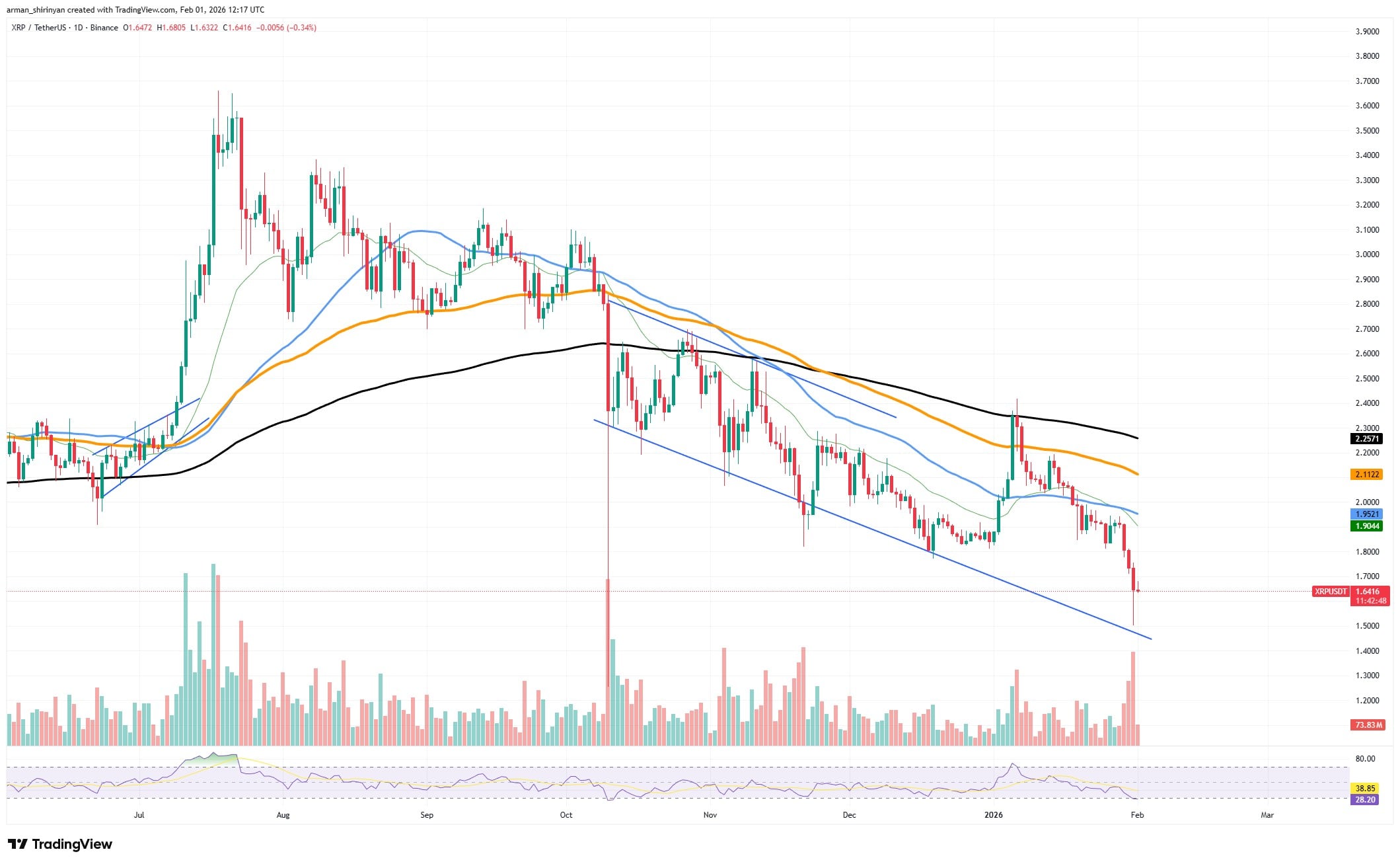
Since surpassing the $3 threshold several months ago, XRP has been stuck in a steady decline on the daily graph. A classic bearish market structure has been formed as each attempt at recovery has resulted in lower highs and subsequent sell-offs have carved out lower lows. The most recent breakdown forced XRP through a number of support zones, including trendline support that had been in place during the consolidation in December.
Because the price has now dropped significantly below important moving averages that previously functioned as dynamic support, the recent move is especially troubling. Every bounce has been swiftly sold into as these levels have turned into resistance.
The most recent decline was accompanied by volume spikes, which further suggest panic selling rather than methodical profit-taking. XRP is entering what traders frequently refer to as deep waters, where sentiment turns defensive and buyers are reluctant to intervene forcefully, at current levels close to $1.60.
The likelihood of further weakness is still high, because momentum indicators are trending downward and there are no obvious support zones until close to the $1 psychological level. Bulls are particularly concerned about the rapidly declining recovery potential.
There is no indication that the market structure will stabilize, and pressure is being increased by the general weakness of the cryptocurrency market. Recovery scenarios become less likely in the near future unless XRP is able to swiftly recover lost support levels and break back above declining resistance zones.
Shiba Inu breaking down
One of Shiba Inu's most challenging market periods of 2026 has begun, as price action has shown a dramatic breakdown that destroyed weeks of consolidation in a matter of sessions. The market's current behavior indicates that bullish momentum has mostly vanished, and the meme token is currently under tremendous selling pressure.
Following months of steady decline, SHIB had been moving inside a tightening structure on the daily chart, raising short-term expectations of stabilization, but now that the consolidation has resolved to the downside, there has been a clear breakdown below important support levels. Heavy selling volume followed the move, indicating that traders are closing positions rather than getting ready for a comeback.

Technically speaking, SHIB is still in a decline. Major moving averages, which are all sloping downward and serving as resistance, are still far below the price. A pattern of lower highs and lower lows, a classic bearish structure, has formed as every attempt at recovery in recent weeks has been thwarted.
Because it followed what many traders believed to be a possible bottom formation, the most recent decline is especially alarming, as SHIB erased expectations for a long-term recovery and sped downward instead of stabilizing after losing support.
The likelihood of a prolonged decline is still high unless the token is able to swiftly regain lost support, which at this point seems improbable. Consequently, the likelihood of a significant bullish recovery is quickly diminishing, and SHIB might have more difficulties in the upcoming weeks unless there is a significant change in the overall state of the market or a resurgence of buying interest.
Bitcoin is not safe anymore
After losing one of the chart's most significant psychological and structural support levels, Bitcoin has formally moved into a riskier technical position. The decline below the $80,000 mark eliminates what many traders believed to be the final solid safety net for the current market cycle, putting Bitcoin firmly back in a bearish position.
After a protracted decline from its peak, Bitcoin has been consolidating over the $80,000-$82,000 range in recent weeks. Buyers frequently intervened in that defensive zone to stop deeper sell-offs and give investors hope that the market was laying the groundwork for a recovery, but according to the most recent analysis, support has now been decisively lost.

As Bitcoin broke through rising support created during the prior rebound, the daily chart shows increasing selling pressure. Following the failure of that structure, the price swiftly dropped and volume increased, indicating that sellers were in charge. Additionally, momentum indicators have rolled over, indicating a decline in buying interest.
Technically speaking, Bitcoin is currently trading below all significant moving averages, including short- and medium-term trend lines that had previously served as barriers to attempts at recovery. The larger downtrend structure has been strengthened by the rejection of every bounce over the previous month in the vicinity of these averages.
The market's attitude is changing from cautious optimism to defensive positioning now that the price is under $80,000. This level's loss is psychologically significant as well, $80,000 was viewed by many traders and organizations as a boundary between correction and bear-phase risk. If buyers are unable to swiftly regain the level, breaking below it increases the likelihood of additional downward tests, possibly toward deeper support zones.
 Dan Burgin
 U.Today Editorial Team
 Vladislav Sopov
