
Disclaimer: The opinions expressed by our writers are their own and do not represent the views of U.Today. The financial and market information provided on U.Today is intended for informational purposes only. U.Today is not liable for any financial losses incurred while trading cryptocurrencies. Conduct your own research by contacting financial experts before making any investment decisions. We believe that all content is accurate as of the date of publication, but certain offers mentioned may no longer be available.

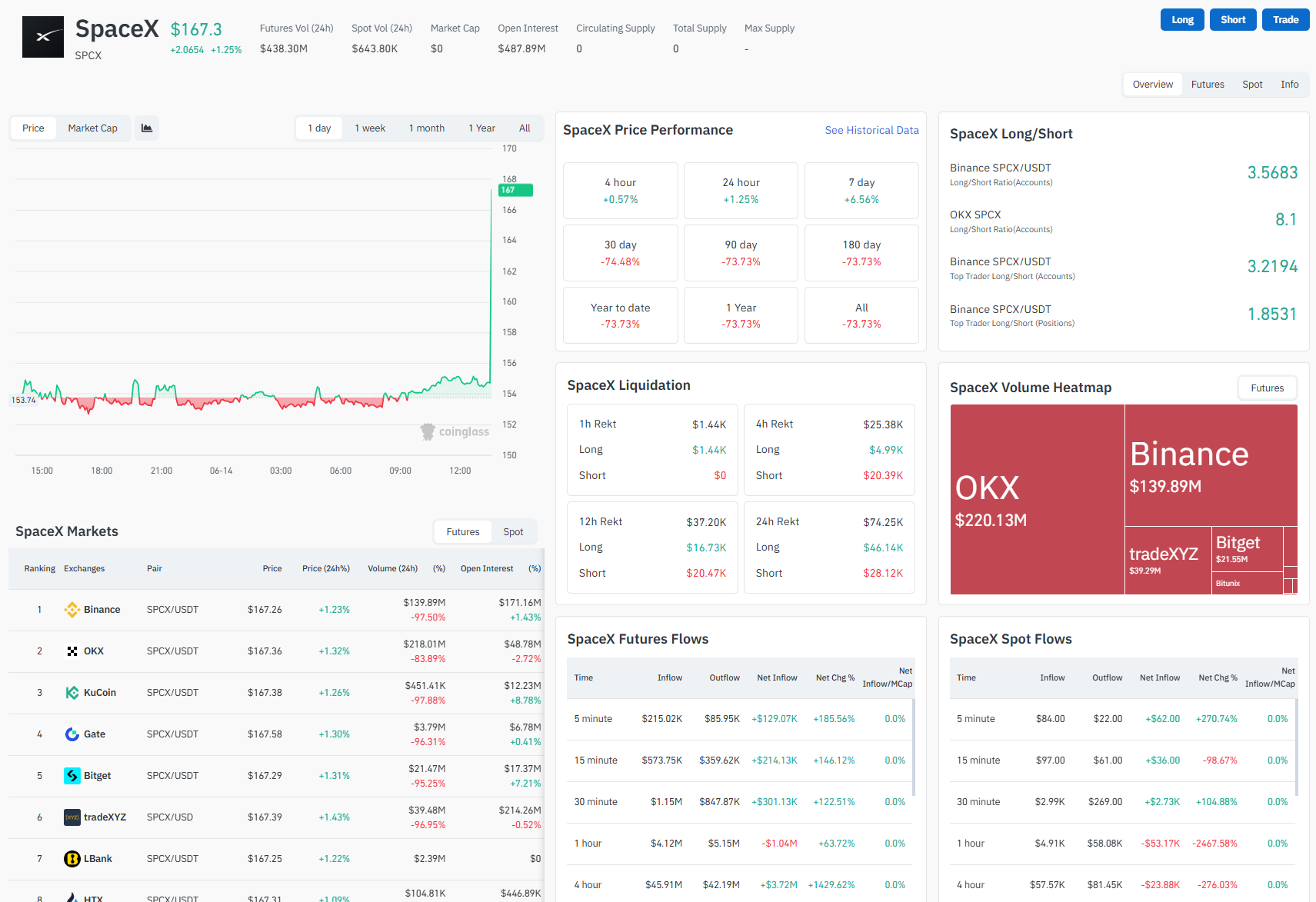
One of the largest tokenized real-world assets (RWAs) in the cryptocurrency sector has experienced a dramatic collapse in trading activity. The on-chain SpaceX pre-IPO token, trading under the ticker SPCX, has seen its daily trading volume fall by more than 95%, according to recent market data.
While the asset still maintains a market capitalization of roughly $440 million, the sharp decline in liquidity raises questions about investor demand and the future of tokenized private-company exposure.
Using RWA exposure
Unlike traditional stocks, SPCX does not represent publicly traded SpaceX shares listed on an exchange. Instead, it is a blockchain-based asset designed to provide investors with synthetic or indirect exposure to the valuation of Elon Musk's aerospace giant before any potential initial public offering.
The exact structure varies depending on the issuer, but these products typically rely on custodial ownership of private shares, special-purpose vehicles (SPVs), or derivative arrangements that track the value of the underlying equity.
The appeal is obvious. SpaceX remains one of the most sought-after private companies in the world, with recent private-market transactions valuing the business at well over $300 billion. For many retail investors, gaining direct access to private funding rounds is virtually impossible. Tokenized products attempt to bridge that gap by bringing private-market exposure onto blockchain networks, where tokens can trade around the clock.
Key differences
Holding a SpaceX pre-IPO token generally does not grant the same rights as owning actual SpaceX stock. Token holders usually do not receive voting rights, direct shareholder protections, or guaranteed claims on company assets. Instead, they are exposed to the structure and legal framework established by the issuer.
The recent 95% drop in trading volume does not necessarily indicate collapsing confidence in SpaceX itself. More often, such declines reflect reduced speculative activity, lower liquidity, or investors choosing to hold rather than actively trade. Nevertheless, thin trading conditions can increase volatility and make entering or exiting positions more difficult.
Looking ahead, the biggest catalyst remains the possibility of a future SpaceX IPO. If the company eventually decides to go public, investor interest in tokenized exposure could surge. Until then, SPCX should be viewed primarily as a high-risk, high-speculation instrument tied to private-market valuations rather than a direct ownership stake in one of the world's most valuable aerospace companies.
 U.Today Editorial Team
 Dan Burgin
