


The State of the Crypto Industry 2026 report by Sumsub argues that the cryptocurrency sector has entered a new phase of development defined by regulation, fraud prevention and operational efficiency rather than rapid, uncontrolled growth.
Sumsub is a leading full-cycle verification platform that enables scalable compliance. From identity and business verification to ongoing monitoring, our platform helps crypto firms adapt to evolving risks, market demands, and regulatory requirements.
Powered by adaptive intelligence and AI-driven risk analysis, Sumsub enables businesses to verify users globally while staying compliant at scale. Sumsub achieves the highest conversion rates in the industry – 91.64% in the US, 95.86% in the UK, and 90.98% in Brazil – while verifying users in under 20 seconds on average.
Drawing on internal verification data, analysis of more than 23,000 daily fraud attempts and a survey of over 300 crypto companies, the report concludes that the industry's biggest challenge is no longer attracting users by any means necessary but scaling securely and compliantly while maintaining a smooth user experience.
From growth-at-all-costs to regulated maturity
The report identifies 2025 as a turning point for the crypto industry. Regulatory frameworks such as MiCA in Europe, the Financial Action Task Force's (FATF) Travel Rule implementation across major jurisdictions, expanding stablecoin oversight and new tax-reporting obligations have transformed compliance from a future consideration into a core operational requirement.
Companies increasingly recognize that sustainable growth depends on balancing regulation, fraud prevention and user onboarding efficiency.
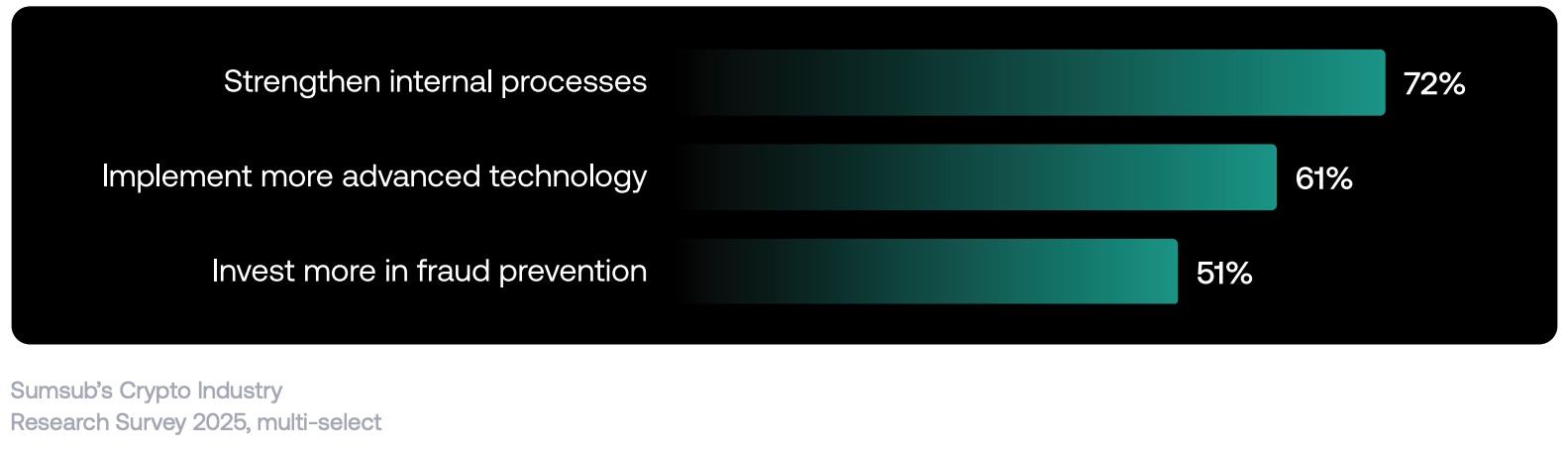
Survey results reveal a major shift in industry priorities. If allowed to start over, 72% of respondents said they would strengthen internal processes, 61% would invest in better technology and 51% would dedicate more resources to fraud prevention.
This suggests that many crypto businesses now view the shortcuts taken during the industry's early expansion phase as costly mistakes that created long-term compliance and risk-management problems.
Verification becomes competitive advantage
Identity verification has evolved from a compliance requirement into a strategic business function. Verification accuracy is now considered more important than speed, with 74% of surveyed companies identifying accuracy as the most critical onboarding factor, compared with only 39% prioritizing speed.
This reflects growing awareness that false negatives, weak customer due diligence and inadequate identity controls can expose companies to regulatory penalties and reputational damage.
At the same time, user experience remains a major concern. Nearly half of surveyed firms listed improving user experience as their top verification priority for 2026. Companies increasingly view verification as part of the product experience rather than a separate compliance process.
As a result, firms are investing in innovations such as non-document verification and reusable KYC systems that reduce friction while maintaining regulatory standards.
Verification speeds also improved globally. Average verification times fell from 22 seconds in 2024 to 19 seconds in 2025, a 14% improvement. However, the report stresses that these gains came primarily from better workflow orchestration and risk-based routing rather than simply faster technology.
Low-risk users are increasingly processed through streamlined automated flows, while higher-risk cases receive additional scrutiny.
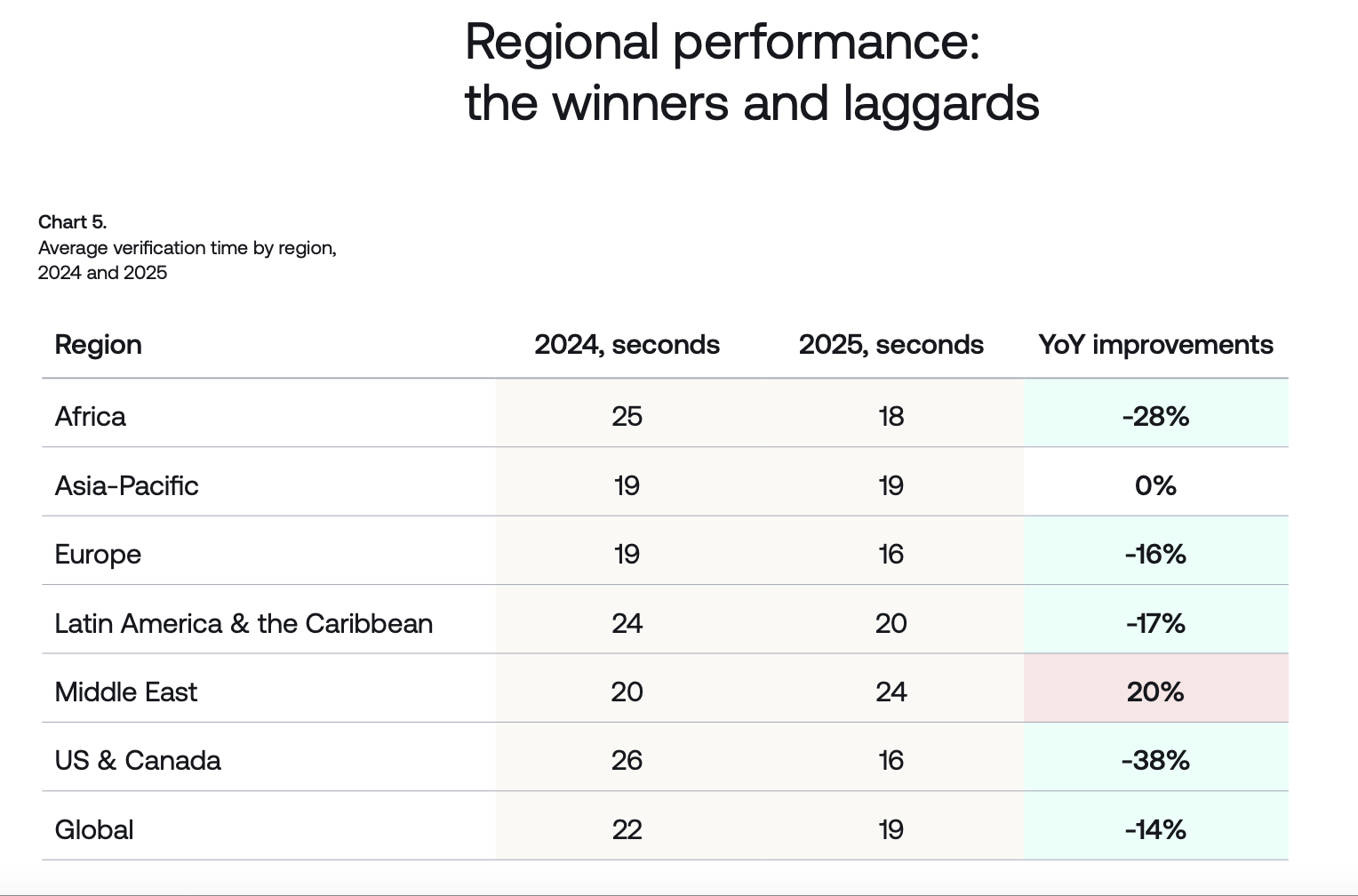
Regional performance varied significantly. The United States and Canada achieved the largest improvement, reducing verification times by 38%, while Europe improved by 16%. Africa also recorded strong gains. In contrast, verification times increased in the Middle East as firms introduced additional compliance controls to meet stricter regulatory requirements.
Hybrid verification models become new standard
One of the report's most important findings is the emergence of hybrid verification architectures as the preferred model for crypto companies. Rather than relying entirely on in-house systems or third-party providers, firms increasingly combine internal decision-making and workflow management with specialized external services for document verification, biometric checks, sanctions screening and Travel Rule compliance.
The report argues that hybrid systems offer the best balance between flexibility, regulatory transparency, scalability and cost. Regulators have also become increasingly skeptical of opaque internal AI systems, encouraging companies to use independent verification technologies that can be audited and benchmarked more easily.
As a result, hybrid models are rapidly becoming the industry standard.
Pass rates improve despite stricter rules
Despite tighter compliance requirements and more sophisticated fraud threats, pass rates continued to improve globally. Successful verification rates rose from 91% in 2023 to 94% in 2025.
Europe and North America maintained industry-leading pass rates of 96%, while Africa recorded the largest long-term improvement, rising from 81% in 2023 to 91% in 2025.
The report interprets this trend as evidence that crypto firms are becoming better at distinguishing legitimate users from fraudulent actors.
Improved workflows, clearer onboarding processes and more advanced verification technologies have enabled companies to maintain strict controls without significantly increasing rejection rates for legitimate customers.
Fraud evolves into a systemic threat
Fraud remains one of the industry's most significant challenges. The global fraud rate increased from 1.5% in 2023 to 2.2% in 2024 and remained at that elevated level throughout 2025.
According to the report, this stabilization should not be interpreted as a reduction in risk. Instead, it reflects an environment in which defenders and attackers continually adapt to one another.
Fraud has become more sophisticated and organized, increasingly relying on synthetic identities, AI-generated content, social engineering, mule networks and coordinated attacks rather than simple document forgery. Regional trends differed considerably.
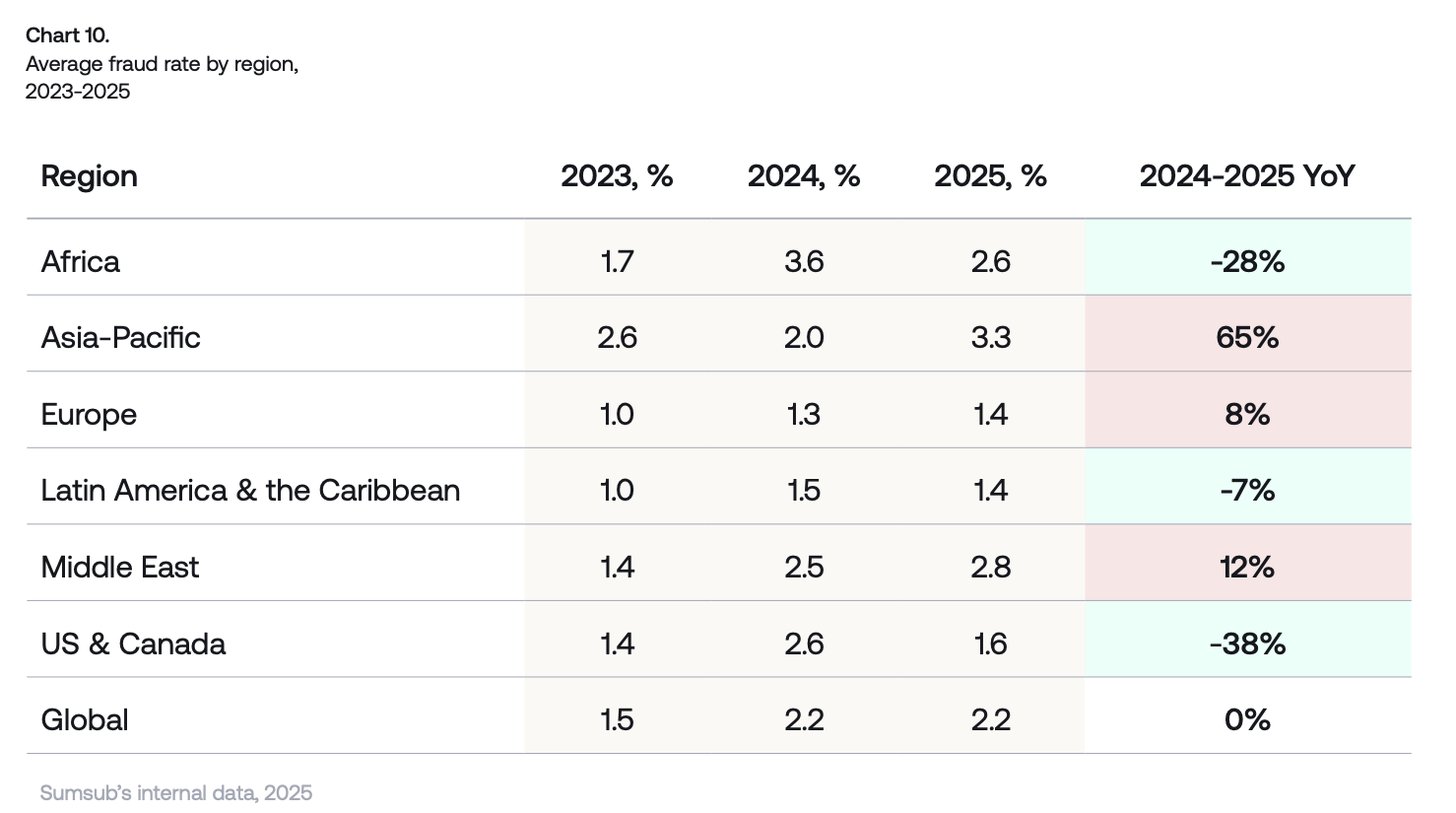
Asia-Pacific experienced a 65% increase in fraud rates, while the United States and Canada recorded a sharp decline. However, the report notes that fraud in North America has shifted toward fewer but more damaging attacks rather than disappearing altogether.
To address these threats, companies are prioritizing AI-powered fraud detection, advanced monitoring systems and stronger biometric verification. More than half of surveyed companies identified AI-based fraud detection as their top fraud-prevention priority for 2026.
The report argues that successful fraud prevention increasingly requires connecting identity verification, behavioral analysis and transaction monitoring into a unified intelligence system rather than treating them as separate functions.
Travel Rule compliance remains uneven
The implementation of the Travel Rule emerged as one of the most significant regulatory developments of 2025. While 73% of jurisdictions have now implemented the rule, industry readiness remains inconsistent. Only 23% of surveyed companies consider themselves fully compliant, while many remain uncertain about their compliance status.
Companies report that Travel Rule compliance has increased operational costs, slowed transactions and introduced additional friction into user experiences. The biggest challenges include data security concerns, expensive implementation requirements, regulatory fragmentation across jurisdictions, and interoperability issues between compliance systems.
Cross-border transactions represent the primary source of Travel Rule complexity. Although only 30% of crypto transactions are cross-border by number, they account for 55% of total transaction volume. These transfers typically involve higher values, more complex compliance checks and greater regulatory scrutiny.
The report predicts that Travel Rule compliance will soon become a basic requirement for market participation rather than a competitive advantage. Companies that fail to integrate Travel Rule processes directly into their transaction infrastructure risk facing operational restrictions and regulatory penalties.
Unhosted wallets under growing scrutiny
Self-custody wallets have become a major regulatory focus because they operate outside traditional VASP oversight structures. Regulators increasingly expect crypto companies to demonstrate ownership verification and risk management procedures for transactions involving unhosted wallets.
Most firms currently rely on user self-declarations to verify wallet ownership, but nearly 40% have adopted cryptographic signature verification methods that provide stronger evidence of control.
The report expects signature-based verification to become increasingly common, particularly for higher-risk transactions, as regulators demand stronger assurance mechanisms.
Institutional adoption and stablecoin growth
The report identifies a structural transformation in crypto transaction activity. While individual users still generate most transactions by number, businesses are rapidly becoming the dominant participants by transaction value.
Company-to-company activity grew from 1% of transactions in 2024 to 12% in 2025, while corporate transactions accounted for 44% of total transaction volume by value.
Stablecoins are a major driver of this shift. Their share of total transactions increased from 31% in 2024 to 36% in 2025 as businesses increasingly use them for cross-border payments, treasury management and operational transfers.
The report argues that stablecoins are transitioning from speculative assets to core financial infrastructure, particularly for institutional users seeking efficient global settlement mechanisms.
Conclusion
The central message of the report is that crypto has entered an era of regulated maturity. Success in 2026 depends less on rapid user acquisition and more on operational excellence, fraud resilience and regulatory readiness.
Verification systems, fraud detection capabilities, Travel Rule compliance and transaction monitoring are becoming core competitive differentiators rather than back-office functions.
Companies that successfully integrate compliance, security and user experience into a unified operating model will be best positioned to benefit from growing institutional adoption, rising stablecoin usage and increasingly clear global regulation.
The full report is available online.
 Dan Burgin
 U.Today Editorial Team
