
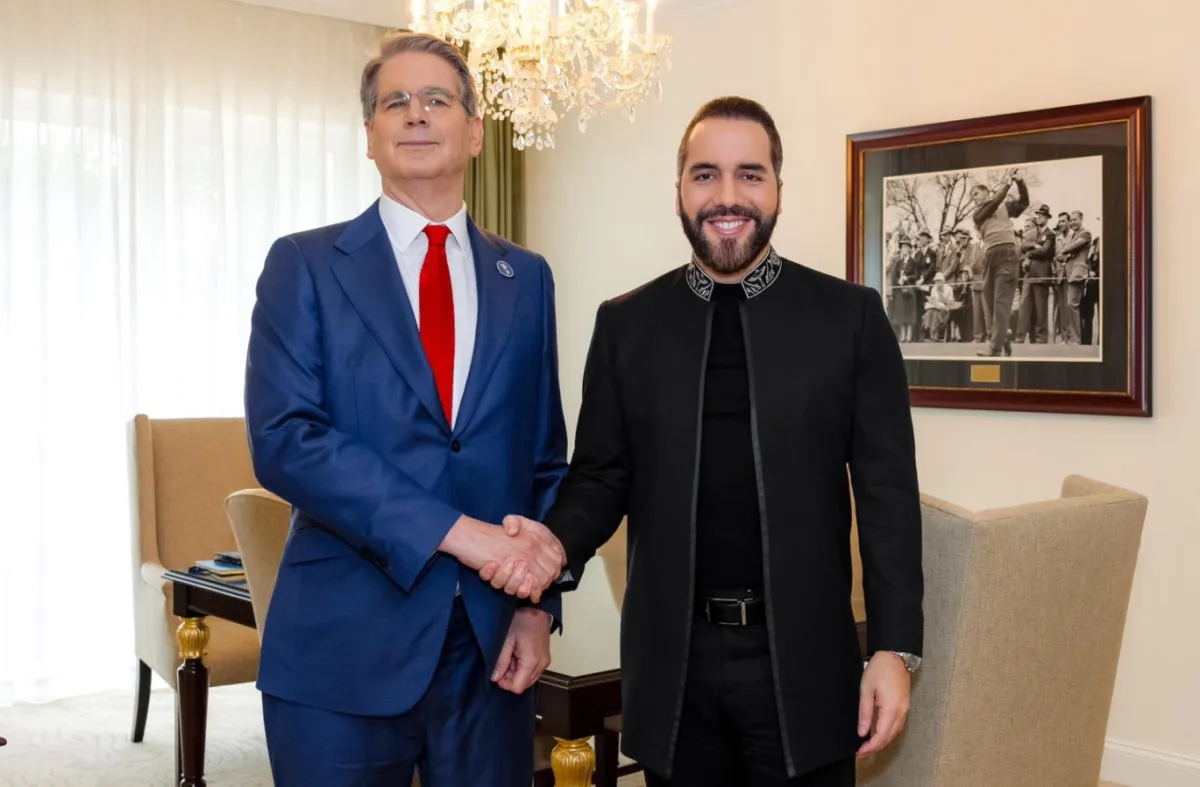

United States Treasury Secretary Scott Bessent and Salvadoran President Nayib Bukele recently held a high-level meeting this weekend to discuss El Salvador's economic transformation and its cryptocurrency strategy.
The bilateral talks took place on the sidelines of the "Shield of the Americas" summit in Miami, Florida.
Following the meeting, Treasury Secretary Bessent took to the X platform to praise the Salvadoran leader’s economic vision. "I was glad to hear more about President Bukele’s pro-market reforms for El Salvador and his efforts to make El Salvador a digital assets hub. We will continue to work together to advance strategies to strengthen our hemisphere," he said.
Before the current administration, interactions between U.S. government officials, international financial institutions and Bukele regarding Bitcoin were notoriously frosty.
After El Salvador decided to make Bitcoin legal tender in 2021, the U.S.-dominated International Monetary Fund (IMF), rating agencies and the U.S. administration issued repeated warnings. U.S. lawmakers even introduced legislation to mitigate potential risks to the American financial system.

Now, however, the aggressively pro-crypto stance of the current administration is extending into its foreign policy.
Failed policy?
In early 2025, the Bukele administration quietly agreed to a major concession: El Salvador amended its historic Bitcoin Law. It was facing mounting debt, which is why there was a desperate need for a $1.4 billion IMF loan.
This came after domestic crypto adoption also failed to pick up steam. According to a 2024-2025 survey conducted by the Public Opinion Institute of the Jesuit Central American University, only "8 out of every 100 Salvadorans" reported actively using Bitcoin.
The government formally removed Bitcoin’s mandatory "legal tender" status. It also agreed to limit the public sector’s direct engagement in crypto-related activities.
That said, the Salvadoran government continued its Bitcoin purchases.
 Dan Burgin
 U.Today Editorial Team
