
Disclaimer: The opinions expressed by our writers are their own and do not represent the views of U.Today. The financial and market information provided on U.Today is intended for informational purposes only. U.Today is not liable for any financial losses incurred while trading cryptocurrencies. Conduct your own research by contacting financial experts before making any investment decisions. We believe that all content is accurate as of the date of publication, but certain offers mentioned may no longer be available.

Canada's second-largest bank, Bank of Montreal (BMO), has disclosed positions in XRP-focused financial vehicles. The information appears in its latest quarterly Form 13F-HR filing submitted to the U.S. Securities and Exchange Commission (SEC).
The new filing officially confirms the presence of XRP within BMO's massive investment portfolio, whose total value exceeded $303 billion at the end of June 2026. Specifically, the bank's reportable positions include 323 shares of the Rex Osprey XRP ETF and 20 shares of the ProShares Ultra XRP ETF.
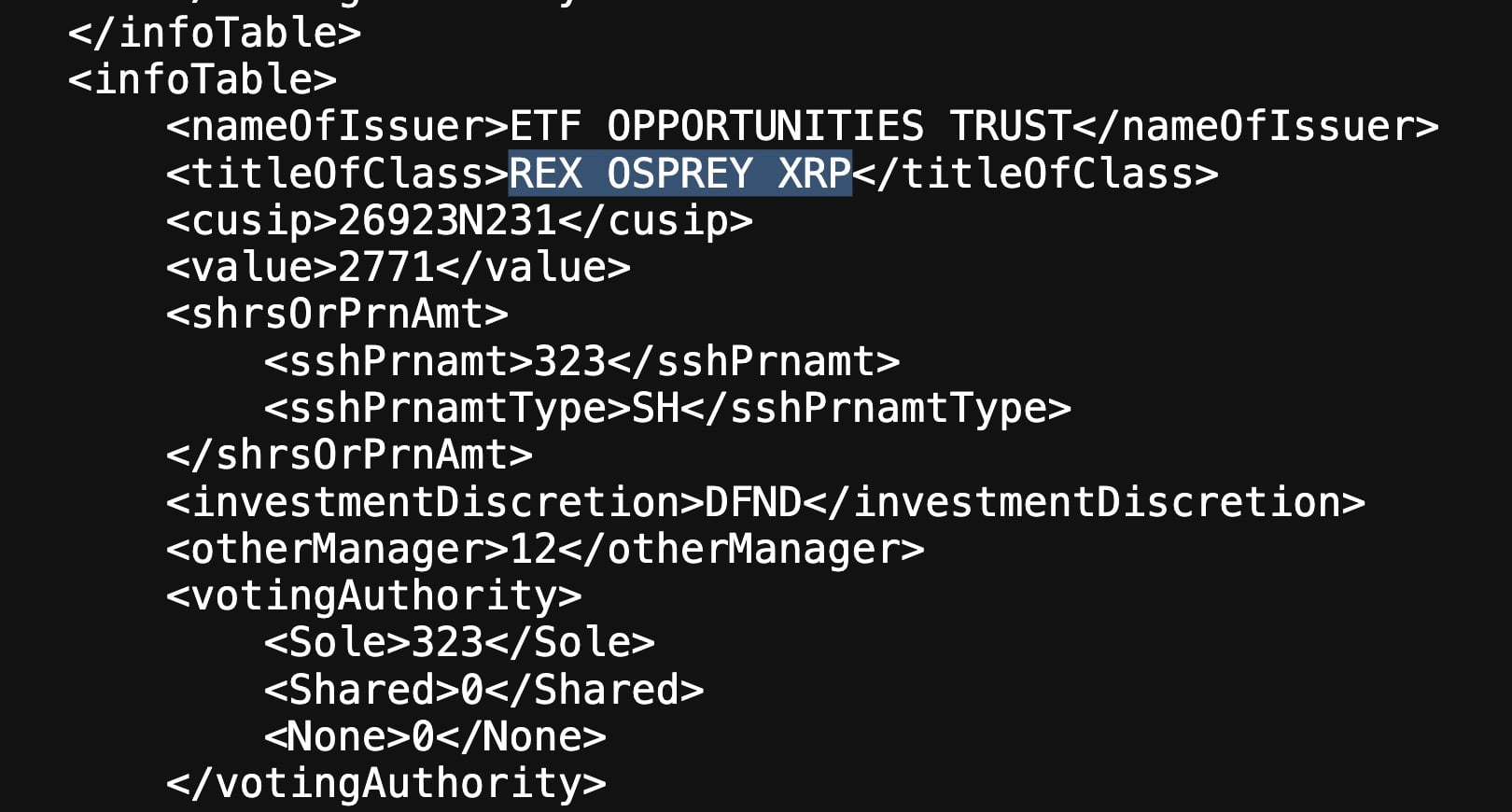
The bank did not purchase tokens directly on exchanges. Instead, it used regulated U.S. infrastructure in the form of spot and derivatives-based ETF products, allowing it to integrate the volatile token into a giant portfolio within a familiar legal framework and without direct custody risks.

For Canada's banking sector, this is becoming a systemic trend. Earlier in the same reporting period, National Bank of Canada disclosed a holding of 3,848 shares in the Bitwise XRP ETF, worth approximately $330,000.
Conservative capital has effectively developed a single playbook: entering the cryptocurrency market selectively and through transparent funds.
New force behind institutional XRP accumulation
At the same time, 13F filings revealed a "changing of the guard" among XRP holders. Major first-wave players led by Goldman Sachs, which held positions worth more than $150 million around the turn of 2025–2026, had reduced or fully exited them by the summer, locking in profits.
However, they were replaced by a group of midsize asset managers and family offices, including Arax Advisory Partners, Gerber, Vista Finance and Gallacher Capital.

These new investors are taking a more flexible approach, splitting capital between traditional spot funds, such as the Franklin XRP Trust and Bitwise, and short-term leveraged instruments such as the ProShares Ultra XRP ETF.
Because 13F filings are published with a 45-day delay, they provide only an interim snapshot. Nevertheless, BMO's filing officially confirms that XRP is now on another top bank's balance sheet.
 U.Today Editorial Team
 Dan Burgin
