
Disclaimer: The opinions expressed by our writers are their own and do not represent the views of U.Today. The financial and market information provided on U.Today is intended for informational purposes only. U.Today is not liable for any financial losses incurred while trading cryptocurrencies. Conduct your own research by contacting financial experts before making any investment decisions. We believe that all content is accurate as of the date of publication, but certain offers mentioned may no longer be available.

After weeks of continuous downward pressure, XRP is currently trading close to $1.53, indicating a modest recovery. Despite the asset's recent short-term rebound, its overall market structure still shows uncertainty, as the cryptocurrency market as a whole finds it difficult to regain steady bullish momentum.
Clear guidelines upwards
After its sell-off in February, XRP has technically formed a gradually rising support line, indicating that buyers are trying to stabilize the price. The asset has been able to test nearby resistance levels created by short-term moving averages thanks to this gradual upward movement, which has helped it rise above the immediate support range around $1.43.
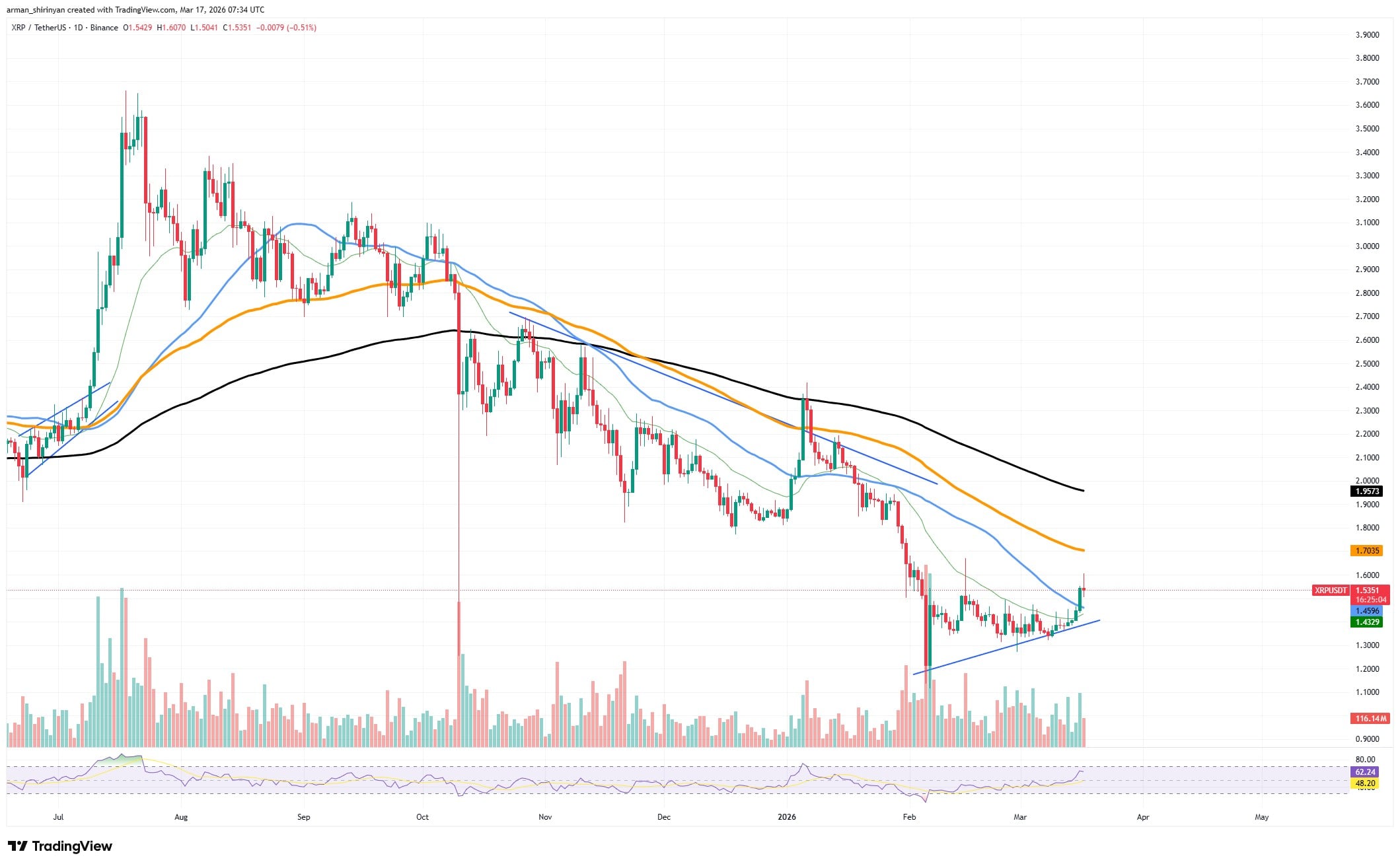
But even though the price structure has improved, XRP is still stuck below a number of significant resistance barriers. The asset's potential to rise is still constrained by the 26-day and 50-day exponential moving averages, which function as dynamic ceilings. The recovery is still precarious until XRP can clearly break through these levels.
On-chain metrics are also starting to gain popularity. According to exchange reserve data, XRP is getting close to the crucial three billion token threshold. The reserve level is currently close to 2.8 billion coins. Increasing exchange reserves are frequently a sign that more tokens are being transferred to trading platforms, which usually comes before more selling activity.
Exchange migration in tact
Large-scale supply migration to exchanges increases the likelihood of profit-taking or liquidation. Given XRP's recent rebound, this is especially crucial because traders who bought the asset during the recent decline might see the current price levels as a chance to sell their positions.

The market may experience a psychological trigger if the exchange reserve level surpasses $3 billion. A milestone like this could indicate that exchanges are becoming more liquid, which could make it easier for major holders to sell their inventory. Similar reserve increases have been linked to increased volatility and stronger downward pressure in past cycles.
XRP needs to break through adjacent resistance levels and hold above the rising support line in order to continue its recovery trajectory. If not, the asset may return to consolidation or even enter a new phase of correction due to an increase in exchange supply and waning bullish momentum.
 Dan Burgin
 Vladislav Sopov
