
Disclaimer: The opinions expressed by our writers are their own and do not represent the views of U.Today. The financial and market information provided on U.Today is intended for informational purposes only. U.Today is not liable for any financial losses incurred while trading cryptocurrencies. Conduct your own research by contacting financial experts before making any investment decisions. We believe that all content is accurate as of the date of publication, but certain offers mentioned may no longer be available.

Even though short-term traders largely ignore it, long-term holders pay attention to Shiba Inu's signal at the beginning of the year. Approximately 176 billion SHIB have left exchanges in the last day. That is not random noise or a tiny fluctuation. It is an obvious quantifiable outflow, and historically these occurrences have been more significant over weeks and months than over days.
SHIB is sleeping
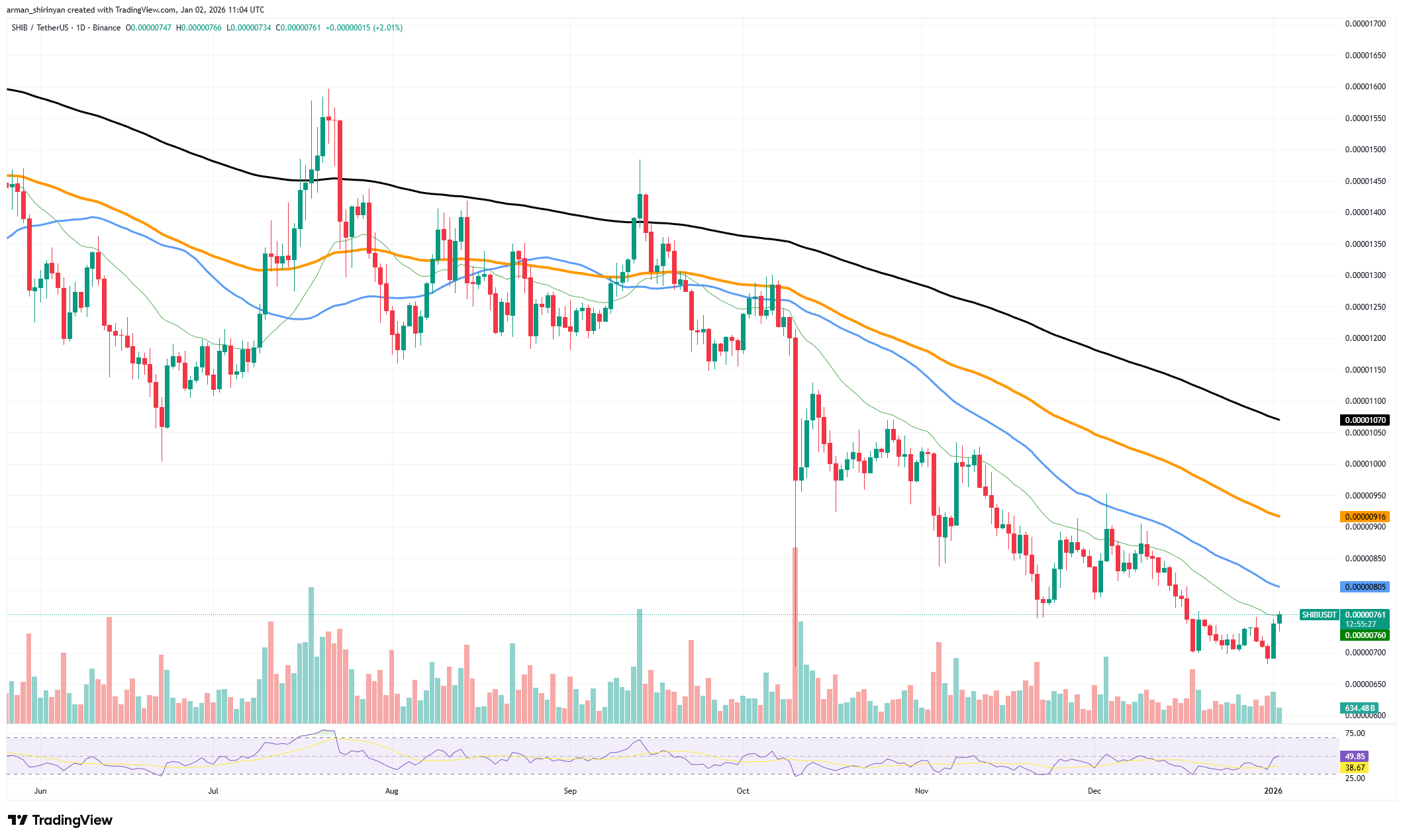
SHIB's price action is still slow as of right now. The 26 and 50 EMAs serve as overhead resistance on the chart, which depicts the asset trapped below important moving averages. The price is still close to local lows, and volatility is still low. This is crucial: the outflow does not immediately result in a pump.
Anyone hoping for a breakout right away will probably be let down. However, this increases the signal's credibility rather than rendering it irrelevant. Generally speaking, significant exchange outflows indicate that holders are transferring tokens into self-custody as opposed to getting ready to sell. To put it simply, fewer coins on exchanges equate to a less accessible supply.

While it lessens selling pressure, which is a prerequisite for any long-term recovery, it does not by itself ensure upside. Rallies are typically short-lived and easily sold into when there is no supply exiting exchanges. Time is another important factor. This kind of outflow at the beginning of the year is significant from a psychological standpoint.
Long-term holders are accumulating
Traders close losing bets, long-term holders quietly accumulate, and speculative volume declines during New Year periods, which frequently reset positioning.
At the moment, SHIB nearly perfectly fits that pattern: low volatility, weak momentum, but improving underlying metrics. Nevertheless, care should still be taken. Exchange inflows may resume swiftly, particularly if Bitcoin loses support or the overall market becomes less risk-taking.
Although the outflow appears to be beneficial at this time, it is not irreversible. Before any significant trend shift can be verified on the price chart, SHIB still needs to recover short-term moving averages and exhibit steady higher lows. This 176 billion SHIB outflow, to put it briefly, is not a magic trigger.
 Dan Burgin
 U.Today Editorial Team
