
Disclaimer: The opinions expressed by our writers are their own and do not represent the views of U.Today. The financial and market information provided on U.Today is intended for informational purposes only. U.Today is not liable for any financial losses incurred while trading cryptocurrencies. Conduct your own research by contacting financial experts before making any investment decisions. We believe that all content is accurate as of the date of publication, but certain offers mentioned may no longer be available.

TL;DR:
- A heavy long-side imbalance in the futures market threatens cascading liquidations of $4.36 billion if Bitcoin drops to the $57,200 level.
- XRP retains its psychological support at $1.0052 (+0.42%) as whale wallets absorbed over 642 million tokens from August 1 to 18.
- The new SEC reform exempts eligible token projects from registration for raises up to $75 million annually, transforming US crypto fundraising rules.
The cryptocurrency market is stabilizing on the morning of Aug. 19 after a difficult week, while the leading digital assets are simultaneously being squeezed into narrow ranges. Institutional capital in the U.S. has abruptly shifted back toward accumulation following the massive downturn from Aug. 10 to Aug. 14, when net outflows from crypto funds reached a record $389.7 million.
The Aug. 18 trading session ended with a powerful comeback: spot Bitcoin ETFs attracted $189.31 million in a single day, while Ethereum ETFs recorded $71.47 million in net inflows. Against this backdrop, U.S. spot XRP ETFs are still showing modest volumes, with $5.81 million in net inflows yesterday, according to SoSoValue.
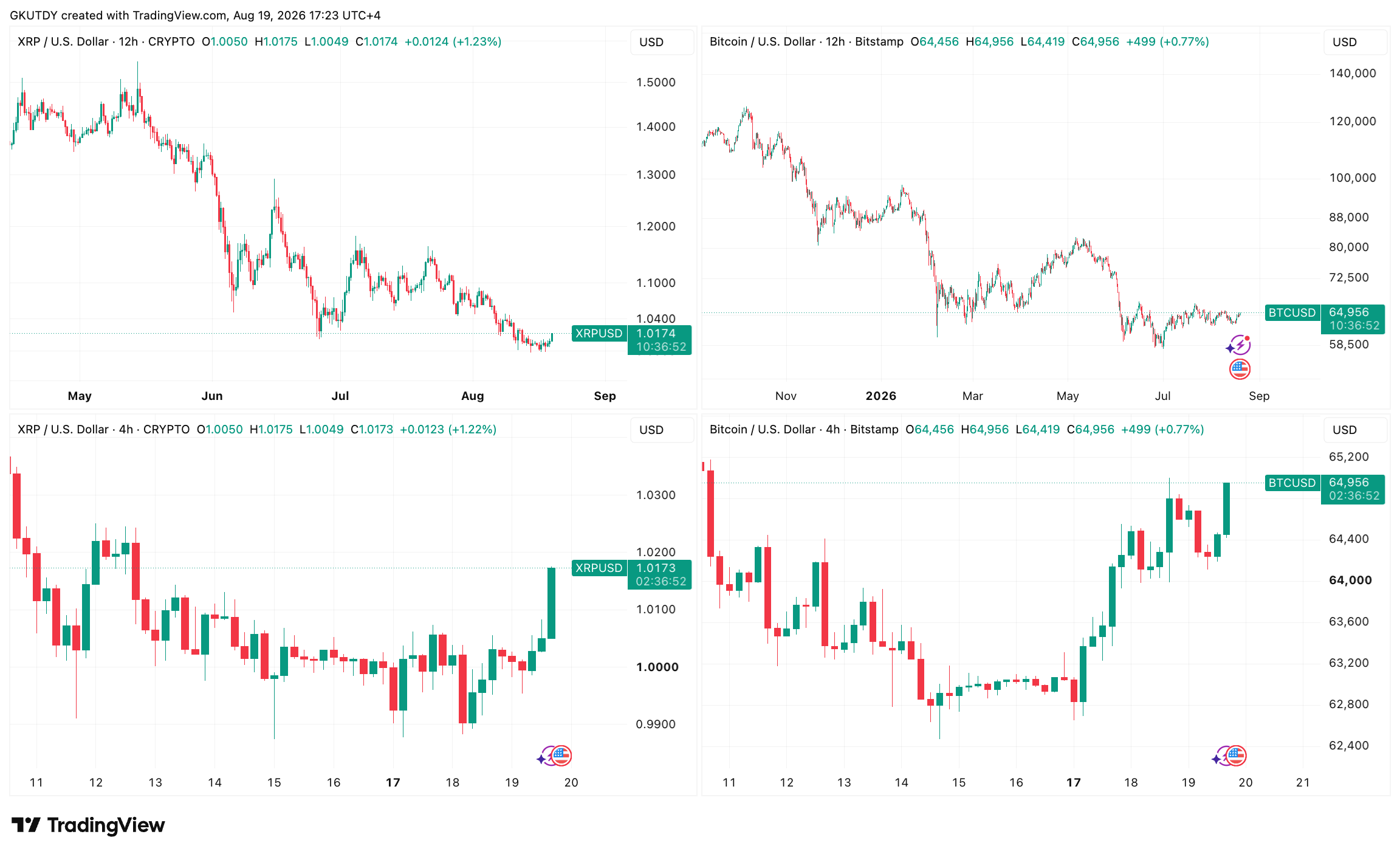
TradingView price charts are currently showing complete calm and tight consolidation. Bitcoin (BTC) is pressing at $65,000 on Bitstamp's 12-hour chart, while XRP/USD is moving in sync with the market leader with a gain of 1.23%.
XRP is firmly holding its crucial psychological and technical support level at $1.0052. This stability is being driven not by retail traders but by an aggressive on-chain strategy among major players, who are buying every local dip.

Institutional whale accumulation was triggered by a powerful fundamental catalyst from Washington. The U.S. Securities and Exchange Commission (SEC) published a historic proposal to simplify token registration, which has already been linked to the Senate's upcoming vote on the CLARITY Act.
XRP news: Whales buy 642 million tokens as Ripple Prime debuts bond offering
Large XRP holders have collectively acquired more than 642 million tokens near the psychological $1 level since the beginning of August. During the first week of the month alone, wallets holding between 1 million and 10 million XRP accumulated 380 million coins, increasing their combined holdings to 8.13 billion tokens.
Buying continued in the middle of the month. Investors added another 72 million XRP to their positions on Aug. 13–14 and absorbed an additional 190 million tokens on Aug. 16–17. Against this backdrop, the number of large XRPL transactions worth more than $1 million jumped 280% on Aug. 17–18, exceeding 38 transactions per day amid an influx of active addresses.
Alongside this on-chain activity, Ripple Prime, the company's brokerage subsidiary, completed its debut private placement of $275 million in unsecured bonds due in 2031. The debt securities carry an 8.25% coupon and received a BBB investment-grade rating from KBRA, while investment bank Piper Sandler served as the lead underwriter.

Including the May agreement, Ripple's total debt financing raised over the past three months has reached $475 million through the infrastructure of Hidden Road, which the company acquired in 2025 for $1.25 billion. Ripple has also expanded its payments presence in Asia by partnering with South Korea's Jeonbuk Bank to introduce instant settlements through Ripple Payments.
In the on-chain sector, Ripple's native dollar-backed stablecoin, RLUSD, demonstrated unusual dynamics. A recent $35.7 million token burn pushed the monthly burn rate on the XRPL to 99%. Over the past 30 days, $449.3 million worth of RLUSD was issued on the network, but immediate institutional redemptions resulted in $448.9 million worth of tokens being burned.
Unlike the XRPL's transit corridor, Ethereum is retaining liquidity. Of the $403 million issued on Ethereum, only $177.3 million was burned, leaving the total RLUSD supply of $1.757 billion divided almost equally between the two blockchains.
The intense token accumulation by whales, combined with Ripple's simultaneous effort to raise hundreds of millions of dollars in debt, signals that major players are not currently planning speculative sales near the $1 level.
Crypto market news: SEC reform and Bitcoin liquidation risks
Yesterday, the New York Federal Reserve purchased short-term Treasury bills up to its full $4.243 billion allotment. The move fits into a monthly reinvestment schedule of approximately $17 billion aimed at supporting bank reserves and reducing liquidity shortages.
The monetary injection coincided with a sudden reversal in sentiment across the U.S. spot crypto fund sector. In a single trading session on Aug. 18, the funds fully offset the prolonged outflows recorded last week, when investors withdrew a record $389.7 million.
At the same time, the U.S. Securities and Exchange Commission published two new fundraising tracks. The new rules introduce the following exemptions:
- Fundraising limit: Eligible token issuers would be exempt from strict registration requirements when raising up to $75 million per year.
- Safe harbor: Assets would automatically lose their status as securities once developers complete the required technological milestones.
- Insider freedom: The mandatory token lockup period would be completely removed once all other restrictions are lifted.
Against this backdrop, the U.S. Senate scheduled a procedural vote on the CLARITY Act for Sept. 15. This round does not guarantee the bill's final passage because of unresolved issues involving staking rewards and potential crypto-related conflicts of interest at the highest levels of government.
Meanwhile, the overall probability of the CLARITY Act being signed into law by the end of 2026 has dropped to 20%. Just a few months ago, markets estimated the chances of the historic legislation taking effect at more than 80%.
Despite the legal uncertainty, analysts at investment firm VanEck believe Bitcoin's prolonged correction is nearing its end. Eight of the 12 key indicators point to the market's final capitulation, while all 12 metrics have entered this zone at some point during the past three months.

The current decline has now continued for 10 months, compared with the historical duration of a bear phase of 11–13 months. VanEck analysts identify the period from September through November as the window for a transition toward full-scale accumulation.
While the spot market is consolidating, hidden risks are building in the futures market because of a critical imbalance in favor of long positions. According to the CoinGlass liquidation heat map, a sudden market decline would trigger cascading liquidations:
- Bitcoin: If BTC falls to approximately $57,200, forced liquidations of long positions would exceed $4.36 billion.
- Ethereum: If ETH falls to approximately $1,715, forced liquidations of long positions would exceed $2.97 billion.

 Dan Burgin
 U.Today Editorial Team
