
Disclaimer: The opinions expressed by our writers are their own and do not represent the views of U.Today. The financial and market information provided on U.Today is intended for informational purposes only. U.Today is not liable for any financial losses incurred while trading cryptocurrencies. Conduct your own research by contacting financial experts before making any investment decisions. We believe that all content is accurate as of the date of publication, but certain offers mentioned may no longer be available.

Amid active debates over the sale of part of its Bitcoin holdings for operational needs, Strategy's leadership is trying to seize the initiative from critics. CEO Phong Le defended the company's new corporate strategy by publishing strong financial results for the past three months.
From April 6 to July 6, the company increased its Bitcoin reserves by 10% and now holds a record 843,775 BTC, Le said.
These figures came at a moment when the market began to question whether the course of the largest institutional Bitcoin investor remains unchanged. The 10% increase announced by Strategy's CEO is meant to prove that the net inflow of coins continues, while the company's operational resilience has improved.
Strategy's dollar cash cushion increased by 13% to $2.55 billion, while the internal yield of its Bitcoin strategy since the start of the year more than doubled, rising from 3.7% to 7.8%.
Can Strategy's new Bitcoin framework save the firm's slumping debt?
Company founder Michael Saylor quickly moved to clarify the logic behind this large-scale shift. He said that Strategy has finally outgrown the format of a passive accumulation wallet and now divides its assets into three different financial instruments.
In the new architecture, Bitcoin itself is defined as Digital Capital. The STRC token, whose obligations triggered the sales, serves as Digital Credit, while MSTR shares remain equity capital.

"Different instruments for different investors. But one strategy," Saylor said, explaining that targeted sales are part of balance sheet management.
Whether the record report will help protect the company's new flexible model in the eyes of investors remains an open question.
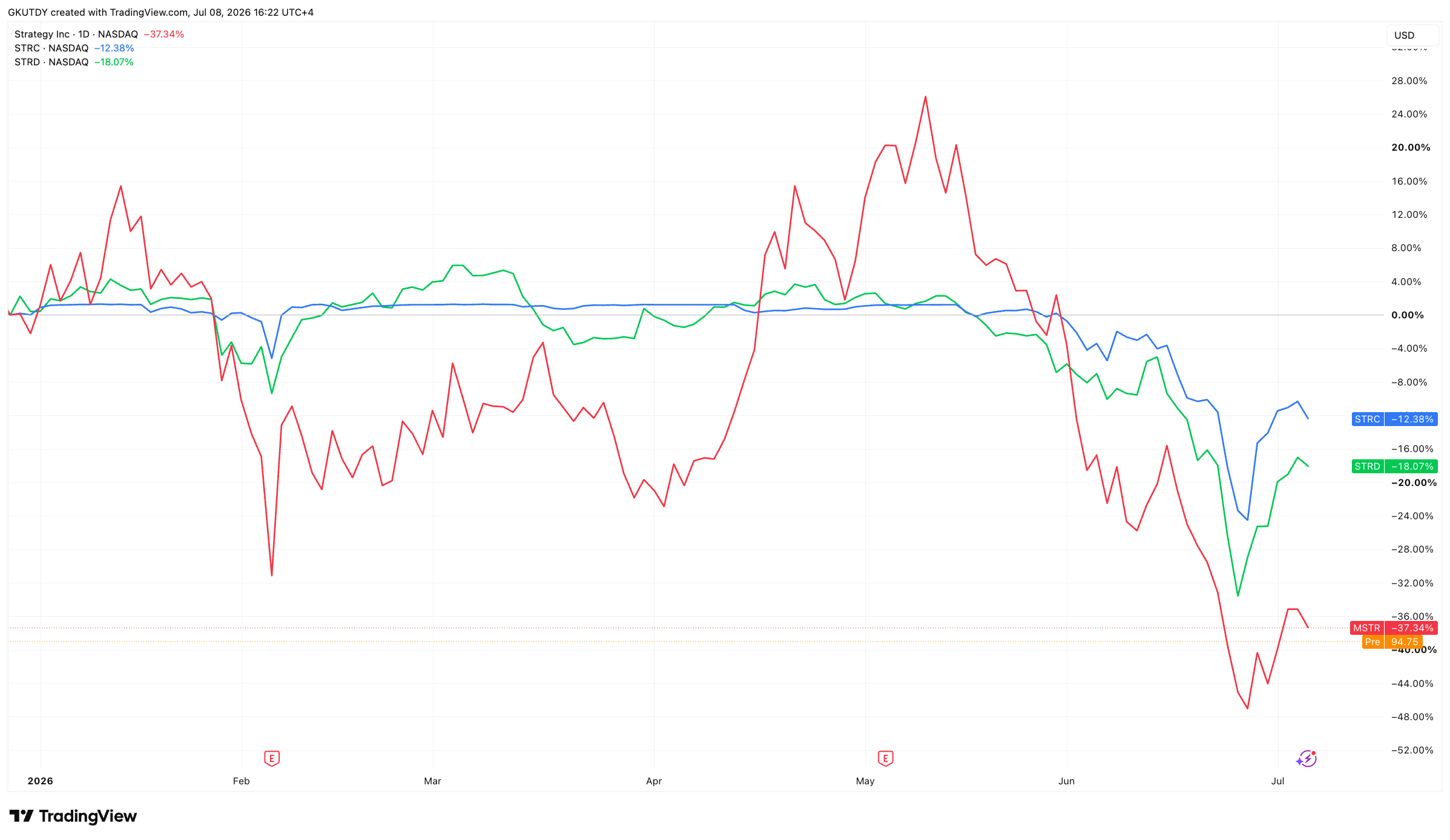
So far, the stock market's reaction has been mixed: over the first eight days of July, the price of MSTR common shares rose by 9.4%, while debt instruments are under clear pressure, with instruments such as STRC and STRD trading significantly below their $100 par value, at $86.56 and $61.68, respectively.
 Dan Burgin
 U.Today Editorial Team
