
Disclaimer: The opinions expressed by our writers are their own and do not represent the views of U.Today. The financial and market information provided on U.Today is intended for informational purposes only. U.Today is not liable for any financial losses incurred while trading cryptocurrencies. Conduct your own research by contacting financial experts before making any investment decisions. We believe that all content is accurate as of the date of publication, but certain offers mentioned may no longer be available.

U.S. financial giant U.S. Bank has successfully completed the first live pilot of its USBDC stablecoin, moving real money between its U.S. and European branches through the public Stellar (XLM) blockchain.
The bank chose not to create an isolated private network, proving that large amounts of capital can be transferred securely over open rails.
Major banks usually avoid open networks because of regulatory concerns, but U.S. Bank addressed this problem through technology. As Jamie Walker, the bank's head of digital assets, explained, its platform is fully integrated into its internal risk management system.
The USBDC stablecoin's code includes freezing and clawback functions. If a payment is sent to the wrong address or draws the attention of financial intelligence authorities, the bank can immediately freeze or return the funds with a single click.
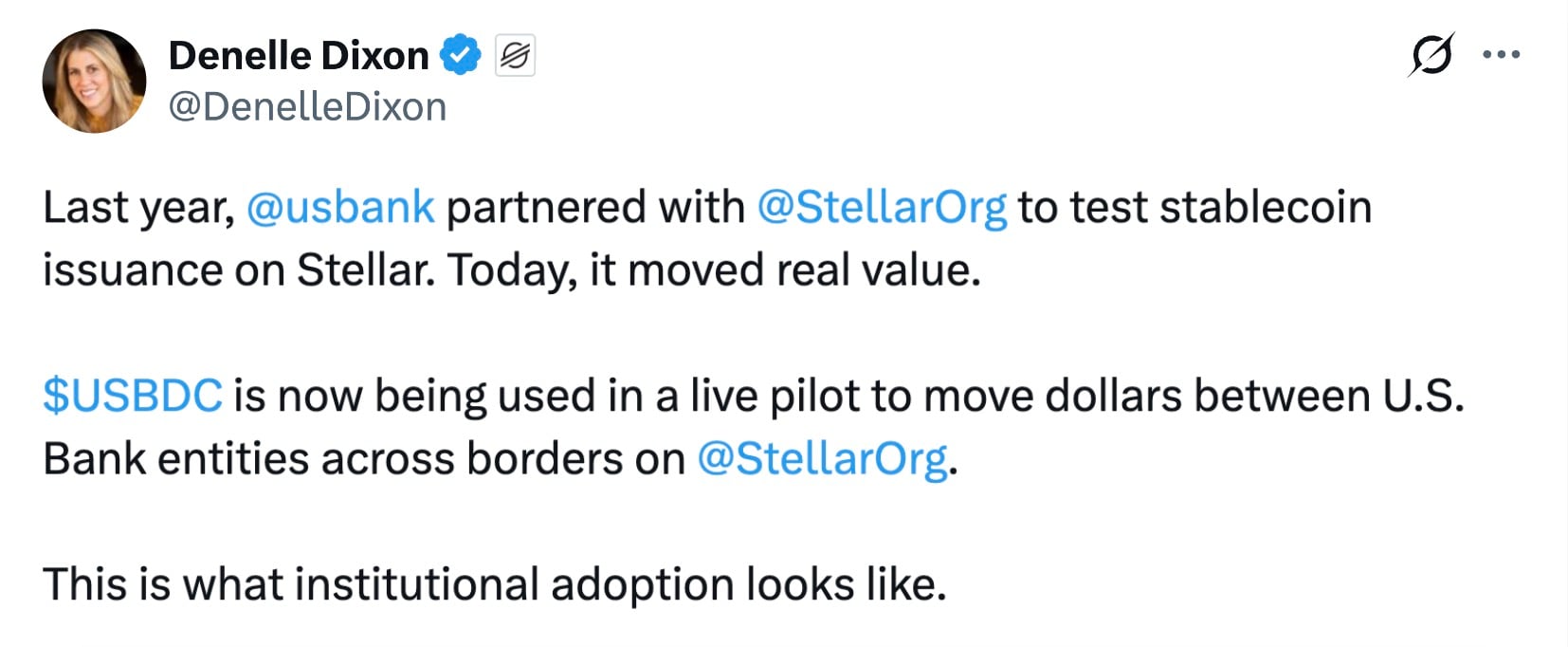
Stellar Development Foundation CEO Denelle Dixon called the launch a major precedent for the entire industry. She emphasized that U.S. Bank's live pilot is a clear example of real institutional adoption, with regulated financial institutions using Stellar's speed and open architecture for secure and compliant cross-border settlements.
U.S. Bank CEO Gunjan Kedia confirmed that the pilot had been successful. According to her, the technology will allow the bank to move capital between continents around the clock and at almost no cost, bypassing traditional intermediaries and lengthy interbank reconciliations.
At the initial stage, USBDC will remain a closed instrument used only for the bank's internal settlements and treasury operations.
Why Stellar? Examining the network's on-chain data and U.S. Bank's strategy for staying ahead of its competitors
Stellar was selected because of its ready-made infrastructure. According to the latest RWA.xyz data, the network's ecosystem currently holds $3.32 billion in real-world assets (RWAs). However, while ordinary users know Stellar through the retail stablecoin USDC, which has 685,000 holders, U.S. Bank is following the path of major funds such as Spiko and Figure's YLDS token.
This is a format that is "not for everyone": the system will have only a handful of wallets belonging to the bank's own divisions, but billions of dollars in transactions will flow through them.

As for U.S. Bank, it can be argued that the institution has beaten its competitors to the punch. While a consortium of two dozen other major banks, including Goldman Sachs, is only promising to launch a shared interbank token by 2027, the fifth-largest U.S. bank has already tested a working solution on a public blockchain.
 U.Today Editorial Team
 Dan Burgin
