
Disclaimer: The opinions expressed by our writers are their own and do not represent the views of U.Today. The financial and market information provided on U.Today is intended for informational purposes only. U.Today is not liable for any financial losses incurred while trading cryptocurrencies. Conduct your own research by contacting financial experts before making any investment decisions. We believe that all content is accurate as of the date of publication, but certain offers mentioned may no longer be available.

Shiba Inu is getting close to a point where bearish momentum might just run out. SHIB has reached one of the weakest technical positions of the year after months of steady downtrend, but price action and on-chain activity also indicate that sellers are progressively wearing themselves out.
Shiba Inu's market performance
The 50-day, 100-day, and 200-day EMAs are still sloping lower, and SHIB is still stuck below all major moving averages. A recent breakout from a brief ascending formation that swiftly collapsed was one of several unsuccessful attempts at recovery.
At $0.0000042, the price is currently trading close to local lows, putting SHIB perilously close to levels where speculative interest usually fades. But the lack of conviction behind the decline is more notable than the decline itself.
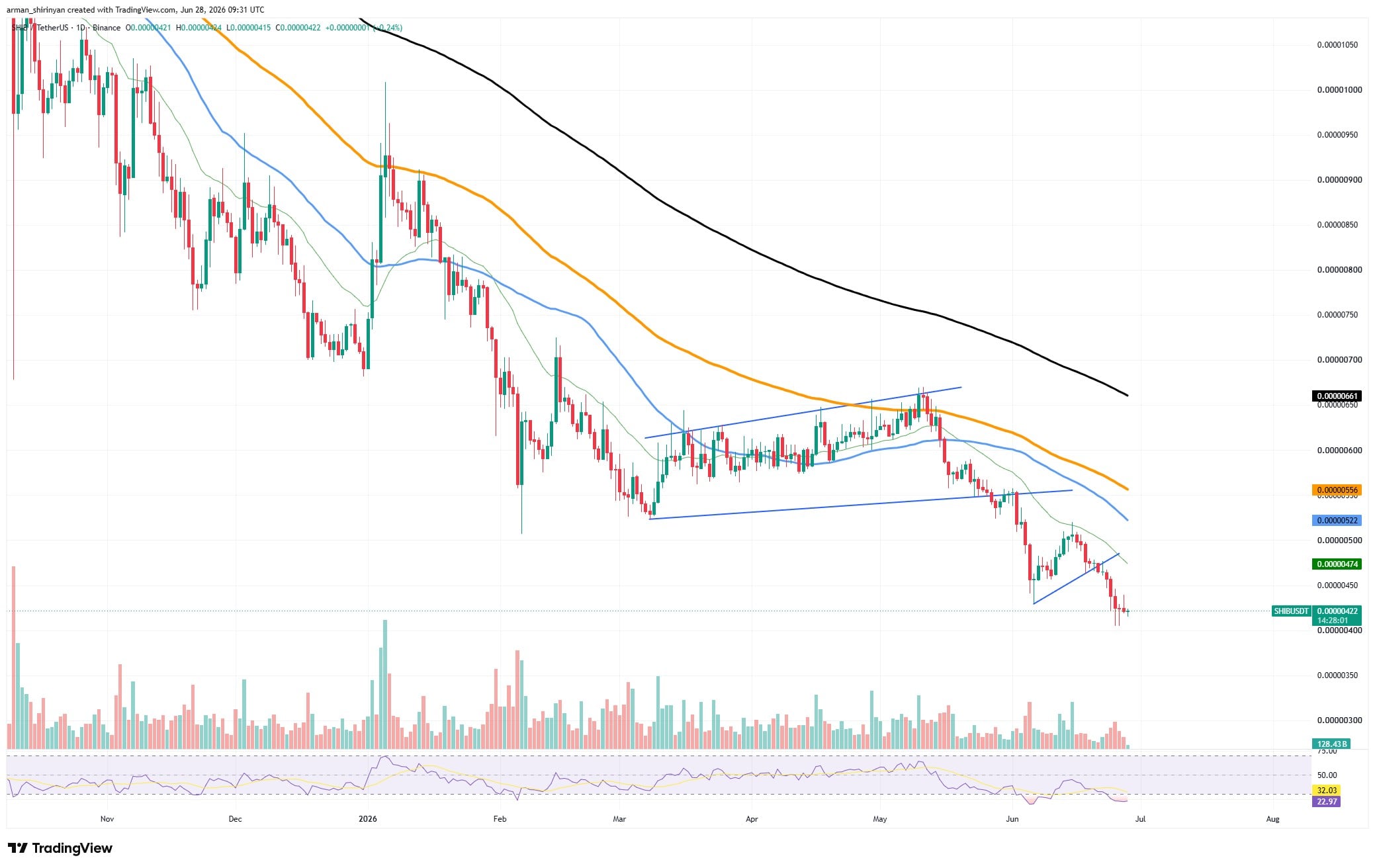
Throughout the most recent decline, trading volume has gradually decreased. In contrast to significant capitulation events that usually coincide with a bear trend's end, SHIB is not under intense selling pressure. Instead, it seems like the market is becoming less active. Although fewer players are still willing to transact at these low levels, sellers are still driving the asset lower. This interpretation is validated by on-chain metrics.
Netflows stay negative
While netflows are still negative, meaning that more tokens are still leaving exchanges than entering them, exchange reserves have stayed comparatively steady at 80 trillion SHIB. It appears that holders are not hurrying to deposit coins for quick liquidation because exchange outflows greatly exceed inflows. In addition, active addresses and transaction counts have remained stable.

The RSI is currently hovering close to levels that have historically been linked to local bottoms, having fallen into extremely depressed territory. Oversold readings by themselves do not ensure a reversal, but they frequently show that downside potential becomes more constrained until a new catalyst appears.
The issue for SHIB bears is straightforward: there might not be many sellers left after months of decline.
On-chain data does not indicate a panic distribution, momentum is weak, and volume is diminishing. That indicates that SHIB is getting close to a point where the risk-reward balance starts to shift away from more aggressive downside, but it does not necessarily indicate that a rally is on the horizon.
 U.Today Editorial Team
 Dan Burgin
