
Disclaimer: The opinions expressed by our writers are their own and do not represent the views of U.Today. The financial and market information provided on U.Today is intended for informational purposes only. U.Today is not liable for any financial losses incurred while trading cryptocurrencies. Conduct your own research by contacting financial experts before making any investment decisions. We believe that all content is accurate as of the date of publication, but certain offers mentioned may no longer be available.

In the XRP community, the view has recently been gaining strength that the token has finally been left on the sidelines of the market. The logic behind this observation is simple: since Ripple has shifted its focus to its new dollar stablecoin, RLUSD, the "old volatile" XRP will no longer be needed, and liquidity will simply flow into the stable asset.
Analysts at Evernorth, the largest independent XRP treasury, examined the logic behind this fear and explained, using fresh on-chain data from Dune Analytics, why the new dollar does not “eat” XRP, but instead acts as its main catalyst.
Inside the RLUSD and XRP synergy
When Ripple first launched its digital dollar, investors expected the worst - if large businesses were given a stable dollar for settlements inside the XRP Ledger (XRPL), XRP itself would be written off. In reality, however, everything moved in the opposite direction.
According to the latest report, 52% of all RLUSD volume now circulates inside XRPL, even though back in April the network’s share was only 17%, while most of the stablecoin was held on Ethereum.
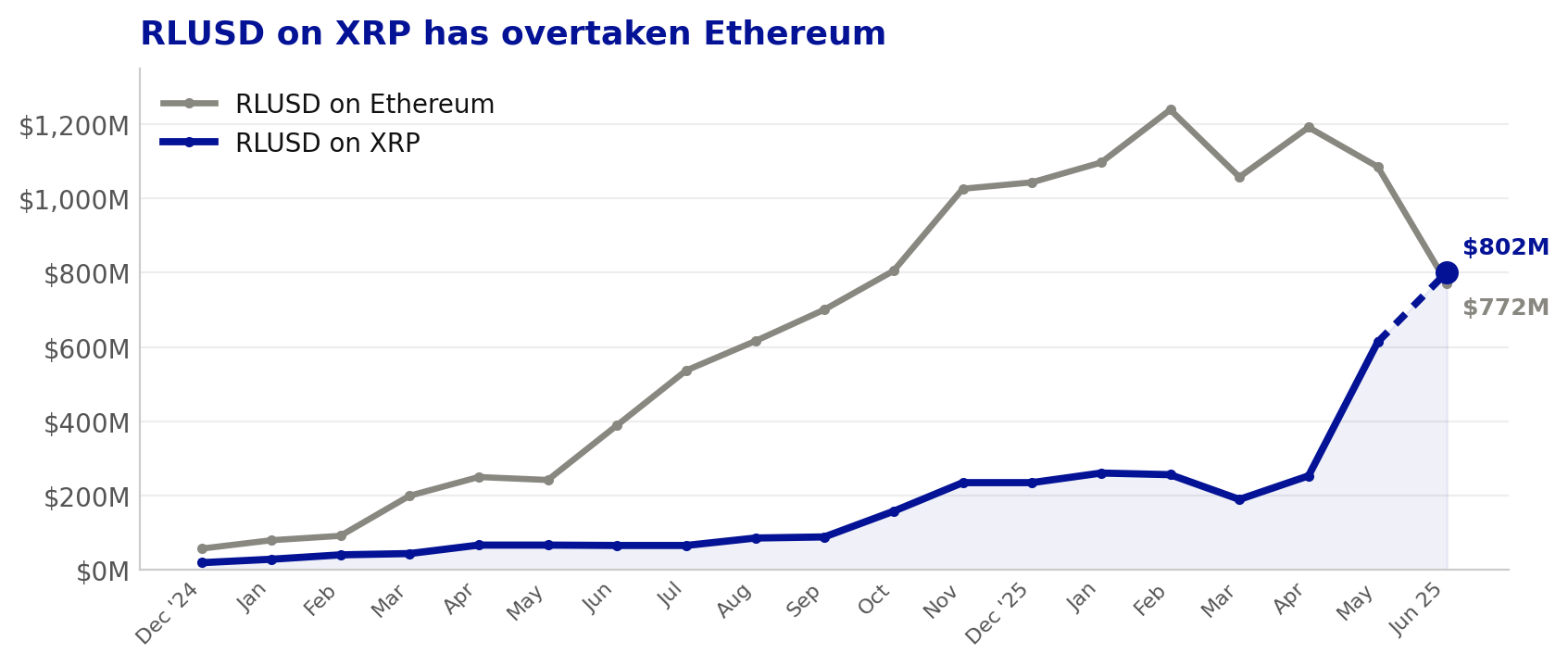
In less than a year and a half, RLUSD’s share of trading operations inside XRPL rose from near-zero levels, below 1%, to 12%. Here, Evernorth’s experts make an important point: the market is not abandoning XRP — traders have simply started actively moving dollars through the token.
To understand the essence of this process, the analysts suggest looking at the traditional foreign exchange market. In the global economy, the U.S. dollar participates in most transactions, acting as the main connecting link. Without it, it is difficult to quickly and cheaply exchange, for example, yen for tugriks.
A similar model is now being built on Ripple’s blockchain.

The direct RLUSD/XRP trading pair has generated $900 million in volume in just six months, creating a deep dollar market that simply did not exist before. Judging by the metrics, these assets are not competing in this pair, but dividing responsibilities:
- RLUSD gives businesses a clear dollar value for settlements without exchange-rate swings.
- XRP remains an independent “bridge” for instant conversion between other assets when the parties on both ends of a transaction do not have a direct match of interests.
But the main technical argument for why XRP has not been left out of Ripple’s expansion into stablecoins lies in how the network itself is built. Any operation, transfer, or order in the RLUSD/XRP pair requires a network fee, which is physically and permanently burned.
This creates a simple relationship: the more popular digital-dollar settlements become, the higher the activity in the XRP pair. And the more activity there is, the more XRP tokens are burned, reducing the total supply of the network’s native asset.
As a result, the dollar does not push XRP out of the market. It is built on top of it, generating liquidity and forcing the native token to burn even faster, Evernorth concludes.
 U.Today Editorial Team
 Dan Burgin
