

During the 2025 “Black Wednesday” market event, crypto swap execution rates declined significantly across parts of the industry, with some estimates placing average completion rates near 10%. According to company-reported data, SimpleSwap recorded an execution rate of 98.7% during the same period.
For developers building crypto wallets, fintech applications, or payment infrastructure, swap reliability can directly affect user experience and operational stability. SimpleSwap, a swap infrastructure provider operating since 2018, reports over 6,000 integrations and 99.9% historical uptime. Its services are integrated into wallets such as Tangem and Exodus, among others.
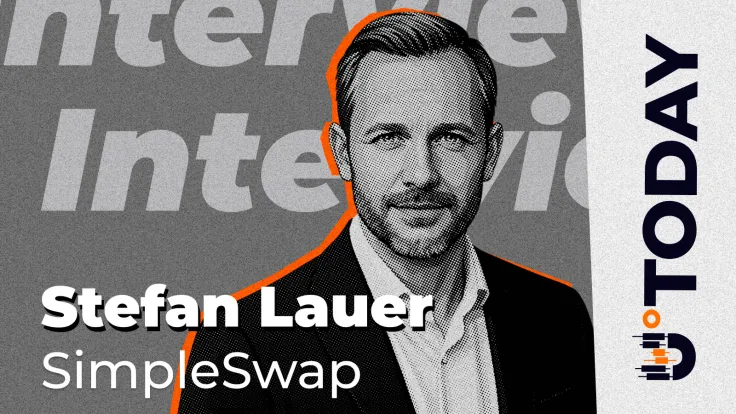
In this interview, Stefan Lauer, Head of Infrastructure at SimpleSwap, discusses how swap systems behave under market stress, common challenges in infrastructure design, and how enterprise requirements are evolving.
U.Today: During the Black Wednesday market event, your platform reported a 98.7% execution rate, while broader industry performance appeared to decline. What factors contributed to this outcome?
Stefan: Architecture, not luck. We aggregate liquidity from 15+ independent sources — CEXs, DEXs, AMMs, and proprietary pools — and no single venue controls more than 25% of our flow. When venues freeze or widen spreads to the point of unusability, routing redistributes automatically. That's what diversified infrastructure does under stress. You can't build that in a quarter — it takes years of refining under real market conditions.
U.Today: Some industry reports, including estimates from KuCoin, suggest that a large share of Web3 projects fail before reaching long-term operational stability. From your perspective, what are the most common reasons infrastructure providers struggle beyond the initial launch phase?
Stefan: Most projects optimize for launch, not for the second year. We've been operating since 2018 through bull runs, crashes, regulatory shifts — and every cycle, partners come to us after their previous provider failed during a volatility spike or changed compliance rules without warning. A fintech partner lost $2 million through another provider on transactions our system would have flagged and blocked proactively. That's the pattern: infrastructure that works on a normal day isn't the same as infrastructure that holds during a flash crash, a regulatory shift, and a liquidity crunch at once.
U.Today: Your infrastructure is integrated into products like Tangem and Exodus, which serve different user segments and technical environments. Those are very different products. Who exactly is your partner?
Stefan: Crypto wallets — custodial and non-custodial. Fintech services are adding an exchange to their product. Payment platforms that need swap infrastructure without building their own liquidity.
Tangem is a security-first cold wallet: private keys on-card, limited NFC sessions. Most providers assume always-on connectivity, which doesn't work with hardware constraints. We adapted routing for device-mediated signing — ensuring non-custodial, cross-chain swaps across 2,800+ assets, all without leaving the secure environment.
Exodus presents a different challenge at the opposite end of the non-custodial spectrum — supporting millions of users and massive volume while maintaining consistent fill rates at scale. They chose us as their built-in fixed-rate swap provider based on our operational track record.
These are two different engineering problems — hardware-level security vs massive scale — that are solved by the same underlying infrastructure.
U.Today: "Boring" is a strange word to build a brand on in crypto. Why lean into it?
Stefan: Because it's what B2B partners actually pay for. Ask any CTO integrating a swap provider — what matters most is whether the system works every Tuesday morning without anyone thinking about it. Enterprises benchmark us like traditional finance now: 99.9%+ uptime, slippage guarantees within ±2%, 15-minute critical support response, SLAs with financial penalties. We publish our compliance procedures, fix our response times, and document what triggers a flag. We've lost significant revenue when a partner demanded routing that conflicted with sanctions — protecting partners' regulatory standing isn't optional. Boring takes eight years to build. There's no shortcut.
U.Today: Compliance measures can reduce transaction volume by filtering or rejecting certain activity. How do your partners approach this trade-off between conversion rates and regulatory safeguards?
Stefan: We run real-time KYT, sanctions screening, geo-fencing, and blockchain monitoring. High-risk transactions auto-decline — that means some volume doesn't convert. It's a conscious trade-off. Partners who work with us understand that compliance infrastructure protects their business and their regulatory standing. The bigger pain in B2B crypto isn't strict compliance — it's providers who hide their processes or change rules without warning. We make it transparent: partners know exactly what triggers a flag, how incidents resolve, and what the response times are. That predictability is what keeps partnerships long-term.
U.Today: Who wins enterprise crypto in the next three years?
Stefan: Enterprise crypto will be evaluated like traditional settlement infrastructure — formal SLAs, audited uptime, regulatory standing. The market is already moving this way. The providers who can meet that bar will compound trust with every integration. The ones who can't won't survive on narrative alone.
U.Today: Final thought for anyone building in this space?
Stefan: Crypto built its first decade on promises. The second decade will be built on uptime. We're ready — the question is whether your current provider is.
 U.Today Editorial Team
 Dan Burgin
