


According to Gate Research, since the start of 2026, major crypto platforms have accelerated their push into traditional financial markets.
Gate is rising to become the No. 1 TradFi platform, adding CFDs, perpetual contracts, tokenized assets, stocks, ETFs, IPO access and wealth-management services to its broader trading ecosystem.
The individual products differ, but the strategic direction is similar. Exchanges are moving beyond the role of digital-asset marketplaces toward unified financial platforms where stablecoins provide a common funding layer and users can access different forms of market exposure from one account.
CFDs are particularly important in this transition because they allow traders to speculate on price movements without directly owning the underlying asset.
What CFDs add to crypto trading model
A CFD settles the difference between the opening and closing price of an instrument. A trader taking a position on gold, for example, does not receive physical gold. Similarly, an equity CFD generally provides exposure to a company's share price without transferring shareholder ownership.
This structure supports both long and short positions and can be combined with margin, spreads, commissions and overnight financing.
For crypto users, the appeal is largely operational. Instead of opening a separate brokerage account to trade gold, currencies or stock indices, they can potentially access those markets through infrastructure they already understand.
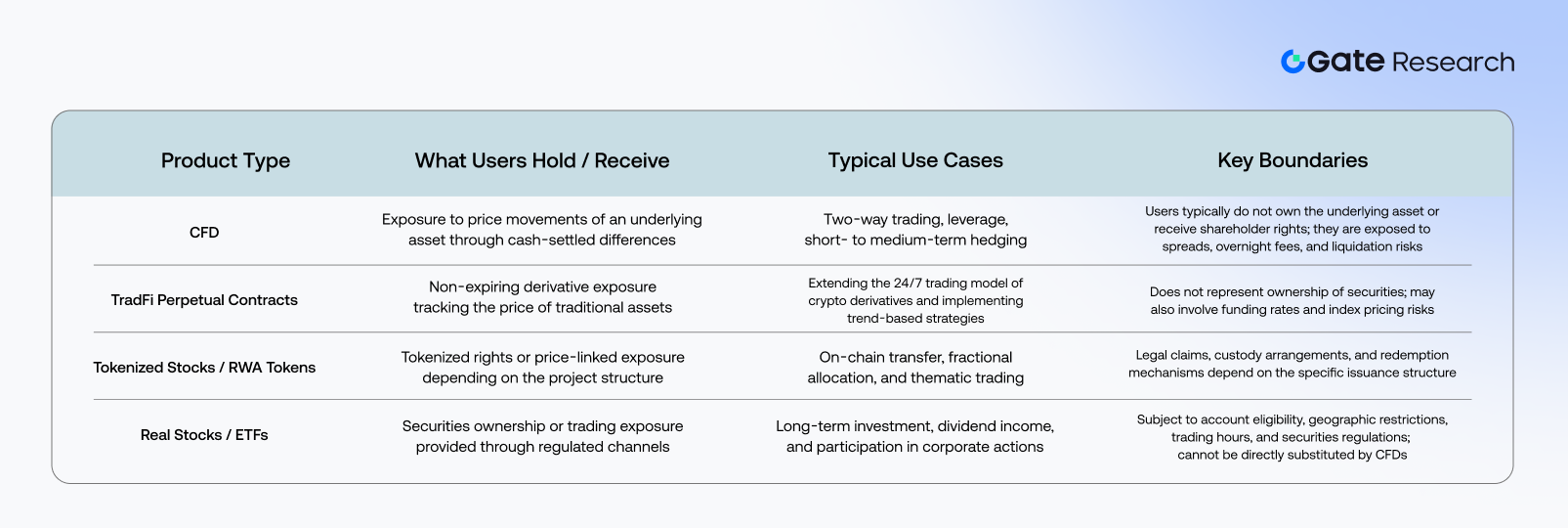
The model also fits event-driven strategies. Macroeconomic releases, central-bank decisions, corporate earnings and geopolitical developments can produce opportunities outside the crypto market, allowing traders to shift their focus without abandoning their existing trading environment.
That convenience does not remove the characteristics of traditional markets. Equities, currencies, commodities and indices operate according to different schedules and liquidity conditions. When a traditional market closes while crypto continues trading around the clock, for example, price gaps and repricing risks can become more significant when that market reopens.
Stablecoins become common funding layer
The expansion of crypto-native TradFi products would be considerably harder without stablecoins. Assets such as USDT allow users to maintain trading capital on a crypto platform without repeatedly moving funds through banks, converting currencies or opening additional accounts.
The same balance can potentially be used across different products, depending on the platform's structure and eligibility requirements.
This creates three practical advantages. First, capital can move between markets more quickly. A trader can potentially shift funds from crypto positions toward gold, forex or equity exposure without beginning an entirely new funding process.
Second, portfolio management becomes easier. Users can measure positions and returns against a common dollar-linked unit rather than constantly converting between different currencies.
Third, capital utilization can improve. Funds that might otherwise sit unused during a quiet period in crypto markets can potentially be deployed elsewhere.
There is an important trade-off, however. A common funding layer can also connect risks that previously existed in separate accounts. Crypto volatility, stablecoin liquidity, traditional-market gaps and platform risk controls can interact within the same financial environment.
A unified account therefore does not mean unified risk.
Why crypto traders are looking beyond crypto
Several factors are driving interest in traditional-asset exposure. Crypto markets remain highly cyclical. When major tokens enter periods of low volatility, traders may have substantial stablecoin balances without attractive opportunities. Meanwhile, currencies, commodities, equities and indices continue responding to their own catalysts.
The second factor is hedging. Correlations between crypto and traditional assets change over time, but macroeconomic conditions often influence several markets simultaneously. Having access to gold, currencies, equity indices or commodities gives traders additional instruments for expressing views or managing exposure.
There is also a behavioral factor. Crypto has already introduced millions of traders to leverage, technical analysis, automated strategies, APIs, stop-loss orders and other tools. Many users now expect traditional markets to be accessible through similarly familiar interfaces.
For international users, access is another consideration. Traditional brokerage accounts can involve different KYC procedures, funding systems, minimum balances and geographic restrictions. Crypto platforms can reduce some of that friction through stablecoin-based funding, although they cannot override local regulations or eligibility requirements.
Four stages of crypto's TradFi expansion
The development of crypto-based CFD platforms can broadly be viewed through four overlapping stages. The first involved leverage within crypto itself, with exchanges competing around perpetual contracts, margin, fees and liquidity.
The second introduced traditional-market exposure through external brokerage infrastructure and terminals such as MT5. Crypto platforms effectively became distribution or funding channels while the actual trading experience remained separate.
The third stage brought CFDs directly into exchange interfaces. Users could fund positions with stablecoins and trade traditional assets through familiar crypto-style applications.
The fourth stage is now emerging: integrated cross-asset accounts. CFDs sit alongside perpetuals, stocks, ETFs, tokenized assets, APIs, custody and wealth-management products.
At this point, the competition is no longer simply about who can offer CFDs. It is about which platform can connect different markets, capital pools and user groups most effectively.
Gate's rapid rise in TradFi trading
Gate provides one of the clearest examples of this shift. According to CryptoQuant data cited in the original research, Gate accounted for 39.4% of the combined TradFi derivatives volume reported by five major platforms, ahead of Binance at 31.9%.
The data represent only the platforms included in that comparison rather than the entire global exchange market.
Gate's growth was particularly rapid during the first quarter of 2026. Its reported TradFi perpetual volume increased from $3.4 billion in January to $56.7 billion in February and $295.8 billion in March.
The surge coincided with stronger demand for exposure to gold, silver and other traditional markets. Gate's strategy was not limited to precious metals, however. It subsequently expanded across equities, indices, forex and commodities.
By June, its reported year-to-date TradFi perpetual volume had reached $368 billion.
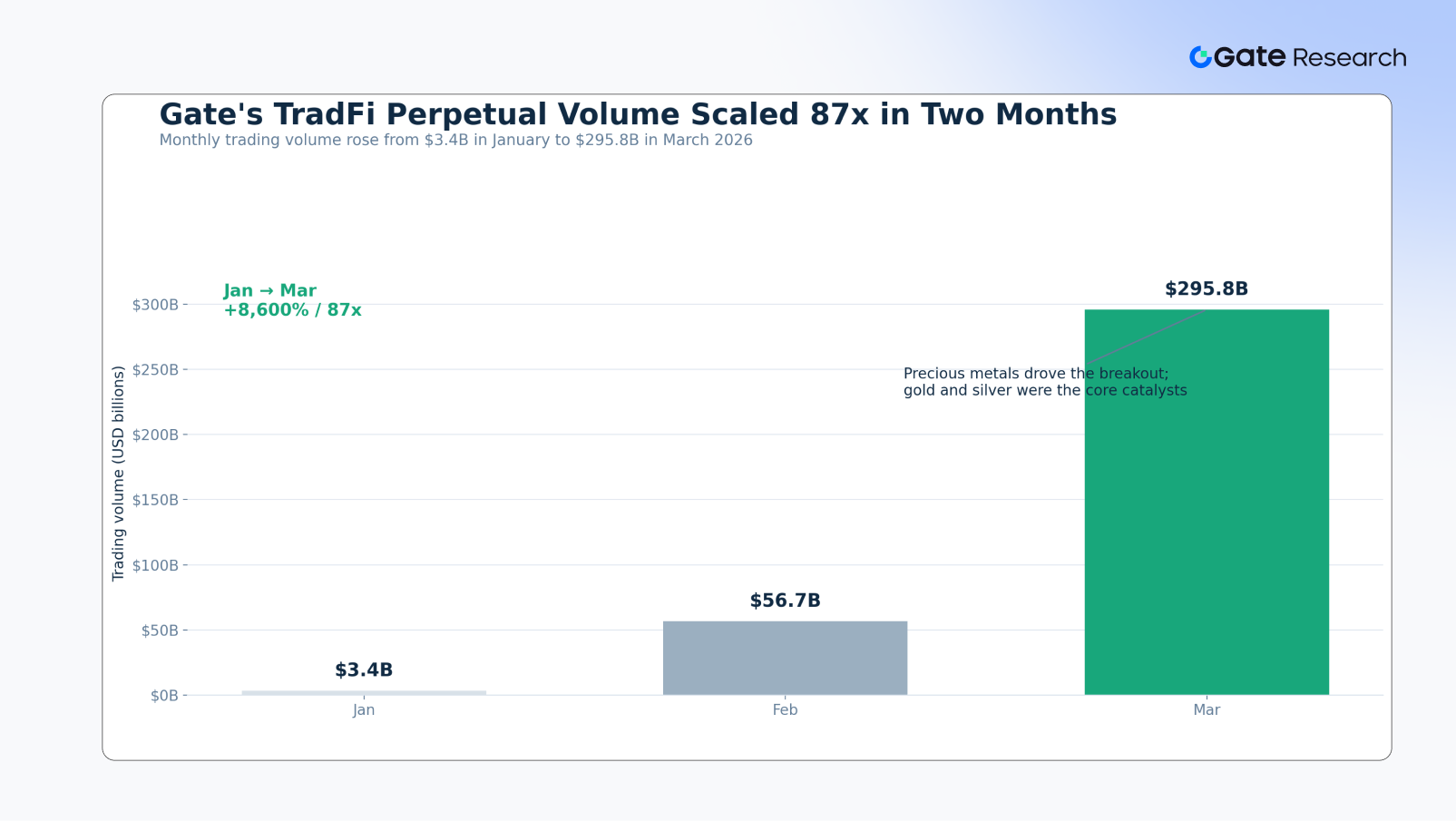
The numbers indicate that Gate's TradFi expansion has moved beyond an experimental product launch. The larger question now is whether high trading volume can translate into durable liquidity, open interest, professional participation and long-term capital retention.
Broader product ladder
Gate's strategy has also relied on expanding the number of ways users can express a view on the same market.
By the end of Q2 2026, Gate reported 663 CFD instruments across equities, ETFs, indices, forex, precious metals, energy and other commodities.
The significance of that range lies less in the headline number than in the different trading scenarios it supports. Gold can serve as a safe-haven instrument, equity indices can capture broader risk sentiment, individual stocks can reflect company-specific developments, while currencies and commodities respond to macroeconomic and geopolitical factors.
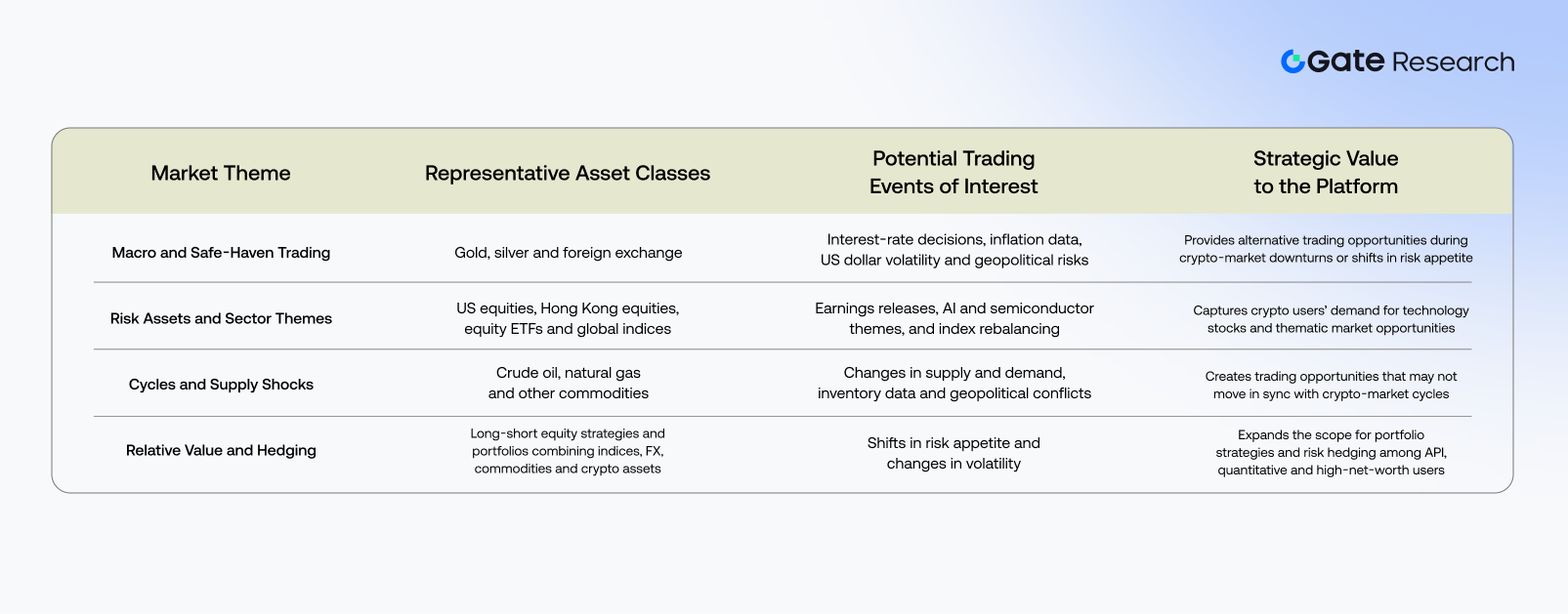
In May, Gate brought CFDs, perpetual contracts and spot tokens into its broader TradFi trading section. The following month, it expanded into real-stock trading in selected US, Hong Kong and South Korean markets and added IPO Access.
A user could begin with a short-term gold CFD and eventually move toward an ETF or individual stock for longer-term exposure. Professional users can enter through APIs, custody or institutional services and use several products within the same broader ecosystem.
Liquidity and capital efficiency become real test
Product count alone does not determine whether a CFD platform is competitive. The underlying pricing infrastructure, liquidity, margin engine and execution system ultimately determine the quality of the experience.
A platform must source reliable prices, maintain sufficient depth, manage leverage and liquidation parameters, and handle periods of extreme volatility. Costs also extend beyond the visible trading fee. Spreads, slippage, overnight financing and corporate-action adjustments can materially affect returns.
Gate's existing derivatives infrastructure provides a foundation for this expansion. CoinGlass data cited in the research put Gate's H1 2026 crypto derivatives volume at $2.53 trillion, with average daily open interest of $10.23 billion.
These figures relate to Gate's crypto derivatives market rather than its CFD business, but they demonstrate the scale of the exchange's existing experience with margin, liquidity and derivatives risk management.
Gate also reported peak weekly CFD volume above $150 billion during Q2, while its CFD copy-trading product generated more than $95 billion in cumulative copied volume during its first quarter.
The next stage of the market is likely to depend increasingly on professional users. Gate introduced a TradFi API supporting automated trading, market data and account management across products including metals, forex, indices and commodities.
Copy trading adds another layer by turning individual trading strategies into products that other users can follow. This can increase the supply of strategies available to retail traders while giving successful lead traders a way to monetize their performance.
Neither mechanism eliminates risk. Copying a strategy can produce different results from the lead trader because of execution timing, fees, slippage and differences in account size.
Institutional infrastructure is another part of the equation. Gate has continued developing custody, cross-exchange trading, OTC financing, unified settlement and wealth-management services alongside its trading products.
The objective is increasingly clear: capture not just trading activity, but the wider lifecycle of professional capital.
CFDs as gateway, not destination
The evolution of Gate's platform illustrates a broader change taking place across crypto markets.
CFDs provide a relatively accessible way to introduce traditional-asset exposure to crypto users. But the longer-term opportunity lies in connecting that exposure with other products.
The resulting structure can be viewed as three layers:
- Trading capital. Perpetuals and CFDs generate positions, margin requirements and trading activity.
- Account capital. Stablecoins, stocks and ETFs allow users to keep capital within the platform across different investment horizons.
- Professional capital. APIs, copy trading, custody, institutional execution and wealth management support more sophisticated strategies and larger portfolios.
This creates a feedback loop. More markets increase the number of potential use cases, while a larger user base provides more liquidity and trading activity. Better infrastructure can then attract more sophisticated participants.
The crypto CFD market is therefore becoming less about adding another derivative product and more about controlling the account layer through which users access global markets.
Traditional CFD brokers retain important advantages in licensing, market infrastructure and established financial-market processes. Crypto exchanges, meanwhile, bring stablecoin liquidity, large digital-asset communities, 24-hour operations and experience with leveraged trading.
Neither model automatically replaces the other. The platforms with the strongest long-term position may instead be those capable of combining both sets of capabilities without hiding the differences in risk, ownership, settlement and regulation between products.
For Gate, the challenge is now to turn its early TradFi volume advantage into a sustainable ecosystem. If it can maintain liquidity, attract professional capital and keep users active across CFDs, derivatives, equities, ETFs and wealth products, CFDs could prove to be more than another revenue stream.
They could become one of the main entry points through which crypto exchanges evolve into broader global trading platforms.
 U.Today Editorial Team
 Dan Burgin
