

Flare’s native token, $FLR, is seeing renewed momentum ahead of a major governance vote that could significantly reshape the network’s economic model.
Last week, Flare has introduced a new governance proposal that would significantly restructure its network architecture, introduce a protocol-level revenue mechanism and reduce token inflation.
The token has climbed roughly 8.6% over the past week to around $0.0081, with trading activity picking up as market participants position ahead of the April 16 to April 24 voting window.
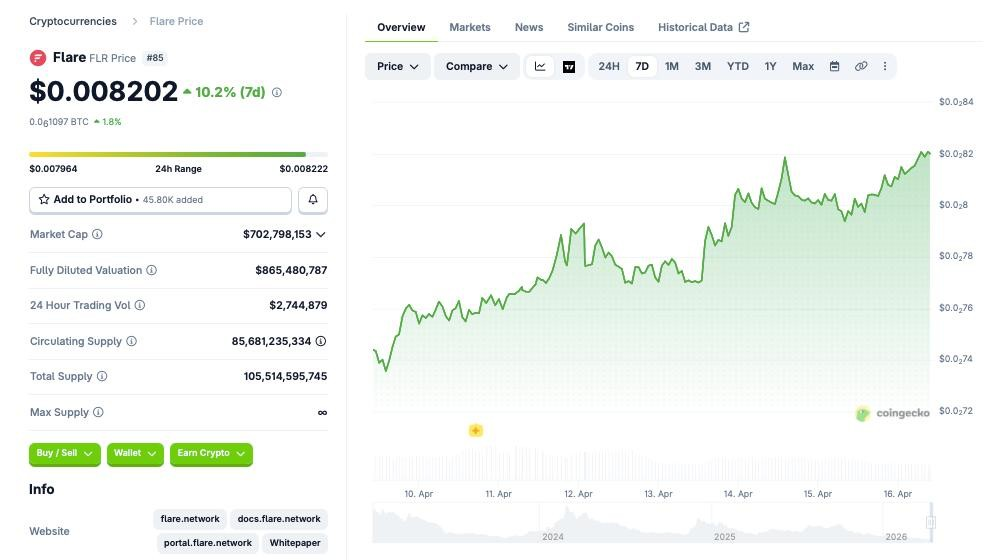
The price reaction reflects growing attention around a proposal that combines structural changes to block production with aggressive tokenomic adjustments.
Investors appear to be pricing in the potential impact of reduced inflation, increased token burns, and a new mechanism to capture value at the protocol level.
MEV capture and network redesign
At the center of the proposal is a fundamental change to how Flare handles block building and maximal extractable value (MEV). Instead of leaving MEV extraction to external actors, the network aims to internalize this revenue stream, redirecting it back into the ecosystem.
The transition would take place in three stages. Initially, block construction would move from individual validators to a designated builder operated by the Flare Entity, with fallback support to maintain network stability.
In the second phase, the process shifts to Flare Confidential Compute, enabling public auditability while preserving transaction privacy. The final stage merges builder and proposer roles, with validators transitioning into a verification-focused function.
This redesign is intended to improve efficiency in transaction ordering while ensuring that value generated through MEV is captured at the protocol level rather than by a small subset of participants.
Token burn model and inflation cut
A key driver behind the recent price move is the introduction of FIRE, the Flare Income Reinvestment Entity. This mechanism would collect revenue from across the protocol and use it for open-market buybacks and token burns, effectively linking network activity to direct supply reduction.
If approved, the proposal would also cut annual inflation from 5% to 3%, reducing the issuance cap from 5 billion to 3 billion FLR per year.

At the same time, the base gas fee would increase sharply, from 60 gwei to 1,200 gwei, significantly accelerating token burn. Estimates suggest annual burns could rise from around 7.5 million FLR to as much as 300 million under current usage conditions.
Together, these changes introduce a more deflationary structure, which appears to be a key factor behind the current market optimism.
 U.Today Editorial Team
 Dan Burgin
