
Disclaimer: The opinions expressed by our writers are their own and do not represent the views of U.Today. The financial and market information provided on U.Today is intended for informational purposes only. U.Today is not liable for any financial losses incurred while trading cryptocurrencies. Conduct your own research by contacting financial experts before making any investment decisions. We believe that all content is accurate as of the date of publication, but certain offers mentioned may no longer be available.

Ethereum transaction fees have reached their lowest point since May 2017, which is a unique and significant structural development for the network. History indicates that extremely low fees are frequently a sign of recovery rather than long-term decline, even though price action remains weak and sentiment around ETH is still cautious.
Transaction fees gone
According to on-chain data, total transaction fees are plunging to levels not seen in almost 10 years, and this is not merely a transient variation or short-lived anomaly. Instead, it reflects a sustained and consistent decrease in user expenses and overall network congestion.
Similar fee compression has occurred near market lows in earlier cycles, typically after speculative excess was flushed out and only genuine usage remained. In those environments, builders tend to benefit far more than traders, and builders are ultimately what drive Ethereum’s long-term value.
Low fees matter because they restore Ethereum’s core functionality. When transaction costs rise, activity either slows dramatically or migrates to alternative networks. Once fees collapse, minting assets, deploying DeFi protocols, executing smart contracts and performing complex transactions all become economically viable again. This is the foundation on which decentralized finance actually grows, rather than the result of hype-driven price rallies.

Periods of suppressed fees have historically coincided with accumulation phases. Low transaction costs accompanied the ecosystem’s quiet reconstruction in 2018-2019, and again after the collapse in 2022.
Price reflection
Long before price action reflected any improvement, developers shipped updates, protocols matured and liquidity slowly began to return. Usage precedes price, not the other way around.
Crucially, low fees also strengthen Ethereum’s competitive position. Cost inefficiency has been a central theme in narratives predicting Ethereum’s decline, and that thesis weakens materially when the cost problem is removed. Lower fees improve the user experience, increase experimentation and enhance capital efficiency across the ecosystem.
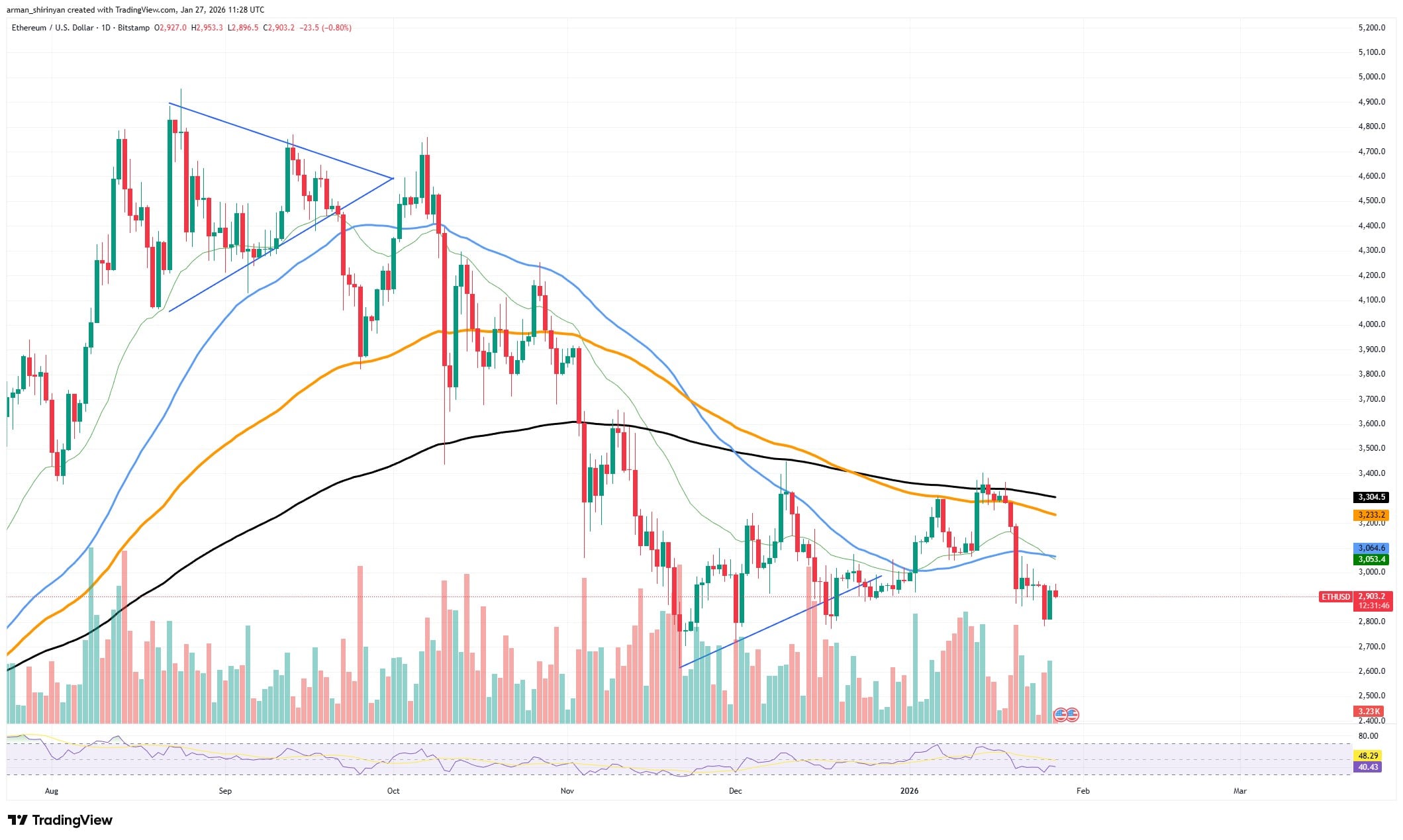
None of this guarantees immediate upside, and it should not be interpreted as a signal that a bull market is imminent. ETH remains below key moving averages on the chart, and structural improvement does not automatically translate into short-term price strength.
Markets do not bottom when conditions look obviously favorable. They bottom when conditions quietly improve while price action still looks bad. Fee collapse is one of those subtle improvements.
 Dan Burgin
 U.Today Editorial Team
 Vladislav Sopov
