
Disclaimer: The opinions expressed by our writers are their own and do not represent the views of U.Today. The financial and market information provided on U.Today is intended for informational purposes only. U.Today is not liable for any financial losses incurred while trading cryptocurrencies. Conduct your own research by contacting financial experts before making any investment decisions. We believe that all content is accurate as of the date of publication, but certain offers mentioned may no longer be available.

The market is not feeling like moving at this point in time: the main source of volatility (U.S. markets) is currently on holidays, which is why we should expect movement only in the next year.
Shiba Inu stays suppressed
Right now, Shiba Inu is trapped in one of the harshest technological environments it has encountered this year. Volatility is muted, the price is drifting close to local lows, and every attempt at a bounce is met with the same issue: stacked resistance overhead.
SHIB is currently battling four walls instead of just one. The short-term moving average cluster is the initial and most direct obstacle. SHIB’s fast averages, which are still declining, are being traded below. Short-term relief rallies are almost immediately capped by these levels, which suppress momentum and discourage follow-through purchases. Upside attempts continue to be reactive rather than trend-driven as long as the price remains below this range.
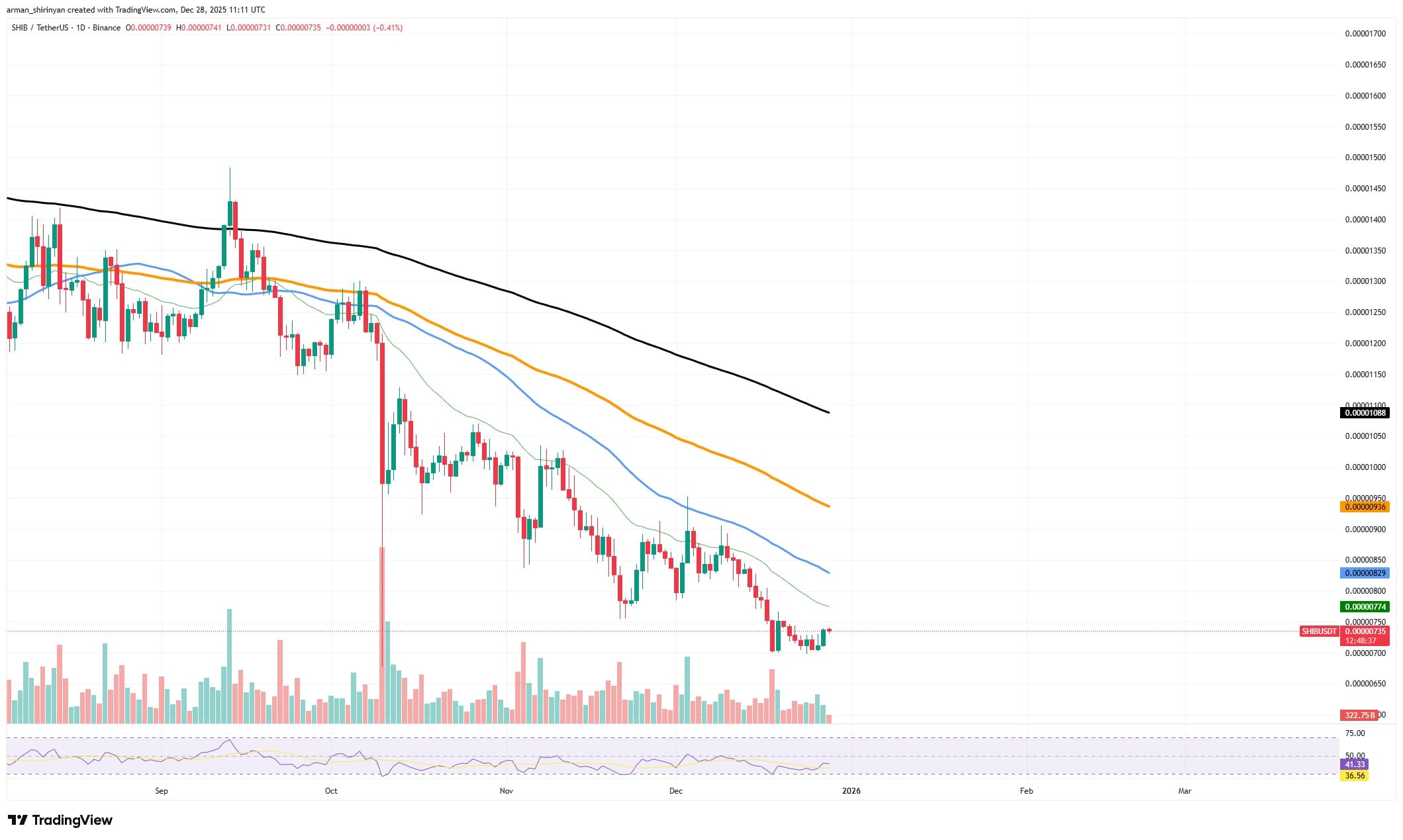
The medium-term moving average, which has been serving as dynamic resistance since October, is the second obstacle. The larger downtrend structure has been reinforced by each push toward it that has been met with rejection. This level is important because swing traders usually add supply on each approach by reentering short positions at this point.
The long-term trend average is the third barrier, which is situated higher and is more psychological than technical. This line indicates whether SHIB is entering a recovery phase or is in a bear phase. It is currently trending lower and much higher than the price. The market will not consider a bullish regime shift until SHIB even gets close to this level.
The fourth obstacle is structural. SHIB is still trapped in a downward price channel with lower highs and lows. The price must break out of this larger structure to indicate that sellers are losing control, even if it is able to recover one or two moving averages. Any bounce without it runs the risk of turning into just another lower high.
This reality is reflected in momentum indicators. The RSI is weak but not giving in, it is currently in the low 40s. Volume has declined, indicating that buyers are not intervening either, but sellers are no longer assertive. Instead of a reversal, this results in stagnation.
Can XRP come back to bull market?
XRP was unable to enter a sustained bull market for the majority of this year. Each push higher ended with lower highs, rallies were brief, and structure continued to be corrective. Price frequently rolled over once it reached important resistance zones, and momentum never persisted. To put it simply, XRP moved more like a distribution-stuck asset than an expanding one.

This context is important because the current situation is different. XRP has changed its behavior following months of constricted and annoying price action. XRP avoided a complete structural breakdown and instead carved out a controlled declining channel while the overall market retreated. Now, selling pressure has clearly diminished, volatility is compressing, and that channel is flattening. This is a regime shift from ongoing rejection, but it is not yet an explosive upside.
XRP was unable to maintain trading above medium-term moving averages for longer than a few sessions earlier in the year. Every trend resistance test was met with instant supply. Instead of crashing through important levels, price action is currently stabilizing close to them. It is a minor but significant distinction. Early bull phases absorb, while bear markets reject.
Indicators of momentum back that change. The RSI is stabilizing in the low-40s range and has stopped making lower lows, indicating that the downward momentum is no longer accelerating. After significant sell-offs earlier in the cycle, volume has returned to normal, indicating that forced selling is mostly complete. Positioning is what’s left.
Calling this a full-blown bull run would be premature because, structurally, XRP is still below long-term resistance. However, bull markets often begin with failed breakdowns rather than clear breakouts. The first indication that control may be shifting is when XRP is unable to move much lower despite a bearish structure.
Bitcoin is sleeping
As is usually the case at the end of the year, Bitcoin is not making any significant moves. Following a steep decline, the price is contracting in a narrow range, volatility is declining, and both sides of the market appear worn out rather than assured. This is a holding pattern rather than distribution euphoria or accumulation panic. Technically speaking, Bitcoin is trading significantly below its important moving averages.
While the 200-day average sits above as far-off resistance, the 50- and 100-day averages are declining. The RSI is stuck in the mid-40s, indicating indecision rather than fear, and momentum indicators are flat. Since the November sell-off, volume has significantly declined, indicating that aggressive participation has temporarily ceased.

What matters is not only what appears on the chart but also the reasons behind it. Risk assets are structurally dead by the end of December. Reallocations are mostly frozen, institutional desks are closing books, and the majority of funds are more focused on year-end reporting than starting new exposure.
Spreads increase liquidity, and the likelihood of significant trend formation declines. Additionally, retail is not driving anything. Following a turbulent year, interest in markets wanes until the calendar flips. Regardless of how bullish or bearish the overall narrative sounds, that combination — institutional absence and retail fatigue — is exactly how Bitcoin ends up chopping sideways.
It is therefore unlikely that volatility will increase before Dec. 31. Unless compelled, big money does not force size into low-liquidity holiday conditions. They stand by. Additionally, flows return with intent when they return, usually during the first full trading week of January.
 Dan Burgin
 U.Today Editorial Team
