

The tokenization of traditional financial assets has moved beyond an experimental niche. Crypto platforms are adding tokenized equities and stock perpetual contracts, while traditional financial infrastructure providers are also exploring blockchain-based settlement and trading.
For market participants, this creates a more complicated comparison problem. An exchange might have substantial trading volume but relatively thin order books, while another venue could have lower volume but tighter spreads or greater depth for specific contracts.
Stock perpetuals add another layer. Unlike spot tokenized stocks, perpetual contracts are derivatives whose liquidity can be influenced by open interest, funding conditions and the structure of the underlying order book.
A ranking that captures only one of these variables can therefore obscure important differences between markets.
How RootData approaches the rankings
RootData's live exchange rankings are designed around this broader set of variables. Its stock derivatives ranking evaluates exchanges using trading volume, open interest, spreads, depth, trading costs and data availability, among other indicators.
The platform also tracks stock spot markets using publicly available trading and order-book data, with its ranking considering trading activity, liquidity, active products and stock and broker-channel coverage.
The distinction is important because trading volume measures activity rather than execution conditions. A high-volume market can still be expensive to trade if its spread is wide or its order book is shallow.
RootData's data provides examples of why these metrics can produce different conclusions. Its recent stock derivatives updates have tracked changes in rankings alongside movements in volume and open interest.
In one July snapshot, Binance, Hyperliquid and OKX occupied the top three positions by the platform's composite ranking, while earlier data showed significant shifts among Bybit, Bitget, MEXC and other venues.
The rankings are therefore better understood as a live market-monitoring framework rather than a static league table.
Why liquidity and depth matter
Spread provides another piece of the picture. RootData describes its spread metric for stock derivatives as a 24-hour volume-weighted measure, with a wider spread generally indicating higher trading costs. Its recent data has also highlighted substantial differences between exchanges.
These measurements can change quickly. On Aug. 18, RootData data showed the widest 24-hour volume-weighted spreads among ranked venues at HTX (0.589%), BingX (0.327%) and OrangeX (0.278%). Such differences illustrate why trading volume alone may not fully describe execution costs.
From rankings to a wider data network
The exchange rankings form part of RootData's broader data infrastructure. Its API serves more than 220 institutional clients, with stock perpetual data covering trading pairs, market conditions and liquidity.
Reported users include major platforms such as Binance, OKX, Bitget and Gate, alongside market makers and research firms including Amber Group and Presto Research.
RootData has also described an ecosystem of more than 220 data partners, through which its structured Web3 information can be distributed across exchanges, wallets, research products and other services.
Examples cited in RootData's broader ecosystem include Binance, OKX, Gate, Bybit, Bitget Wallet, TokenPocket, CertiK and the Ethereum Foundation. Their presence in the network should not be interpreted as an endorsement of any particular RootData ranking or methodology.
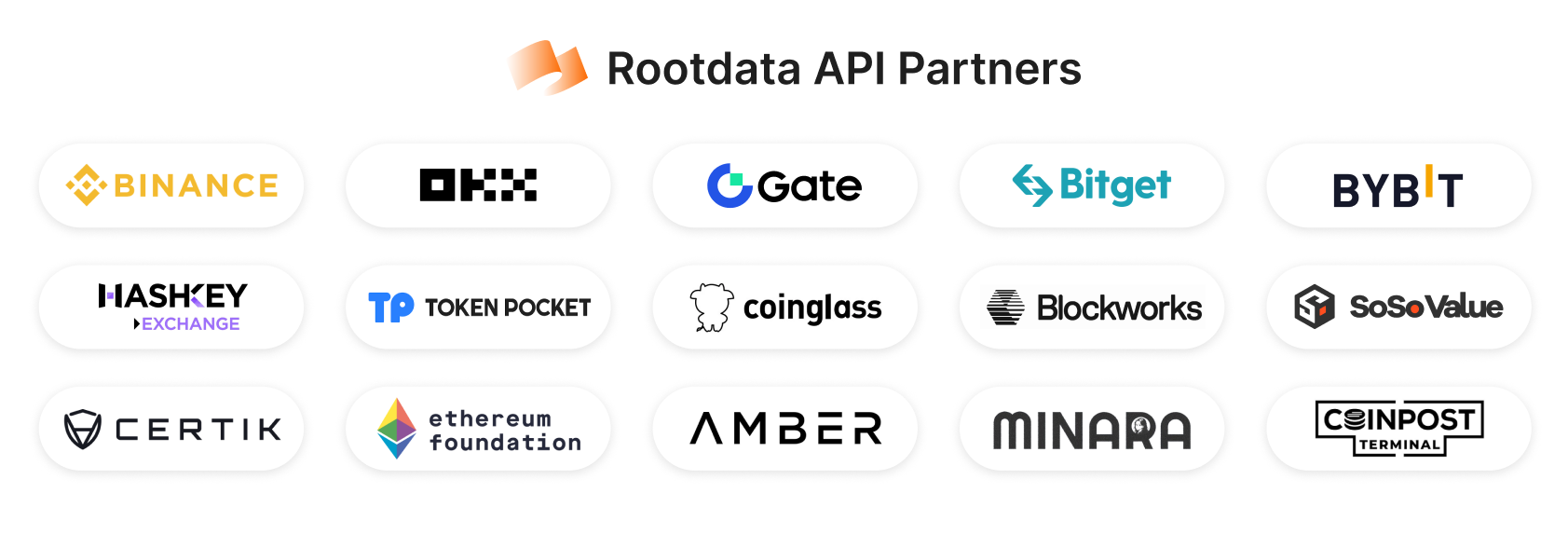
Rather, it illustrates the wider role structured market and project data can play across the Web3 information ecosystem.
A growing reference point for the market
RootData's stock rankings have also begun appearing in regional crypto coverage and market discussions. Several renowned APAC media outlets have reported multiple ranking updates, including changes in the positions of Binance, Hyperliquid, OKX, Bybit and other platforms. According to Binance, citing RootData, among 3,244 crypto projects with financing histories spanning no more than four years and with verifiable amounts, 1,617 had raised no more than $5 million in total, accounting for 49.8% of the sample.
The data is also being circulated through RootData's social channels, where recent updates have focused on specific changes in market share, spreads and order-book depth rather than rankings alone.
This gives the rankings a more dynamic role: they can function as a starting point for discussing why exchange positions change, rather than simply identifying who sits at the top.
Tokenized stocks may ultimately bring traditional securities closer to blockchain infrastructure, but their markets will still depend on familiar concepts such as liquidity, execution costs and depth. As the sector expands, transparent and regularly updated data can make those differences easier to observe.
RootData's rankings are one attempt to provide that reference layer, moving the conversation beyond headline trading volumes toward a broader view of market quality and participation.
Rankings are informational snapshots, not investment advice. Tokenized stock products and stock derivatives may differ materially in legal rights, custody arrangements, liquidity and jurisdictional availability.
 U.Today Editorial Team
 Dan Burgin
