
Disclaimer: The opinions expressed by our writers are their own and do not represent the views of U.Today. The financial and market information provided on U.Today is intended for informational purposes only. U.Today is not liable for any financial losses incurred while trading cryptocurrencies. Conduct your own research by contacting financial experts before making any investment decisions. We believe that all content is accurate as of the date of publication, but certain offers mentioned may no longer be available.

As revealed in the latest SEC filing, U.S.-based Riot Platforms will sell 4,300 BTC and direct the proceeds toward expanding its data center network for AI workloads, confirming that the largest miners are moving away from the strategy of passively accumulating cryptocurrency.
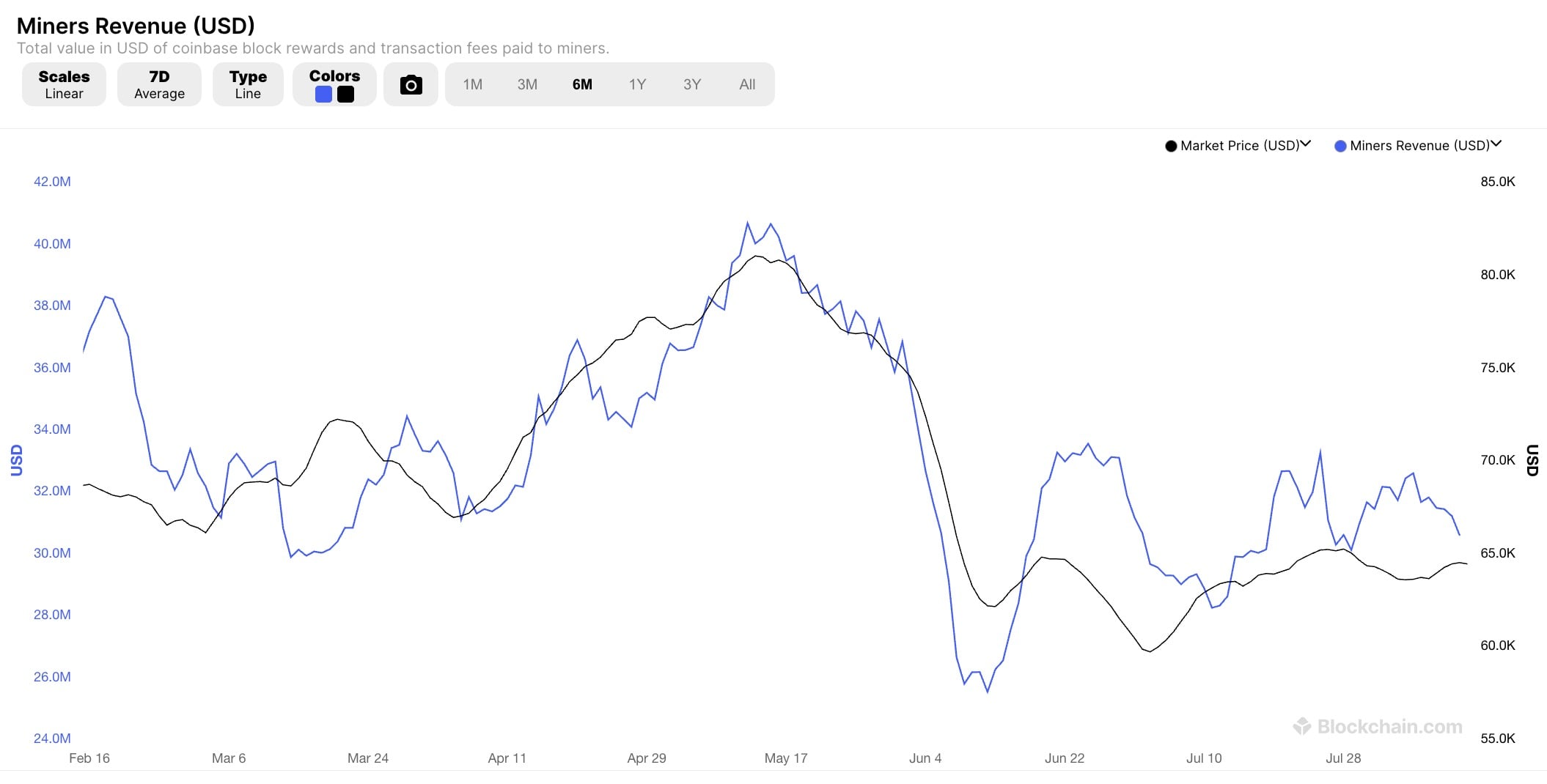
The shift in priorities was driven by a prolonged decline in mining income. In the second quarter, the company's mining revenue fell 19.3% due to rising electricity costs and hashprice falling to historic lows.
Bitcoin mining margin pressures are funding the AI pivot
The market situation remains tense. Bitcoin is trading within a narrow range of around $63,500–$63,700, while the average cost of mining it across the market, according to industry models, stands at $76,000–$78,000 per coin.
As a result, the average miner on the network is currently operating at a loss, as hashprice has fallen to a record low of $30–$35 per PH/s per day. Only operators with extremely cheap electricity and the latest equipment remain profitable.
Riot's figures are better than the market average, but the broader trend has affected the company as well. Its direct cost of mining one Bitcoin rose to $49,912 due to higher energy rates and the expansion of its capacity in Kentucky.
This forced management to partially liquidate its holdings by selling some of its accumulated coins, while mining revenue stood at $113.7 million.
At the same time, the company maintains a strong balance sheet and a $1.2 billion cushion of liquid assets, including $548.9 million in cash and a reserve of 11,380 BTC.

However, its business model is shifting toward a more predictable infrastructure business. Riot has already delivered its first capacity for AMD, while its key long-term project is a 20-year contract to lease AI laboratory facilities, with expected revenue of $9.1 billion.
Riot's actions reflect a broader market trend in 2026, as miners gradually transform into operators of computing centers. Other major players, including MARA Holdings, Core Scientific, and Bitdeer, have previously partially or fully liquidated their crypto reserves to fund the construction of AI infrastructure.
 U.Today Editorial Team
 Dan Burgin
