

Disclaimer: The opinions expressed by our writers are their own and do not represent the views of U.Today. The financial and market information provided on U.Today is intended for informational purposes only. U.Today is not liable for any financial losses incurred while trading cryptocurrencies. Conduct your own research by contacting financial experts before making any investment decisions. We believe that all content is accurate as of the date of publication, but certain offers mentioned may no longer be available.

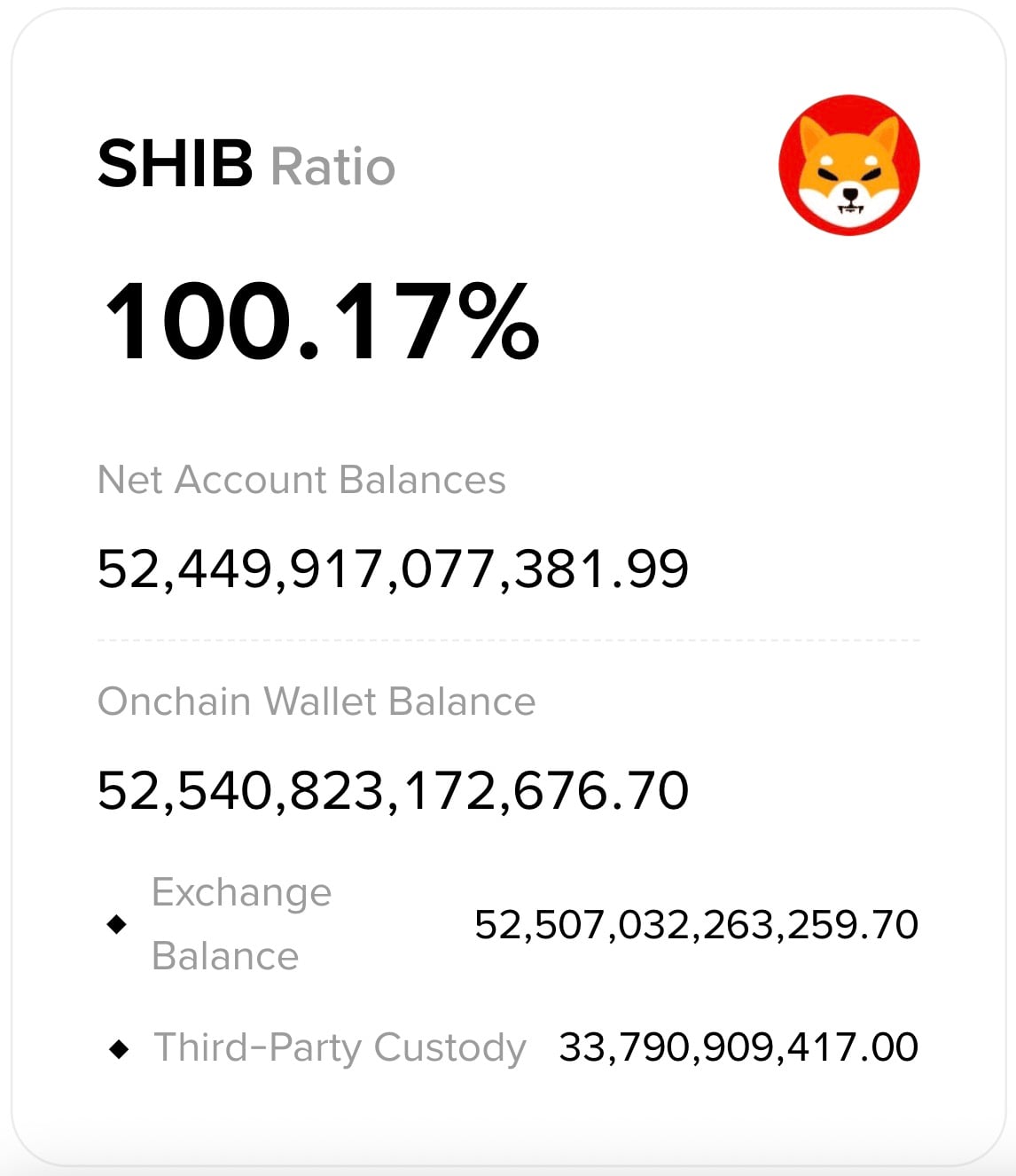
According to the latest proof-of-reserves report from Binance for February 2026, Shiba Inu (SHIB) experienced a period of so-called "soft unloading," reflecting notable changes in the behavior of large holders of the token.
Over the month, total SHIB reserves on the world's largest crypto exchange declined from 53.27 trillion to 52.54 trillion tokens. In percentage terms, this represents a drop of 1.38%. At first glance, it may appear insignificant, yet in absolute terms, more than 733 billion SHIB "disappeared" from the platform.
Interpreting Shiba Inu (SHIB) migration from Binance
One notable detail is that user balances and the exchange’s own reserves decreased almost identically, indicating that Binance is not simply selling its own holdings but is effectively responding to client withdrawals while maintaining the coverage ratio at 100.17%.
It is also noteworthy that the amount of 33.79 billion SHIB held in third-party custodial storage remained unchanged. This can be considered a protected reserve that the exchange keeps outside its hot wallets to enhance security.
Despite the outflow, Binance remains one of the largest whales of the token, controlling about 9% of the entire market supply of SHIB. What happened can be interpreted in two ways. On one hand, it may reflect a reduction in speculative interest. Some participants either locked in profits or moved capital into other assets.
On the other hand, mass withdrawals of tokens from exchanges are often described as a bullish signal. In such cases, investors move assets to cold wallets for long-term holding, which can reduce immediate selling pressure.

Overall, the February report confirms the full solvency of Binance with respect to the Shiba Inu token, while recording a local pattern of capital moving from exchange order books into private hands.
As a result, the SHIB market may become more distributed, while trust in the exchange as a custodian remains strong.
 Dan Burgin
 Vladislav Sopov
