
Disclaimer: The opinions expressed by our writers are their own and do not represent the views of U.Today. The financial and market information provided on U.Today is intended for informational purposes only. U.Today is not liable for any financial losses incurred while trading cryptocurrencies. Conduct your own research by contacting financial experts before making any investment decisions. We believe that all content is accurate as of the date of publication, but certain offers mentioned may no longer be available.

TL;DR
- $560 million in daily trading volume hits Robinhood Chain as the CashCat token drives new wallet activity.
- Bitwise removes Polkadot and Avalanche from its 10 Crypto Index, replacing them with Stellar (XLM) and Hyperliquid.
- 40 BTC moves from a wallet untouched since 2010, worth $2.54 million at current prices.
- Spot Bitcoin ETFs post a $221 million net inflow on July 9, ending a 10-day outflow streak.
- CPI and PPI data due July 14 to 15, followed by the Fed's July 28–29 meeting, will test Bitcoin's path toward $100,000.
How the CashCat meme coin pushed Robinhood's new blockchain to $560 million
The new Robinhood Chain blockchain, launched just a week ago, is already going through its first major hype cycle. Speculative excitement around the Cash Cat meme coin (CASHCAT) pushed daily trading volume on local DEXs to a massive $560 million, according to Dune data.
In just one day, users created almost 16,000 new tokens on the network, while the number of active wallets jumped to 200,000 — and for most of them, it was their first-ever transaction on the chain.
The market fever was partly triggered by Robinhood CEO Vlad Tenev himself. On X, he dropped a short but striking comment: "Although we built Robinhood Chain as the best network for serious assets (RWA)… it works great for meme coins too."
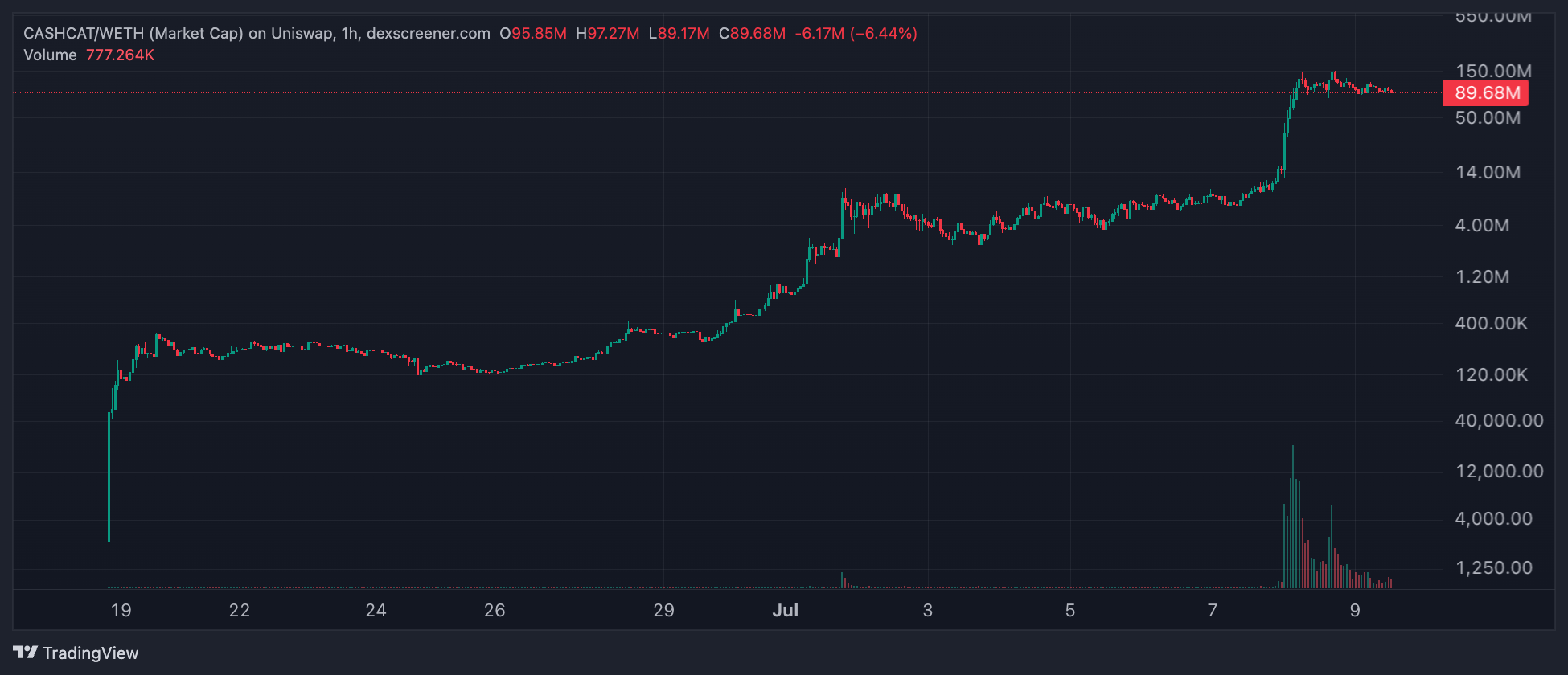
That was enough for the market capitalization of the network's flagship meme coin, CASHCAT, to break above $140 million at its peak. In one day, it gained more than 1,000%, and by morning its price had settled around $0.083.
This surge instantly turned a couple of early investors into millionaires. According to Lookonchain, one trader bought a batch of CASHCAT 20 days ago for just $838, then during the hype withdrew $917,600 in pure profit, while leaving another hundred thousand dollars in tokens.
But behind the beautiful screenshots lies a harsh reality. The total liquidity pool of CASHCAT is only $2.6 million, which means only a few people could actually pull real millions out of the system. Social media is already full of fake claims, such as allegations that Uniswap creator Hayden is heavily buying the token, or that Robinhood's CFO put the "cash cat" on his avatar — in reality, the description in his profile had always been there.

In the end, Robinhood Chain got the perfect start for any new blockchain: wild activity and a lot of money in fees. The only question is whether anyone will stay once this "cat token" stops delivering multiples.
Hyperliquid pushes the old guard out of Bitwise's top-10 index
The major crypto index fund, the Bitwise 10 Crypto Index ETF (BITW), has carried out a tough portfolio cleanup — Polkadot (DOT) and Avalanche (AVAX) were completely removed. Their places were taken by Stellar (XLM) and, much more notably, the young token of decentralized exchange Hyperliquid (HYPE).
The newcomer received a weight of about 0.95% and now trades in the same lineup as Bitcoin, Ethereum, and XRP.
Institutions are clearly shifting priorities. Instead of promise-based blockchains, they are choosing projects that generate real revenue right now. Hyperliquid posted massive numbers in the first half of 2026: $1.34 trillion in trading volume and $320 million in net revenue.
The HYPE token itself has gained 165% since January. On top of that, the platform runs the HIP-3 upgrade, under which 99% of fees go toward token buybacks and burns.
For large players, this looks like a classic and straightforward stock buyback.
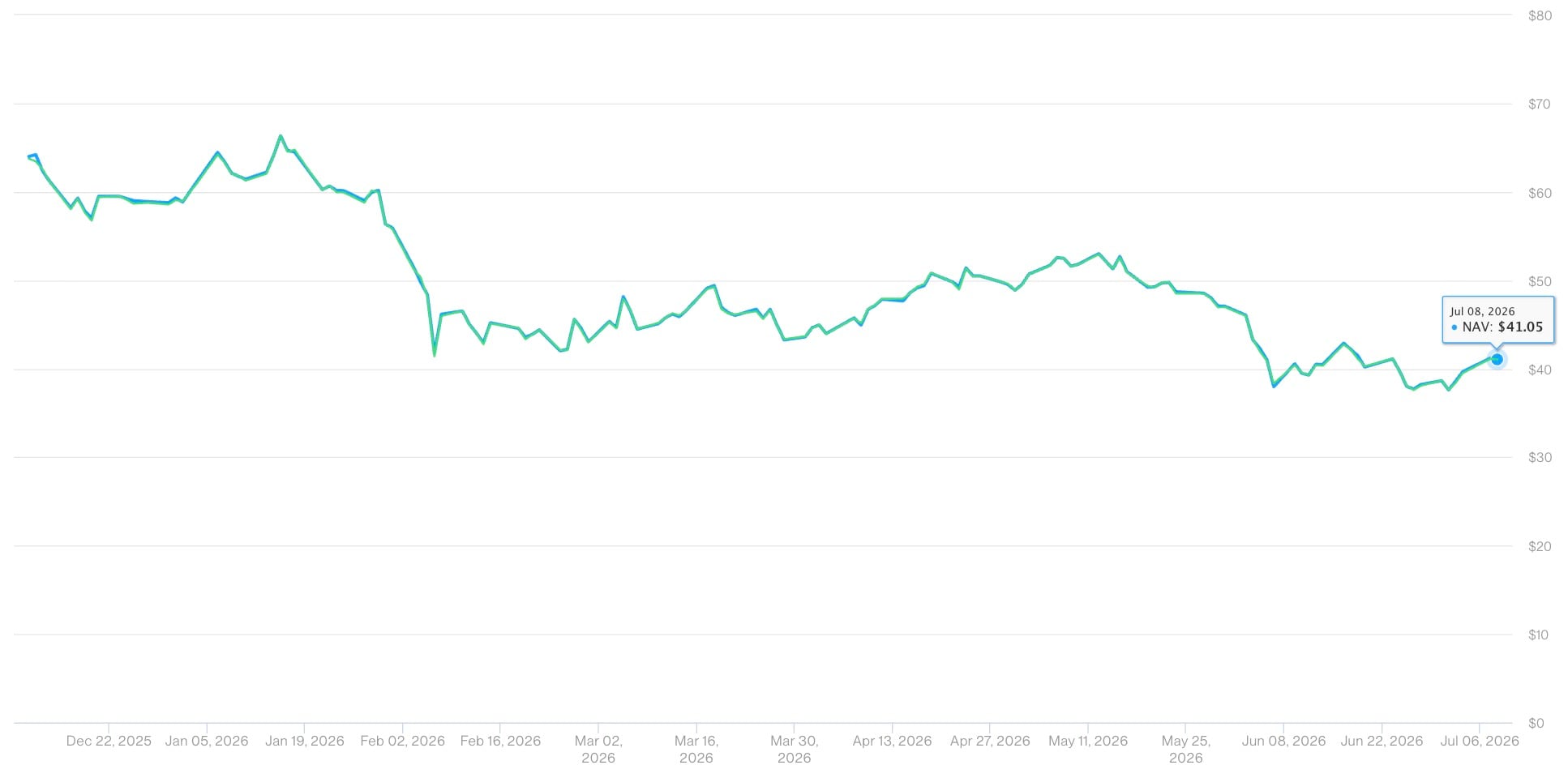
The index urgently needed fresh blood. BITW has been sliding for almost a year: in September 2025, it peaked at $78.74, by April it had fallen to $44.92, and now it trades around $41.01. One positive point is that the fund remains highly stable, with its spread on NYSE Arca staying within 0.2%, meaning there are no liquidity problems.
For Bitwise, this is a logical move. In May, it had already launched a separate spot ETF on Hyperliquid, beating Grayscale and VanEck. Now HYPE has officially secured its status as a new "blue chip".
A Bitcoin investor from the Satoshi era wakes up for a seven222-digit profit
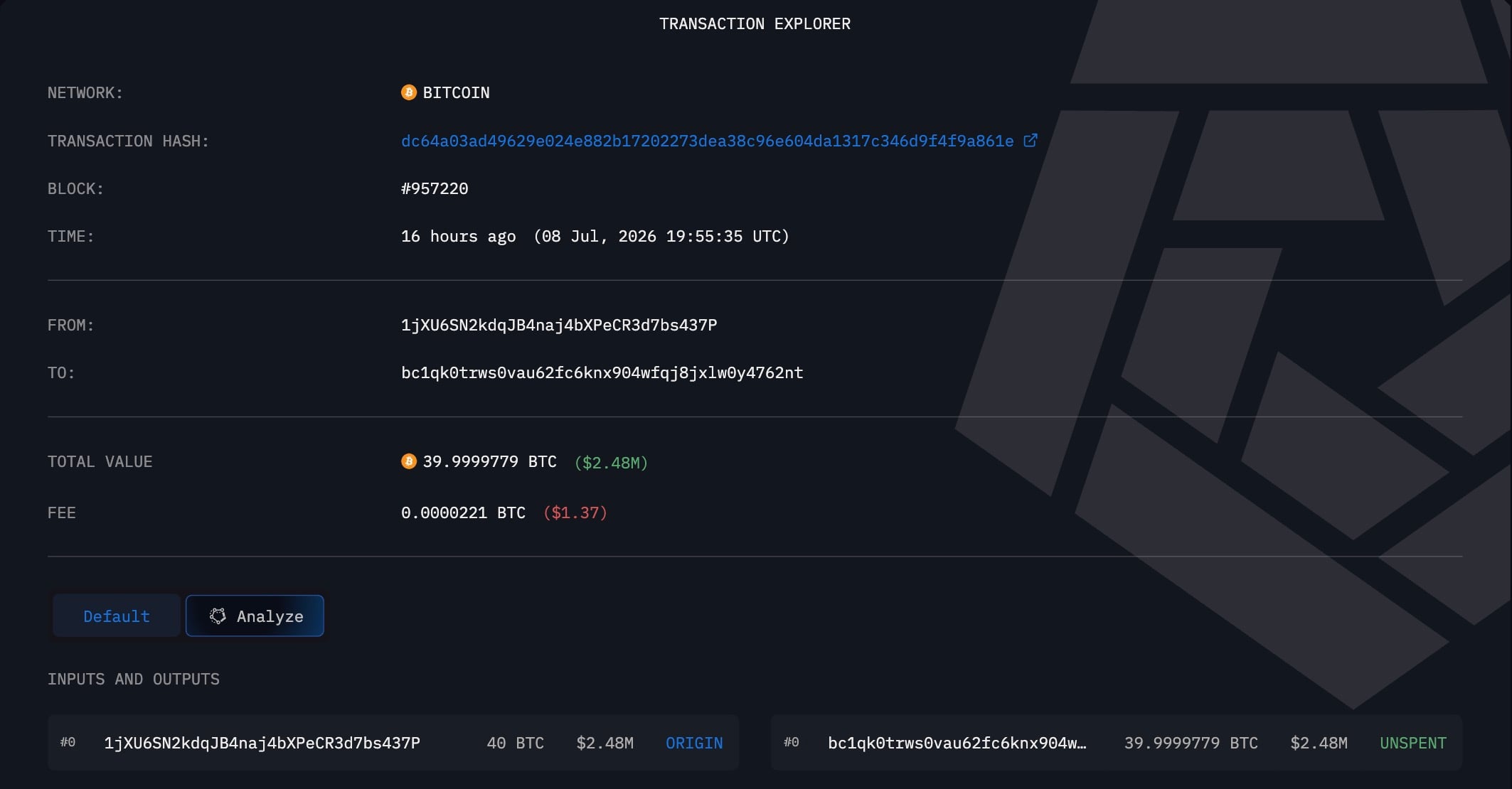
A few hours ago, an ancient wallet woke up on the blockchain when an unknown miner fully transferred 40 BTC, worth about $2.54 million, after leaving them untouched since August 3, 2010, according to on-chain data. This is the deep "Satoshi era" — the time when Bitcoin's creator was still online and coins were mined on ordinary home CPUs.
The main point of this news is pure mathematics. In 2010, Bitcoin was worth cents, so the starting price of this wallet's position is listed by analysts as roughly $0. After almost 16 years of waiting, the owner's net profit reached +105,742,020%. At the same time, they paid a tiny network fee to move millions of dollars in block 957220 — just 2,210 satoshis, or about 10 sat/vB.
The event prompted the crypto community on X to debate once again how many "lost" bitcoins really exist. Galaxy Digital head of research Alex Thorn summarized the awakening briefly: "'Lost coins' are more myth than you think."
On-chain data shows that the wallet had previously received a "dusting attack" marked as Salomon Client Dusted, in which tiny transactions are sent in an attempt to deanonymize an address.
The movement of 40 BTC does not mean they will be dumped into an exchange order book right now. Most often, ancient whales wake up for basic security reasons: to move funds from old legacy addresses to newer and better-protected formats.
Crypto market outlook: ETF reversal and volume hold BTC ahead of the inflation test
Buyers successfully defended a strong historical trading zone above local support after 10 days of outflows from spot ETFs. The strength of this technical structure will be determined by the U.S. CPI/PPI reports and the Fed meeting, which will either confirm the market’s readiness for a move toward $100,000 or trigger a liquidation cascade toward $54,000.
Key checkpoints:
- The end of ETF capitulation and a reversal into inflows: After 10 days of aggressive capital outflows from spot BTC ETFs totaling $2.73 billion, the funds recorded a net inflow of $221 million on July 9. The reversal in the institutional trend signals that open-market selling pressure is being exhausted.
- Leverage wipeout and Bitwise forecasts: The current market drawdown has officially been described by Bitwise experts as a classic leverage squeeze. They note the formation of a local bottom and confirm a Bitcoin price target of $100,000 by year-end, supported by the cleanup of the derivatives market.
- Solana dominates the RWA race: The Solana network set a historic record by attracting $1 billion in net capital into the real-world asset tokenization sector in just 30 days. That is more than three times the result of its closest competitor, BNB Chain, which attracted only $292 million over the same period.
- The nearest inflation trigger, CPI/PPI, arrives on July 14–15: The publication of the U.S. Consumer Price Index will be the first hard filter for risk assets. If the report shows inflation cooling below consensus expectations, it could trigger a major short squeeze in BTC. Hot data, by contrast, would strengthen sellers.
- The Fed interest rate decision comes on July 28–29: The final FOMC meeting of the month will close July and define the monetary vector for the second half of the year. Any hints of policy easing, or a pivot, would give Bitcoin a powerful impulse to break out of its current consolidation zone toward new highs.

 Dan Burgin
 U.Today Editorial Team
