

Disclaimer: The opinions expressed by our writers are their own and do not represent the views of U.Today. The financial and market information provided on U.Today is intended for informational purposes only. U.Today is not liable for any financial losses incurred while trading cryptocurrencies. Conduct your own research by contacting financial experts before making any investment decisions. We believe that all content is accurate as of the date of publication, but certain offers mentioned may no longer be available.

A rare structural change that could alter Shiba Inu's short-term course is coming up this weekend. Over the past day there has been a net outflow of about 101 billion SHIB, according to on-chain exchange flow data. To put it simply, more tokens are being removed from exchanges than are being added.
Shift in market dynamics
In addition to suggesting that holders are shifting assets into private storage rather than getting ready to liquidate, this dynamic frequently lessens immediate sell pressure, and this is a significant shift in tone for an asset that has been under distribution pressure for several months.
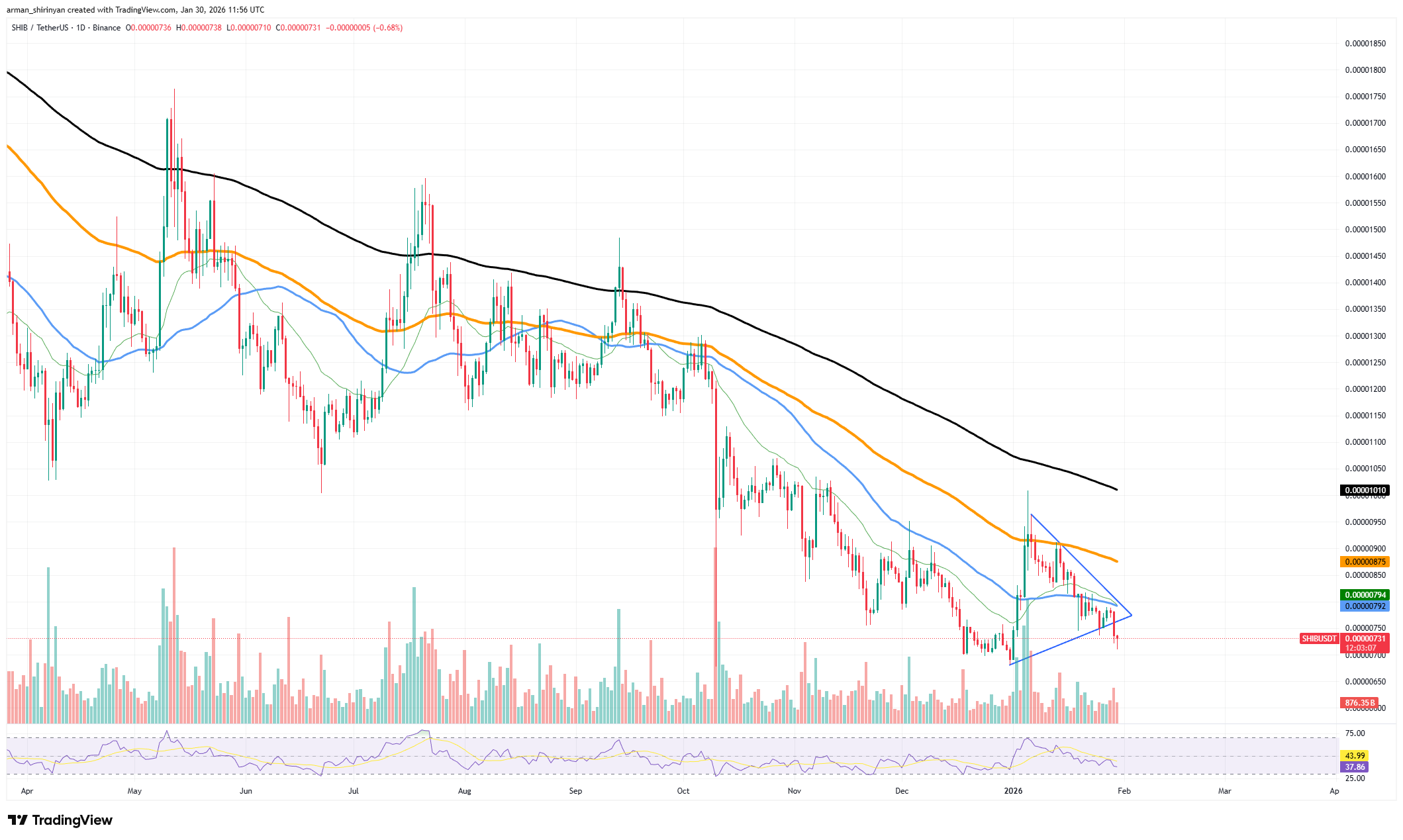
A market attempting to stabilize following an extended downtrend is reflected in price action, as SHIB has been moving between lower highs and marginally higher lows within a tightening triangle formation, a structure that usually indicates the emergence of subsurface volatility.
Sellers cannot push anymore
The current consolidation indicates that sellers are losing the ability to push prices sharply lower, even though the overall trend is still bearish on longer time frames, and the rate of absorption is increasing with each dip.
This interpretation is supported by the exchange metrics, while netflow has turned negative total exchange reserves marginally lower; however, overall inflow and outflow continue to be high, suggesting active repositioning as opposed to inactivity.

When outflows predominate in such an environment, it frequently indicates that larger participants are accumulating or, at the very least, taking defensive positions, which does not guarantee an immediate rally but creates the conditions for a longer-term reversal attempt.
Technically speaking, SHIB continues to encounter significant opposition from its falling moving averages overhead, and any upside breakout from the triangle will likely encounter friction quickly. But control is the crucial shift. If liquidity continues to exit exchanges at this rate, bears will no longer have uncontested dominance, and a sustained period of net outflows would gradually tighten available supply and shift the balance of power.
If exchange outflows persist through the weekend, SHIB may finally have the foundation needed to build a broader recovery phase rather than just another temporary bounce.
 Dan Burgin
 U.Today Editorial Team
