
Disclaimer: The opinions expressed by our writers are their own and do not represent the views of U.Today. The financial and market information provided on U.Today is intended for informational purposes only. U.Today is not liable for any financial losses incurred while trading cryptocurrencies. Conduct your own research by contacting financial experts before making any investment decisions. We believe that all content is accurate as of the date of publication, but certain offers mentioned may no longer be available.

TL;DR
- XRP Inflow Catalyst: XRP ETFs saw a 63% daily surge ($3.59M) driven by Rakuten Pay's integration into 5M retail spots, though Santiment warns of a "social overheating" peak.
- BTC Price Target: Despite $137.7M in ETF outflows, Bitcoin maintains the $76,500 weekly support; a close above this validates the Bollinger Band target of $95,200.
- Wasabi DeFi Breach: A compromised deployer wallet led to a $5.5M exploit across Ethereum, Base, Blast, and Berachain via a malicious UUPS logic update.
- Crypto Market Outlook: Canada's AIMCo ($142B AUM) officially disclosed a $219M MSTR position, marking a major sovereign pivot into Bitcoin-linked assets. A $1B USDT injection by Tether is currently offsetting Jerome Powell's hawkish pause (3.50-3.75% rates) and oil prices exceeding $100.
XRP ETF inflows surge 63% in a day amid extreme sentiment overheating
The XRP market has entered a phase of double overheating, where record institutional appetite collides with dangerous retail euphoria. While funds are absorbing supply, sentiment indicators are signaling caution.
Against the backdrop of capital outflows from BTC and ETH funds, the XRP ETF sector is showing anomalous strength as net daily inflows jumped 63% to $3.59 million, according to SoSoValue. The main volume came from Bitwise (XRP) and Franklin Templeton (XRPZ), while total assets under management held above $1.04 billion.
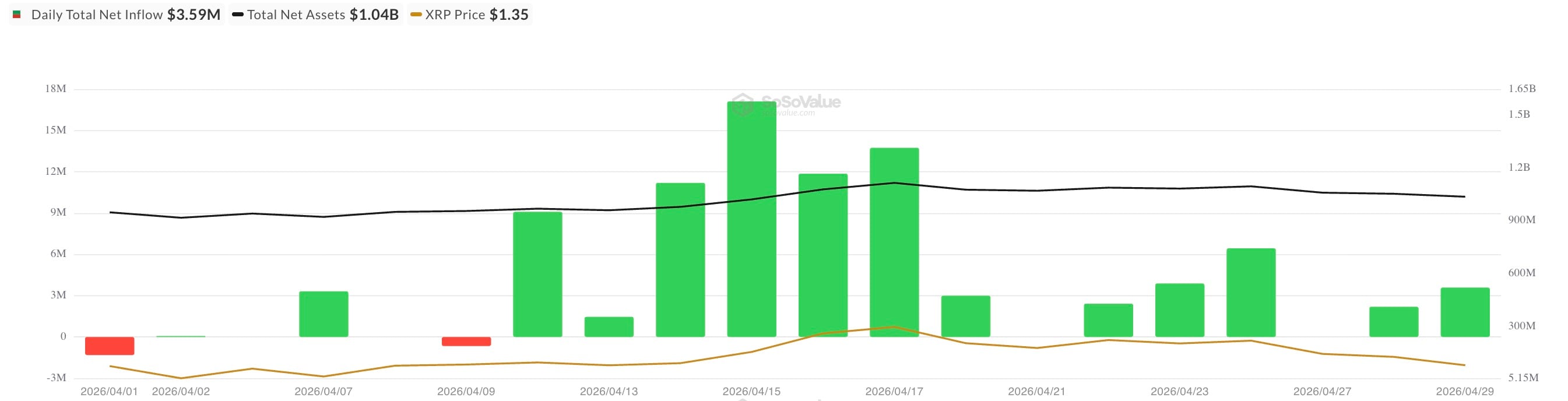
Institutions are effectively buying at $1.35–$1.40 what retail participants are now chasing at the peak of emotion. The fundamental fuel for XRP is its integration with Rakuten Pay, according to Santiment.
As of April 30, XRP has ceased to be just a digital asset for millions of users in Japan, turning into a means of payment across 5 million retail locations. This transformation into "everyday money" has triggered a powerful social response, which analysts now call the main threat to stable growth.
Santiment data confirms that the crowd has entered a state of dangerous greed. On April 29, the social sentiment index broke above the upper boundary of the critical range, and historically, such spikes precede local tops.

A similar pattern was observed on March 19, when a peak in optimism was followed by sharp cooling. The indicator is now in a zone where professional players prefer to take profits against emotional buyers.
Despite millions in ETF inflows, the price remains trapped under resistance at $1.45 - a level that holds supply from those who entered earlier in spring and are now willing to exit at breakeven or a small profit amid Rakuten-driven news. Meanwhile, the $1.28 level remains key support, determining whether this FOMO spike becomes a launchpad toward $1.50 or a trigger for a deeper correction.
How the compromise of a single wallet cost Wasabi Protocol $5.5 million
The unprecedented wave of exploits across DeFi protocols continues. This time, the lending liquidity protocol Wasabi lost more than $5.5 million due to the compromise of the deployer wallet.
This time, the main attack vector was not a code flaw but the use of standard protocol functions against itself. According to Blockaid and CertiK, the attacker gained control over the deployer's EOA address and granted admin rights to a helper contract.
Using the standard UUPS upgrade mechanism, the attacker simply rewrote the rules by updating vault logic to a malicious version. The system treated the theft as a legitimate upgrade from the owner.

The attack affected Wasabi across four networks: Ethereum, Base, Blast, and Berachain, with total losses reaching $5.5 million. CertiK identified a chain of addresses, including "0x6244...f906", where around $2.2 million has been accumulated, while the remaining funds continue to be split.
The Wasabi case once again highlights a critical failure point in many DeFi projects: governance risk and the fact that preventing a legitimate contract upgrade from a compromised admin remains a complex challenge for automated defense systems.
The Wasabi team confirmed the issue, urged users not to interact with the contracts, and stated that an investigation is underway, with more information to follow.
Why ETF outflows do not prevent Bitcoin from targeting $95,000
A notable divergence has formed in the Bitcoin market between fund sentiment and technical structure. While headlines focus on outflows, the price chart of BTC by TradingView suggests consolidation before a potential trend change.
SoSoValue data shows cooling interest in spot instruments. Over the past trading day, net outflows reached $137.77 million for BTC ETFs and $87.73 million for ETH ETFs. Short-term holders are taking profits or moving to cash amid hawkish Federal Reserve rhetoric and rates held at 3.50–3.75%.
This is not panic selling but a structured reduction of positions by major players such as BlackRock and Fidelity, creating localized pressure on price.
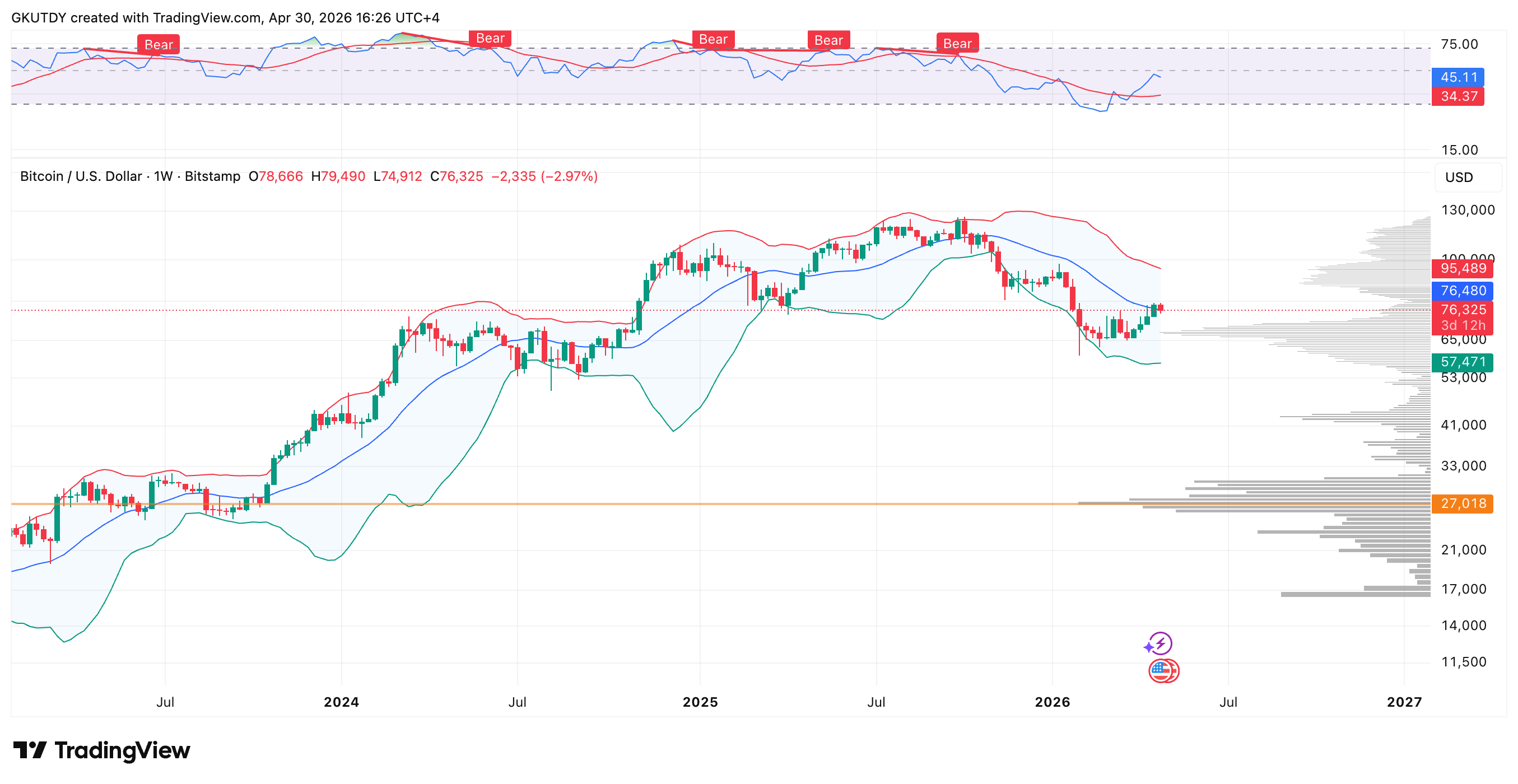
Despite the negative backdrop, Bollinger Bands indicate that BTC is positioned on the weekly chart at the middle band, represented by the 20-week moving average, and is holding it as support. If the week closes above this level at $76,500, the technical scenario favors trading within the upper Bollinger range with a ceiling at $95,500.
The price currently sits at this midpoint and dips below it during the day, so claiming strong stability at this level would be premature. With oil above $100, inflation warnings from Powell, and a pause in rate cuts, outflows are expected. At the same time, these negative fundamentals are keeping BTC within the bounds of strong weekly support.
The decisive factor is whether BTC can secure a weekly close above $76,500, confirming the path toward $95,000.
Crypto market outlook: Bitcoin, Tether, Ripple, and Canada
Despite Powell's hawkish stance, the coming week will be shaped by the seasonal May factor and the reaction to US unemployment data. If the labor market shows signs of cooling, it may offset the Federal Reserve's tone and create conditions for an impulsive breakout from the accumulation range.
Key checkpoints:
- Hawkish Fed pause (3.50-3.75%): Jerome Powell kept interest rates unchanged and ruled out cuts in the near future. The market views this as a short-term negative, expecting possible policy easing after the confirmation of Kevin Warsh in May.
- Tether injects $1 billion: Tether issued 1 billion USDT over the past 24 hours. Such issuance volumes have historically helped the market absorb post-FOMC meeting drawdowns.
- Canada's sovereign fund gets into BTC: Alberta Investment Management Corporation with $142 billion in AUM disclosed a $219 million position in MicroStrategy (MSTR). This creates a precedent for pension and sovereign funds to include Bitcoin-linked instruments in state portfolios.
- Global expansion of XRP: Ripple opened an office in the Dubai International Financial Centre, strengthening the region as a key crypto hub.

 Dan Burgin
 U.Today Editorial Team
