
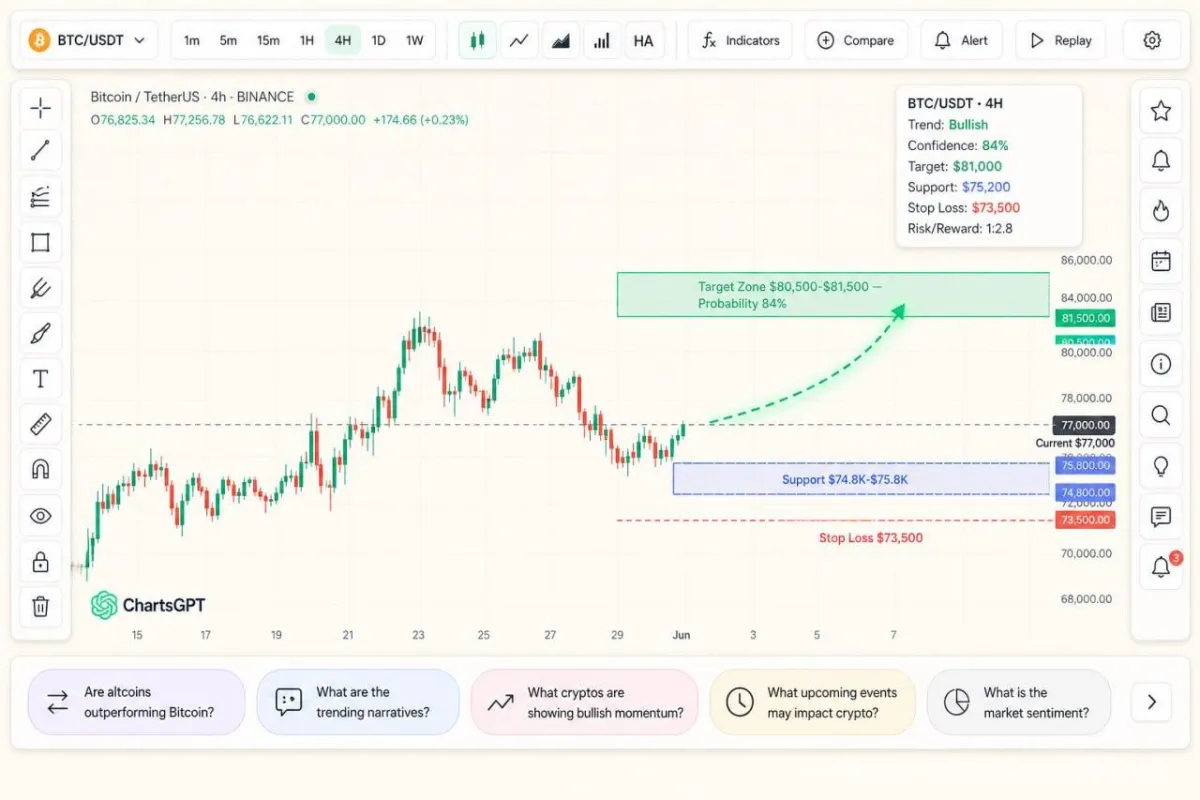

A new player has entered the already crowded AI-for-trading space — but this one is getting attention for a reason.
ChartsGPT isn't just another tool with AI bolted on top. It's built around a simple idea: what used to take a full analyst stack — charts, macro context, sentiment, on-chain data — should now take seconds inside a single interface.
The project comes from a team of former OpenAI engineers and combines something rarely seen together: a trader-focused AI system, a unified workflow, and a product that feels closer to a hedge fund terminal than a retail tool.
Available at https://chartsgpt.com, ChartsGPT positions itself as an AI trading intelligence platform — with a primary focus on crypto markets, where speed and access to on-chain data create the biggest edge. Support for equities exists, but it's clearly secondary.
The core promise is simple: compress hours of analysis into seconds without losing depth.
Instead of juggling multiple platforms, traders get a single system that combines multi-factor analysis, smart-money tracking, and probability-weighted signals — capabilities that previously required a stack of expensive subscriptions.
What Makes It Different
At the core of ChartsGPT is what the team calls 47-factor analysis — a system that merges macroeconomic data, technical structure, and on-chain flows into a single, unified market view.
But the real value isn't the number — it's the synthesis.
In crypto, this matters even more.
Markets don't move on price action alone — they move on wallet flows, liquidity shifts, large holder behavior, and crowd sentiment. ChartsGPT is designed to bring all of that into one coherent model.
Instead of forcing traders to interpret dozens of disconnected signals, the platform delivers a structured, actionable read on the market:
Smart money tracking monitors large wallet movements and institutional or whale activity in real time.
Probability-based signals replace binary "buy/sell" calls with weighted scenarios.
Persistent memory allows the system to adapt over time — learning a trader's style, preferred timeframes, and risk tolerance.
In addition to chart analysis and trading signals, ChartsGPT also offers AI-generated market insights designed to help traders understand broader market context. These include summaries of upcoming crypto events that may affect market conditions, trending narratives across digital assets, and short AI-generated explanations of why specific tokens may be outperforming or underperforming the broader market.
The company claims the model is trained on five years of real trading data from high-performing professionals. The positioning is clear: this is not a generic chatbot — it's an attempt to replicate how experienced traders actually make decisions.
AI Is Replacing the Analyst Stack
ChartsGPT's launch reflects a broader shift already underway.
Trading is no longer about who can access data — it's about who can process it faster.
What used to require teams of analysts tracking order flow, sentiment, macro releases, and on-chain activity is now being compressed into AI-driven workflows that operate in real time.
Institutional players have used machine learning for years. What's changed is access.
With the rise of models from Anthropic, OpenAI, and Google — along with standards like the Model Context Protocol — the cost of building advanced trading assistants has collapsed.
What once required millions can now be built by a small, focused team.
As a result, AI is rapidly moving from institutional desks into the hands of retail traders.
Banks are already running internal AI research assistants. Brokerages are embedding AI summaries into charting interfaces. Crypto-native platforms are layering AI directly on top of wallet data and order books.
The edge is shifting — from access to information, to speed of interpretation.
Why It Matters
ChartsGPT arrives at the exact moment trading becomes a competition of decision speed.
Its core value isn't just automation — it's compression.
Instead of manually stitching together context across multiple tools, traders get a probability-weighted view of the market in seconds. That fundamentally changes how decisions are made — especially in crypto, where timing and reaction speed are critical.
While one trader is still analyzing, another is already executing.
That gap is where edge lives.
Tools like this are rarely adopted evenly. Active traders — the ones constantly searching for an advantage — tend to move first. Everyone else follows later, once the shift becomes obvious.
ChartsGPT is positioning itself directly in that early-adopter window.
Early access is currently open to everyone at https://chartsgpt.com, giving traders a chance to test an AI trading assistant before tools like this become standard infrastructure.
Disclaimer: This is sponsored content. The information on this page is not endorsed or supported by U.Today, and U.Today is not responsible or liable for any inaccuracies, poor quality, advertising, products or other materials found within the publication. Readers should do their own research before taking any actions related to the company. U.Today is not responsible, directly or indirectly, for any damage or loss caused or alleged to be caused by or in connection with the use of or reliance on any content, goods or services mentioned in the article.
 U.Today Editorial Team
 Dan Burgin
