

Disclaimer: The opinions expressed by our writers are their own and do not represent the views of U.Today. The financial and market information provided on U.Today is intended for informational purposes only. U.Today is not liable for any financial losses incurred while trading cryptocurrencies. Conduct your own research by contacting financial experts before making any investment decisions. We believe that all content is accurate as of the date of publication, but certain offers mentioned may no longer be available.

With daily payments exceeding 1.7 million, XRP Ledger activity has reached one of its highest levels in months. Given the comparatively flat activity observed earlier in the quarter, this type of spike could become a meaningful dynamic change for XRP.
Stabilization is in
The chart displays a stable baseline in late March and early April, followed by a dramatic increase in the number of transactions during the final few sessions. Typically, retail usage alone does not naturally lead to this kind of shift. Large entities, batching behavior, institutional flows, and ecosystem-specific activities like exchange-related transfers or liquidity routing typically drive it.
While not at the same explosive rate, active user data has also increased concurrently. This discrepancy is significant. It implies that rather than a significant influx of new users, the increase in payments is probably due to higher throughput per participant. Practically speaking, more transactions are being pushed by fewer actors, which is usually an indication of operational or liquidity-driven usage rather than pure adoption growth.
Short-term weakness
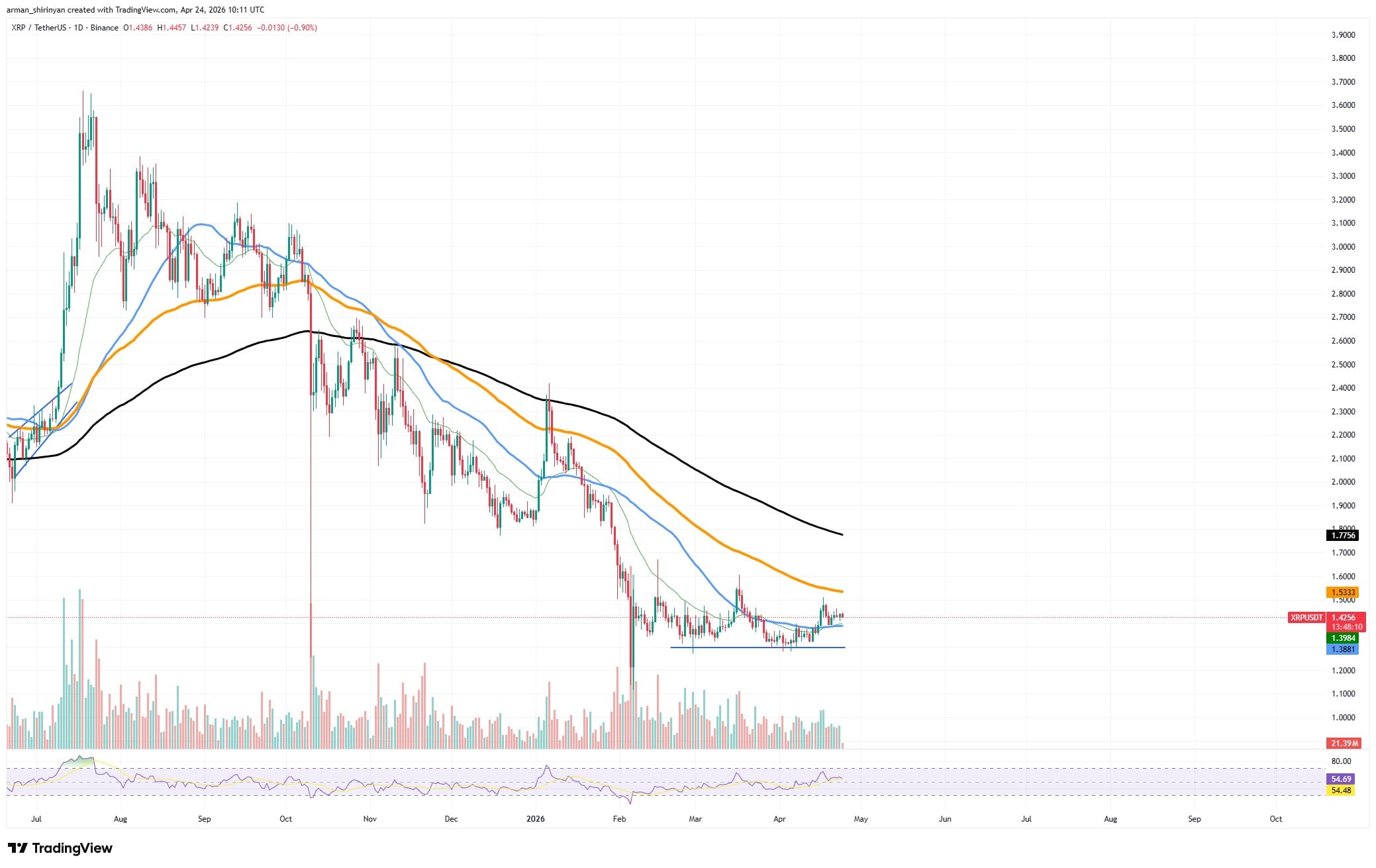
The price is currently testing short-term moving averages, and the chart indicates that a distinct base is forming around the $1.30-$1.35 region. However, XRP is still below important higher timeframe resistance levels, especially the 100 and 200 EMA, which continue to decline. As a result, the general trend remains cautious.

What, therefore, is causing the spike? Increased settlement activity and internal network usage related to liquidity corridors are probably one the main causes in addition to institutional activity via XRP ETFs. High-frequency transfers, where cost effectiveness is important, are frequently handled by XRP Ledger, and periods of high market volatility or arbitrage opportunities may cause spikes in the number of transactions.
Whether or not this activity continues will determine what happens next. If high payments continue and start to correspond with an increase in the number of active users, price usually follows. This would indicate true network growth. If not, the spike could be mistaken for transient throughput rather than structural demand if activity returns to baseline. XRP is currently exhibiting early indications of life.
 Dan Burgin
 U.Today Editorial Team
