
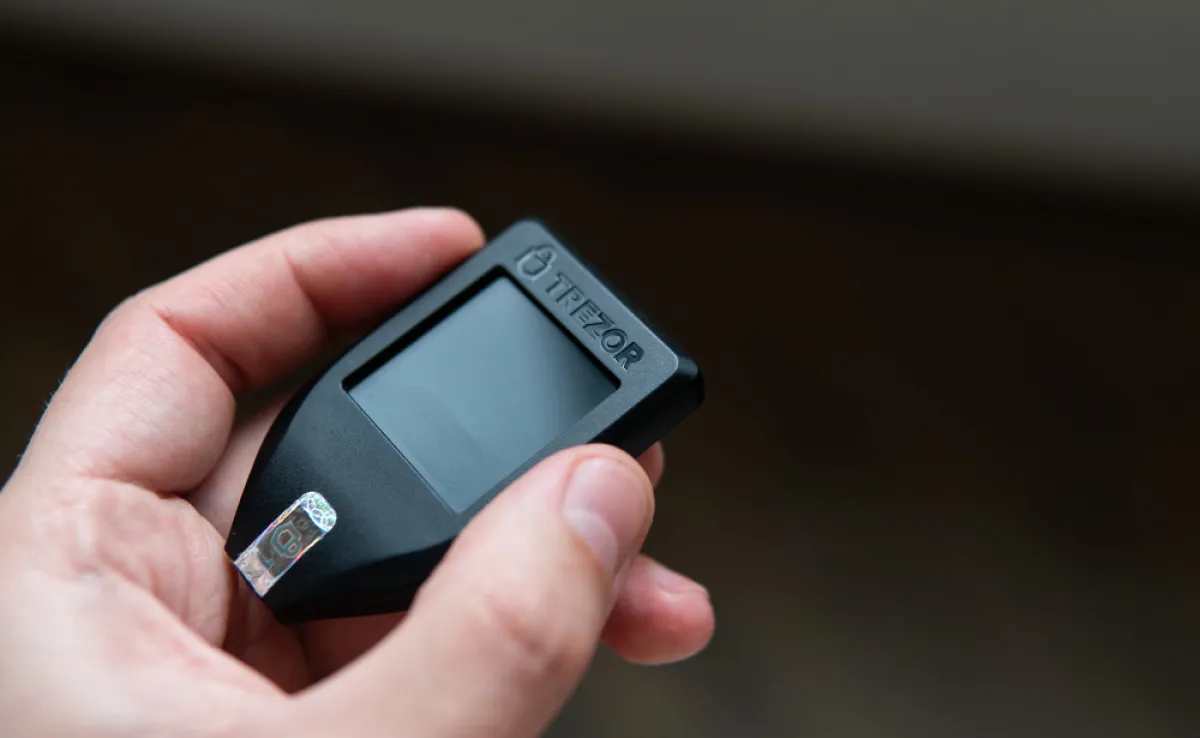

Trezor has rolled out Clear Signing across its hardware wallet lineup, giving users a way to inspect the actual details of supported Ethereum transactions on the device before signing them.
Clear Signing moves transaction interpretation onto the trusted device. Rather than relying on the interface connected to the wallet, the Trezor device reads the transaction data itself and presents information such as the action being performed, the assets involved, the amount and the destination.
The feature currently works with contracts included in the ERC-7730 registry. The list includes protocols such as 1inch, Aave, Lido, Tether, LiFi, Hyperliquid, and others, with additional coverage expected as more projects publish transaction descriptors.
ERC-7730 provides a common framework for describing contract interactions and publishing those descriptions through an open registry.
The Ethereum Foundation introduced the standard in May 2026 alongside wallets and security companies as an effort to address blind signing, which has been associated with major losses across the crypto industry.
The transaction is decoded from the raw calldata on the hardware wallet itself. If the information shown in a browser differs from the transaction being presented on the Trezor device, the user has an opportunity to spot the discrepancy before signing.
For example, instead of displaying an opaque transaction payload, the device can identify an operation such as a swap or token approval and show the relevant token amount using appropriate decimals. The destination address is also presented for verification.
The principle is straightforward: the screen users trust should be capable of explaining what they are signing.
Open standard for wider DeFi ecosystem
Trezor's implementation is built around the open nature of ERC-7730 rather than a proprietary database of transaction descriptions.
That distinction is significant. A closed system maintained exclusively by one wallet manufacturer would require users to trust that company's interpretation of every supported transaction.
An open registry allows protocols to publish descriptors while giving other participants the ability to inspect and verify the information.
Trezor says its Clear Signing implementation, including the parsing and display components, is open source and auditable. Contract verification is also part of the process before descriptors are added to the registry.
The approach is designed to make transaction information independently verifiable rather than turning readable signing into another black box.
The ecosystem around ERC-7730 has expanded since its introduction. Trezor joins Ledger, Ambire, Gemini and WalletChan among wallets and services supporting the standard.
The registry has also continued to grow as more protocols add descriptors, with the number of on-chain transaction descriptors increasing by about 28% between the standard's May launch and the end of July.
Security risks
For users, the system does not require a separate workflow. Trezor says Clear Signing operates through Trezor Suite, WalletConnect and Trezor Connect without requiring additional software or a separate setting.
Where a contract is not yet covered by the registry, the wallet falls back to the conventional blind-signing warning. This means the usefulness of the system will ultimately depend on how quickly protocols add their contracts to the standard.
That also highlights the current limitation of Clear Signing. Readable transaction information can make malicious or unexpected operations easier to identify, but it does not eliminate every security risk associated with self-custody.
Users still need to verify transactions, protect their recovery information and consider whether they trust the application and protocol they are interacting with.
 Dan Burgin
 U.Today Editorial Team
