
Disclaimer: The opinions expressed by our writers are their own and do not represent the views of U.Today. The financial and market information provided on U.Today is intended for informational purposes only. U.Today is not liable for any financial losses incurred while trading cryptocurrencies. Conduct your own research by contacting financial experts before making any investment decisions. We believe that all content is accurate as of the date of publication, but certain offers mentioned may no longer be available.

TL;DR
- SBI Digital Finance and Doppler Finance are developing regulated XRP lending infrastructure for Japanese funds and market makers, allowing institutions to use XRP as collateral and unlock liquidity.
- SHIB's average exchange deposit size increased 76.26% to 969.01 million tokens, but negative netflows and declining reserves indicate that the market is not experiencing a broad panic sell-off.
- Wintermute identifies cooler US inflation and sustained crypto ETF inflows as Bitcoin's two main recovery catalysts, with a move above $67,250 requiring several consecutive sessions of institutional demand.
- Bitcoin is testing resistance near $64,000–$64,500, while Robinhood Chain growth, rising institutional BTC adoption, and preparations for the digital euro strengthen the broader crypto market outlook.
How SBI and Doppler will put XRP to work for Japanese banks
Financial conglomerate SBI Holdings has divided infrastructure roles between different blockchains as part of its Asian strategy. While the market discusses its recent agreement with the Solana Foundation, SBI Digital Finance is developing a lending platform designed to bring long-term capital into XRP.
The initiative's partner is digital markets provider Doppler Finance. The companies are creating regulated B2B infrastructure in Japan for lending and collateral management.
According to Doppler Finance, the launch is aimed at Japanese funds and market makers, with the goal of turning passive XRP reserves into productive working capital. In this context, institutional participants will be able to legally use the token as collateral, borrow liquidity against it, and manage risks under local compliance requirements.
This move confirms SBI's multichain approach, under which the conglomerate has clearly separated its financial business lines. While the partnership with the Solana Foundation is focused on the tokenization of real-world assets such as corporate bonds, real estate, and retail stablecoins, the agreement with Doppler Finance addresses demand from major players for B2B lending backed by XRP.
Why a 76% surge in SHIB inflows did not turn into a panic sell-off
A morning on-chain audit delivered a surprise for meme coin enthusiasts, as the average size of a single SHIB deposit to exchanges rose sharply by 76.26% over the past few days, reaching 969.01 million tokens.
In plain English, large holders have started moving more Shiba Inu tokens onto trading platforms. CryptoQuant's chart shows that this inflow has already put pressure on order books. Over the past week, the token's price has moved lower and is now hovering near a local bottom at $0.0000041.
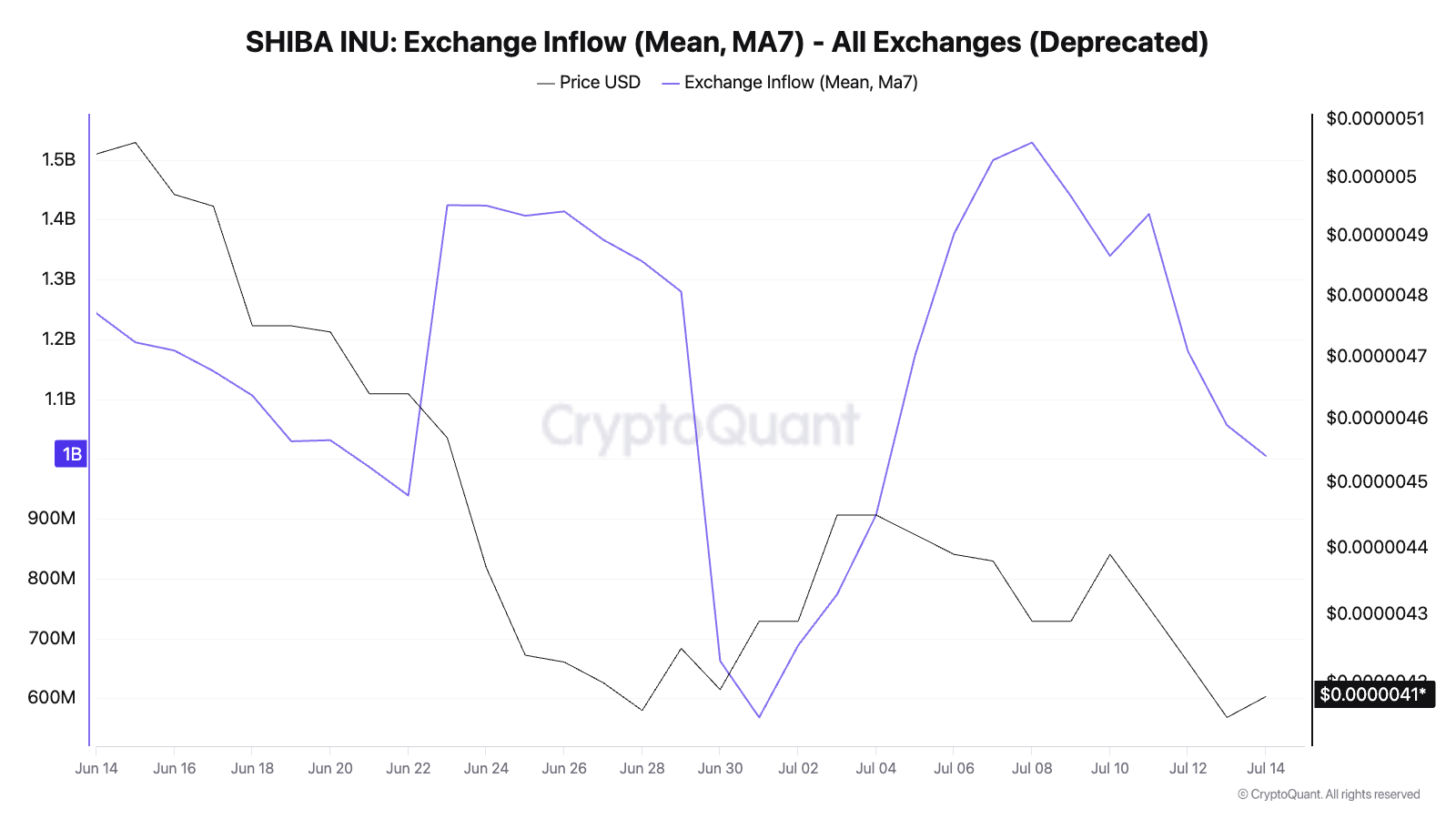
However, it is too early to write off the asset, as the details of the daily statistics tell a different story. Looking beyond the average deposit size and focusing on total activity over the past 24 hours changes the picture:
- Exchange netflow: Fell deep into negative territory at -186.29 billion SHIB.
- Total exchange reserves: Declined to 86.61 trillion SHIB, losing around 2.12% in dollar terms.
- Top-10 wallet activity: Whales withdrew 5.26 billion SHIB during the day while depositing only 3.85 billion.
Yes, several large players created local selling pressure and pushed the price toward psychological support. Globally, however, tokens continue to move into cold wallets, meaning the market is not experiencing mass panic or a complete sell-off.
SHIB is now in a holding pattern. If the $0.0000041 level holds, the morning selling pressure could turn into an evening rebound.
Major market maker Wintermute names two catalysts for a Bitcoin price recovery
While external markets are being shaken by commodity-related disruptions, with Brent crude climbing toward $79 and US Treasury yields breaking above 4.57%, Wintermute OTC analysts say Bitcoin is showing remarkable resilience.
In their latest report, they stated that weak hands have already been flushed out and there is no one left to panic. The market absorbed even Strategy's massive sale of 3,588 BTC, worth around $216 million, without major disruption. Just a few months ago, a sale of this size could have triggered a sharp decline.
Sellers are exhausted, Wintermute concluded, and Bitcoin's price recovery now depends on two factors:
- Cooling inflation data. Wintermute analysts emphasized that the latest inflation figures would determine everything and that the market urgently needed a cooler CPI reading to reduce fears of another Federal Reserve rate increase. According to the latest data, US inflation fell to 3.5%, while the monthly reading dropped by 0.4% — the steepest decline since May 2020.
- Consistent ETF inflows. Last week finally ended a severe eight-week streak of outflows, with approximately $282 million entering crypto ETFs. However, Wintermute warned that one positive week is not enough. Now that the CPI barrier has been removed, breaking the trend and confidently moving above $67,250 will require several consecutive sessions of positive ETF flows.
As a final potential catalyst, analysts continue to focus on the CLARITY Act, which is expected to receive a vote in the US House of Representatives later this month.
Wintermute analysts concluded that Bitcoin has demonstrated its ability to rise on internal market volume despite unfavorable external conditions. The options market, where traders had continued to hedge and buy puts ahead of the inflation data, has now received a powerful bullish signal. The main catalysts are in place, and the market is waiting for confirmation from ETF flows.
Crypto market outlook: Bitcoin challenges $64,000 resistance amid CPI cooldown
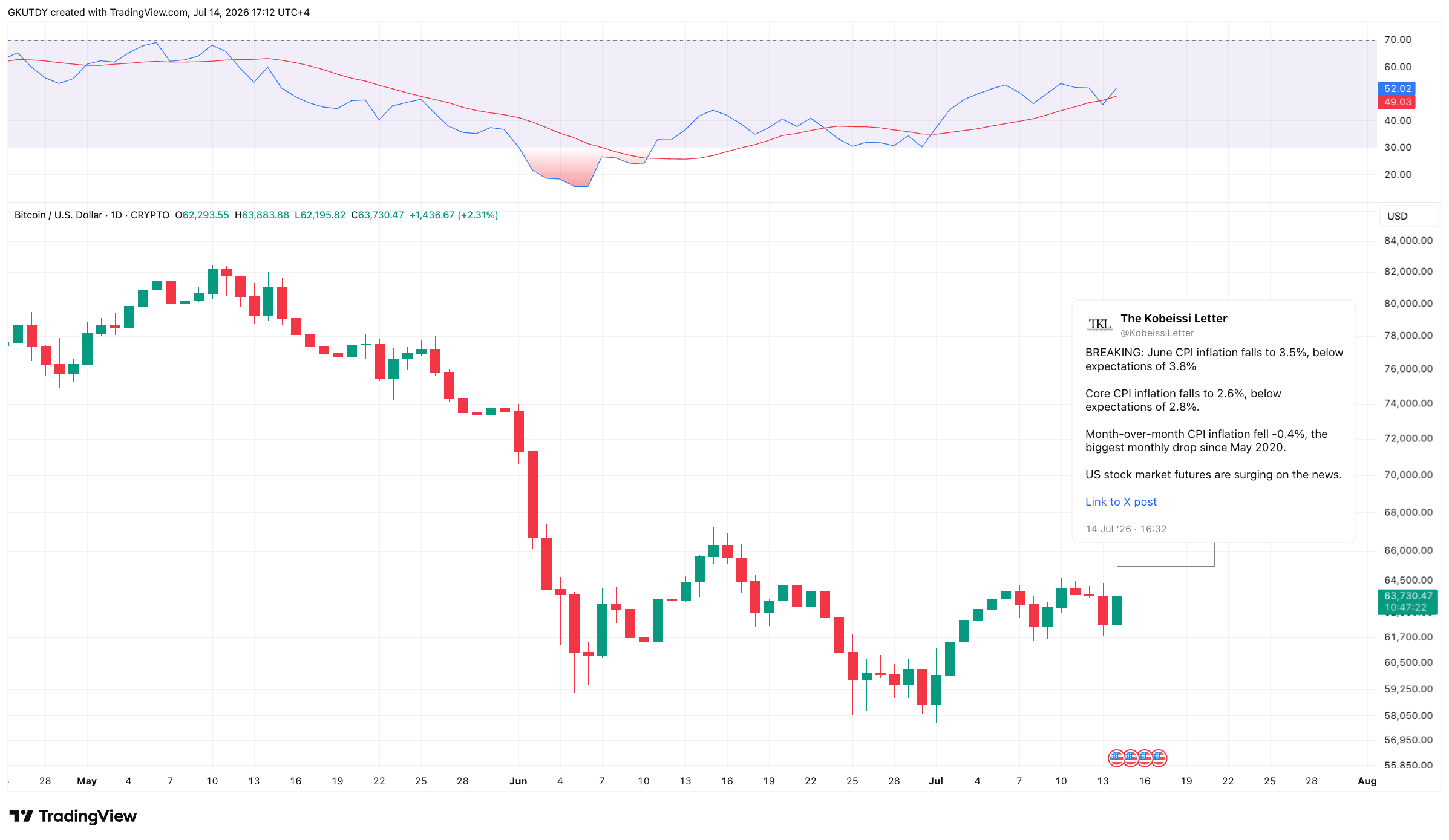
Bitcoin is testing the upper boundary of its local range near $64,000 following a slowdown in US inflation, with CPI falling to 3.5%. The current chart structure points to an attempt to form a local bottom, supported by the launch of the first banking adoption index and easing macroeconomic pressure.
Key developments:
- BTC technical outlook: The daily BTC/USD chart shows Bitcoin trading at $63,698, up 2.32%. The price remains trapped in a consolidation range between support at $58,000–$59,250 and resistance at $64,500, while still trading below a descending trend line. The RSI is at a neutral reading of 51.88, confirming continued uncertainty.
- Launch of the Bitcoin Banking Index: Strategy Inc. has launched an index measuring BTC adoption among the world's 25 largest banks. The current adoption level stands at 32%. Fidelity leads with 71%, followed by BNY Mellon at 46%, Goldman Sachs at 45%, and JPMorgan at 43%.
- Robinhood Chain activity: The new blockchain reached $800 million in daily DEX trading volume within two weeks. Its main driver is the CASHCAT meme coin, which has a market capitalization of $150–$200 million and gained 19.5% following its listing on Binance Wallet.
- Positive macroeconomic backdrop: US CPI for June fell to 3.5%, compared with a forecast of 3.8% and a previous reading of 4.2%. Core CPI declined to 2.6%, below the 2.8% forecast. This reduces pressure on the Federal Reserve and opens the door to renewed liquidity inflows into the crypto market.
- Preparations for the digital euro: The European Central Bank has selected 36 providers, including Stripe and Nexi, for a 12-month CBDC pilot. Testing is scheduled to begin in the second half of 2027, while the full launch of the currency is planned for 2029.

 Dan Burgin
 U.Today Editorial Team
