
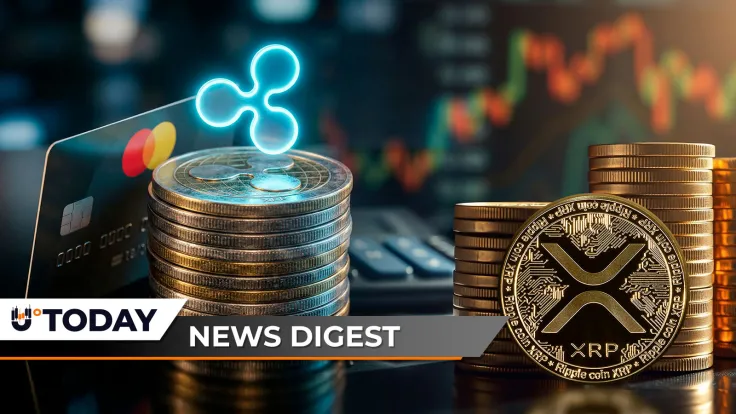

Mastercard expands blockchain push with Ripple and CBDC partners
Ripple joins forces with payment giant Mastercard to enable the seamless use of CBDCs as money.
- Ripple partnership. Mastercard is deepening its collaboration with blockchain firms to support the development of central bank digital currencies (CBDCs).
Global payment giant Mastercard is pushing further in its collaboration with Ripple as regards its commitment to facilitating the development of digital dollars, also dubbed CBDCs. In a recent presentation revealed on X, Mastercard showcased its growing list of blockchain partners, which include Ripple, Binance, Consensys, PayPal and many others.
While the renowned payment firm has remained keen on facilitating and exploring blockchain payments, its collaboration with the companies targets helping central banks and financial institutions to seamlessly experiment with digital currencies.
- Institutional adoption. Mastercard emphasized its goal of making CBDCs as easy to use as traditional money.
The presentation displayed on a wide screen highlighted Mastercard's unwavering commitment to making CBDCs as easy to use as money as the firm pushes for practical testing and real-world deployments among financial institutions.
As Mastercard remains keen on exploring blockchain-based payments, it has specifically partnered with Ripple, Consensys, Fluency and Fireblocks to effectively execute the initiative.
Dogecoin trading volume doubles as price remains in downtrend
Despite the overall outlook of the market, Dogecoin's downtrend is nowhere near an end.
- Up 100%. Dogecoin has seen trading volume surge by more than 100% in recent sessions.
Trading activity for Dogecoin has increased dramatically; in recent sessions, total volume has increased by more than 100%.
The increase in liquidity raises concerns about whether traders are starting to pay more attention to meme coins, at a time when the larger cryptocurrency market is trying to stabilize following months of pressure.
Even with the increase in volume, Dogecoin's price movement is still quite controlled. The asset is currently trading at about $0.092, exhibiting very little movement in relation to the volume of trading activity.
- Price action. Dogecoin remains in a downtrend that started late last year, with the price trading below key averages.
The price has slightly declined over the past day, which is indicative of the continuous conflict between buyers trying to start a recovery and sellers keeping control of the overall trend.
Dogecoin is still technically stuck in a downtrend that started at the end of last year. The price is trading below a number of important moving averages, and the chart structure displays a steady series of lower highs and lower lows.
As dynamic resistance, these indicators keep sloping downward, preventing the formation of significant upward momentum.
XRP Bollinger Bands squeeze signals potential breakout
XRP volatility is brewing and might fuel the $2 retest if bullish signals are sustained.
- Selling pressure. XRP fell from a daily high of $1.44 to $1.37 over the past 24 hours as broader crypto market pressure persists.
In the last 24 hours, XRP has dropped from a daily peak of $1.44 to $1.37 as bearish pressure continues to linger on the broader crypto market.
However, renowned on-chain analyst Ali Martinez thinks XRP might be close to a major price breakout based on the Bollinger Bands squeeze of the asset’s charts.
As per the chart shared by Ali, XRP's Bollinger Bands are contracting around $1.38. This classic squeeze pattern suggests that the price is consolidating in a narrow range, and a big move might happen soon.
- Bullish sign. Such squeezes typically signal low volatility consolidation before a significant price move.
Notably, when the Bollinger Bands squeeze this close, it signals that XRP’s price could move as volatility is likely to increase. Such a squeeze usually precedes a strong market move for an asset in the crypto space.
Despite the price dip, trading volume has climbed by 14.22% to $2.89 billion. This suggests increased accumulation on the part of investors amid exchange outflows.
 Dan Burgin
 U.Today Editorial Team
