
Disclaimer: The opinions expressed by our writers are their own and do not represent the views of U.Today. The financial and market information provided on U.Today is intended for informational purposes only. U.Today is not liable for any financial losses incurred while trading cryptocurrencies. Conduct your own research by contacting financial experts before making any investment decisions. We believe that all content is accurate as of the date of publication, but certain offers mentioned may no longer be available.

American institutional investors have begun reallocating capital into spot XRP ETFs while actively taking profits in the DeFi segment. According to SoSoValue, daily net inflows into XRP funds reached $5.66 million, while Hyperliquid (HYPE) funds lost $698,040.
Wall Street's shift in priorities comes amid rapid progress in the U.S. Senate on the historic CLARITY Act. The bill, passed by the House of Representatives in July 2025, transfers oversight of digital commodities to the CFTC while leaving the SEC in control only of tokens classified as securities.
Why XRP is gaining traction ahead of the CLARITY Act
Optimism surged after Treasury Secretary Scott Bessent said the bill was on the "1-yard line" before approval. Senate Majority Leader John Thune and White House officials also confirmed progress in negotiations, easing disagreements over ethics provisions.
A special Senate briefing will take place behind closed doors in the near future, with the goal of accelerating an official vote before lawmakers leave for recess. Despite opposition from Democrats, prediction markets now estimate the bill's chances of success at 50%–70%.

For investors, buying XRP ETFs is a beta bet on the American company Ripple, which develops payment solutions based on the XRP Ledger blockchain. Full legal clarity under the CLARITY Act would give the company's infrastructure more room to expand, including the scaling of its new RLUSD stablecoin.
In the long term, this ripple effect could sharply increase transaction activity across XRPL and trigger mass adoption of XRP by large businesses. Major capital is clearly moving into regulated assets ahead of the curve, restructuring portfolios around the future rules of the market.
Wall Street prefers policy
Yesterday's crypto ETF data clearly illustrates this trend. While Bitcoin continues to attract most of the capital, recording its sixth consecutive day of growth, and Ethereum steadily holds its position, a clear divide has emerged in the altcoin market.
XRP is attracting funds at roughly the same pace as Solana. However, while capital in Solana remains at high levels because of the network's strong performance in the real-world asset tokenization sector, the DeFi-focused Hyperliquid segment is losing ground.
Investors are actively withdrawing money from BlackRock's iShares HYPE fund. Capital flows into Bitwise's fund have completely stalled, while Grayscale recorded only a symbolic daily transaction.
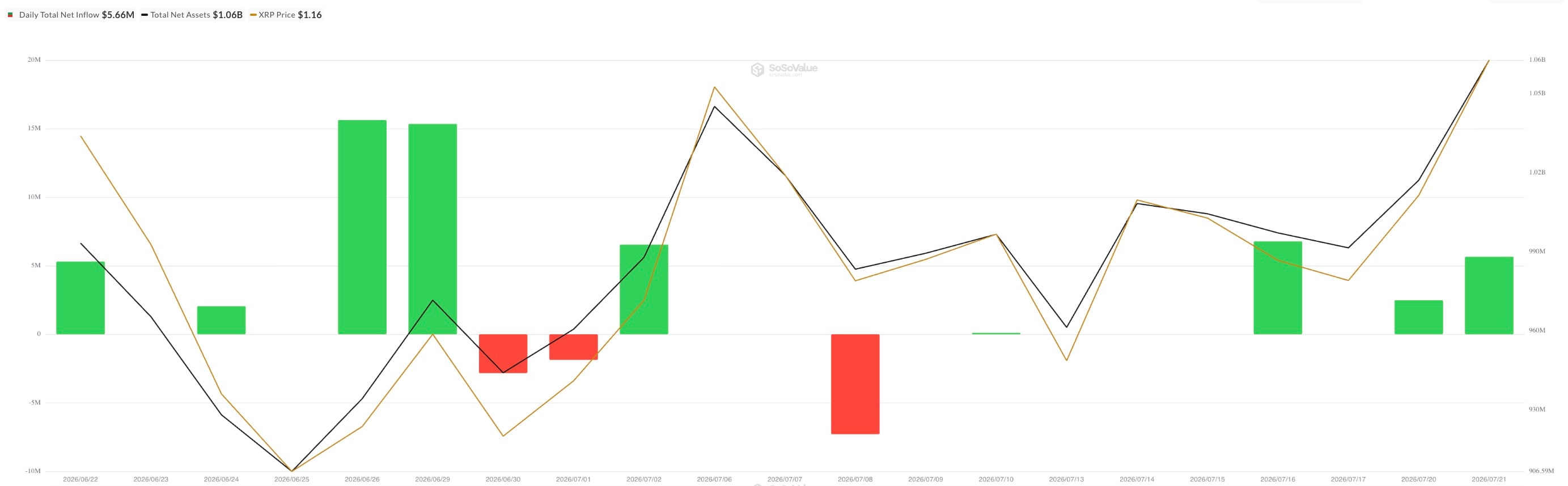
This outflow continued a negative trend for Hyperliquid, whose ETFs already suffered substantial losses last week. The rest of the market is currently at a standstill: investors showed only minimal interest in Litecoin and Dogecoin, while capital flows into BNB, LINK, HBAR, AVAX, and DOT funds stopped completely.
An official date for the Senate vote has not yet been set, but fund data confirms that major U.S. buyers no longer want to play regulatory roulette and are already choosing assets tied to American jurisdiction.
 U.Today Editorial Team
 Dan Burgin
