

Disclaimer: The opinions expressed by our writers are their own and do not represent the views of U.Today. The financial and market information provided on U.Today is intended for informational purposes only. U.Today is not liable for any financial losses incurred while trading cryptocurrencies. Conduct your own research by contacting financial experts before making any investment decisions. We believe that all content is accurate as of the date of publication, but certain offers mentioned may no longer be available.

Against the backdrop of the escalating scandal surrounding trading firm Jane Street, which has been accused of excessive manipulation of the crypto market, well-known cryptography pioneer Nick Szabo stated in a recent post his position on the real risks that Bitcoin and ETFs carry. Szabo expressed strong skepticism toward Wall Street and once again reminded readers that cryptocurrency was created precisely to get rid of such trusted intermediaries.
His main theses can be conditionally divided into the following: Bitcoin ETFs committed negligence by entrusting market-making to structures like Jane Street, which can play against their own clients. That is why capital is flowing out of ETFs and into Bitcoin in particular, because people are losing trust not in Bitcoin, but in the dirty methods of Wall Street.
"Not your keys, not your coin": Nick Szabo
Szabo's words have confirmation since, according to SoSoValue data, U.S. spot Bitcoin ETFs have lost $179 million since the beginning of February alone. In general, the outflow has been ongoing since November 2025, and over these four months it has amounted to more than $6 billion, which is more than 10% of the total value of inflows for the entire time since their launch.
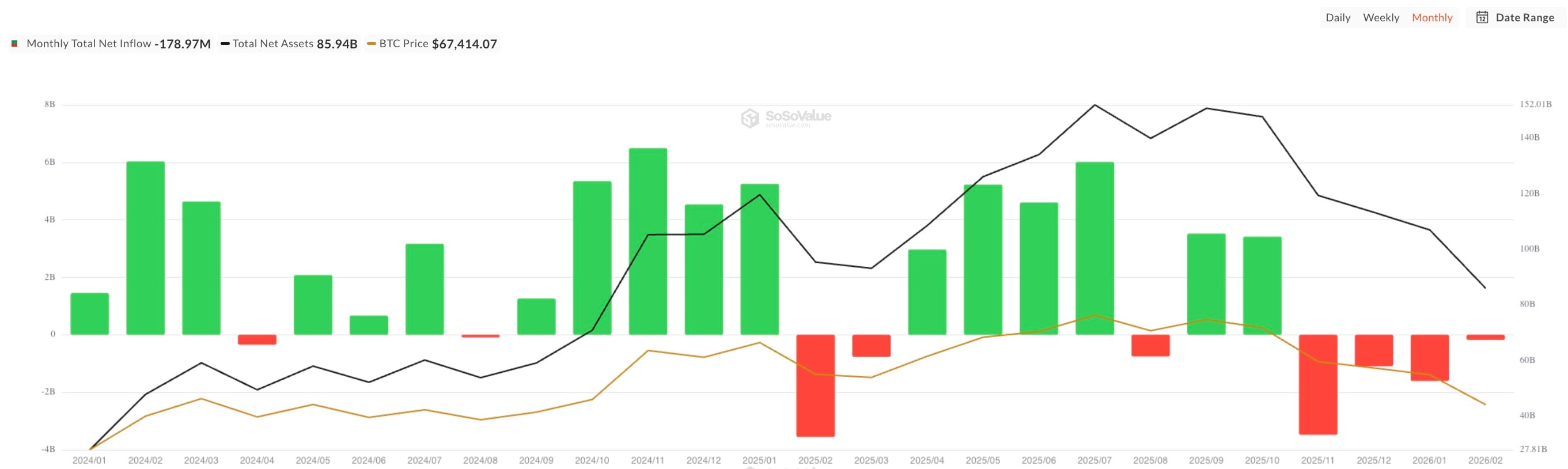
According to Szabo, the main conclusion from this situation is “not your keys, not your coins,” and any dependence on intermediaries like Jane Street is a security driver. While the market celebrated the arrival of institutions, Szabo and others saw only a return of the problems of traditional finance that Bitcoin was supposed to solve.

Interestingly, Szabo evaluated Jane Street's participation in the collapse of the algorithmic stablecoin UST from Terraform Labs and the token LUNA as natural selection.
In his words, the fact that Jane Street "knocked down this Jenga tower" is good because, if a protocol cannot be broken, then it deserves to survive. If it is like UST or LUNA, then what happened is what should have happened.
 Dan Burgin
 U.Today Editorial Team
